AQA · GCSE · Physics
Course version: 8463 · Version from Sept 2016
(HT only) Inertial mass is a measure of how difficult it is to change the…
Full specification wording
Newton's Second Law: (HT only) Inertial mass is a measure of how difficult it is to change the velocity of an object.
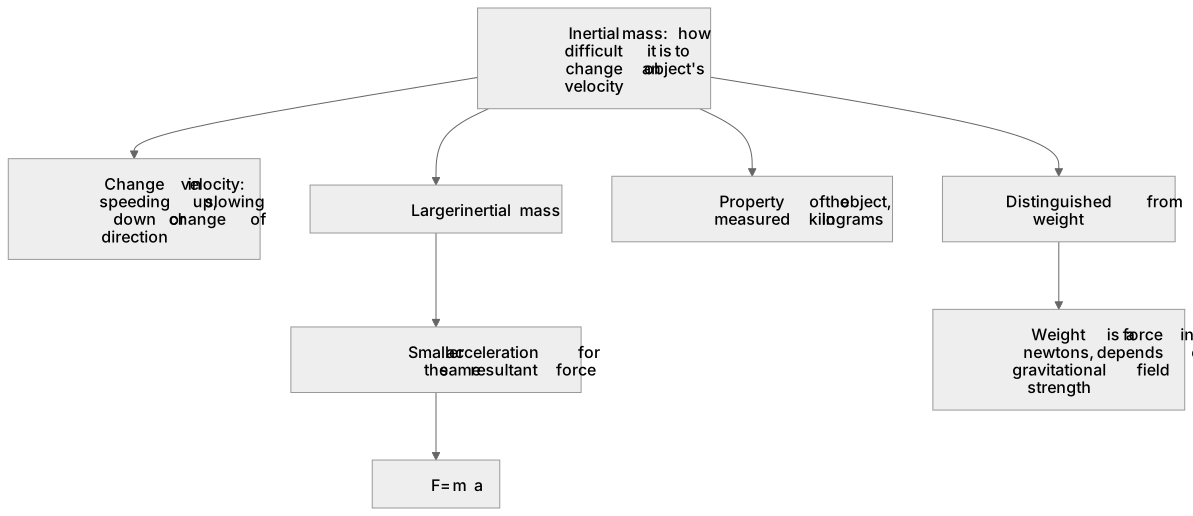
Inertial mass describes an object's resistance to any change in its velocity, whether that change is a speeding up, a slowing down or a change of direction.
Checked against the AQA 8463 specification (opens in a new tab) on .
- Point 7 of 11
- 4 key terms
Study notes
From the checked teaching notes for this specification point.
The idea
Inertial mass describes an object's resistance to any change in its velocity, whether that change is a speeding up, a slowing down or a change of direction. A larger inertial mass means a smaller acceleration for the same resultant force, because the force is shared over more mass. For example, a loaded lorry has a much larger inertial mass than an empty one, so the same engine force produces a smaller acceleration and it takes longer to reach a given speed. The idea links directly to Newton's second law, F = m a, where the mass being used is the inertial mass. It is a property of the object itself and does not depend on gravitational field strength, which distinguishes it from weight.
What earns the marks
- State that inertial mass measures how strongly an object resists a change in its velocity, including speeding up, slowing down or changing direction.
- Link a larger inertial mass to a smaller acceleration for the same resultant force, using F = m a to support the reasoning.
- Distinguish inertial mass from weight, noting that inertial mass is a property of the object and is measured in kilograms.
- Apply the idea to a comparison, such as a loaded versus an unloaded vehicle, and explain the difference in acceleration.
- Use the equation in the form m = F ÷ a when a numerical value of inertial mass is required.
Common mistakes and how to put them right
Confusing inertial mass with weight.
Put it right: Weight is a force measured in newtons and depends on gravitational field strength, whereas inertial mass is measured in kilograms and resists velocity change.
Thinking that a larger mass always means a larger acceleration.
Put it right: The correct relationship is that for a fixed resultant force, a larger mass gives a smaller acceleration.
Treating a change of direction as unrelated to inertial mass.
Put it right: Any change in velocity, including direction, involves acceleration and is resisted by inertial mass.
Exam tips
- Read the question carefully to see whether it asks about difficulty of changing velocity or about the ratio of force to acceleration, and answer the version asked.
- When comparing two objects, quote the equation F = m a and explain the effect on acceleration rather than only stating that one is heavier.
- Use the term resultant force, not just force, because an unbalanced resultant force is what causes the acceleration.
Try the lesson
The start of the Newton's Second Law: (HT only) Inertial mass is a measure of how difficult it is to change the velocity of an object. lesson, made from checked teaching notes for this specification point.
Have a go first
Which statement best describes what is meant by the inertial mass of an object?
Listen
Inertial mass describes an object's resistance to any change in its velocity, whether that change is a speeding up, a slowing down or a change of direction. A larger inertial mass means a smaller acceleration for the same resultant force, because the force is shared over more mass. For example, a loaded lorry has a much larger inertial mass than an empty one, so the same engine force produces a smaller acceleration and it takes longer to reach a given speed. The idea links directly to Newton's second law, F = m a, where the mass being used is the inertial mass. It is a property of the object itself and does not depend on gravitational field strength, which distinguishes it from weight. A strong answer earns marks for these points. State that inertial mass measures how strongly an object resists a change in its velocity, including speeding up, slowing down or changing direction. Link a larger inertial mass to a smaller acceleration for the same resultant force, using F = m a to support the reasoning. Distinguish inertial mass from weight, noting that inertial mass is a property of the object and is measured in kilograms. Apply the idea to a comparison, such as a loaded versus an unloaded vehicle, and explain the difference in acceleration. Exam tip: Read the question carefully to see whether it asks about difficulty of changing velocity or about the ratio of force to acceleration, and answer the version asked.
See it
Key words
Say what each word means before you turn the card.
Inertial mass
Try answering aloud or in your head before turning the card.
Newton's second law
Try answering aloud or in your head before turning the card.
Weight
Try answering aloud or in your head before turning the card.
Resultant force
Try answering aloud or in your head before turning the card.
See every definition
- Inertial mass
- A measure of how difficult it is to change the velocity of an object, including speeding up, slowing down or changing direction.
- Newton's second law
- The relationship F = m a, where the mass being used is the inertial mass.
- Weight
- A force measured in newtons that depends on gravitational field strength, unlike inertial mass, which is a property of the object.
- Resultant force
- An unbalanced force that causes acceleration, so a larger inertial mass gives a smaller acceleration for the same resultant force.
Label the diagram
Some boxes have lost their names. Pick the right name for each number.
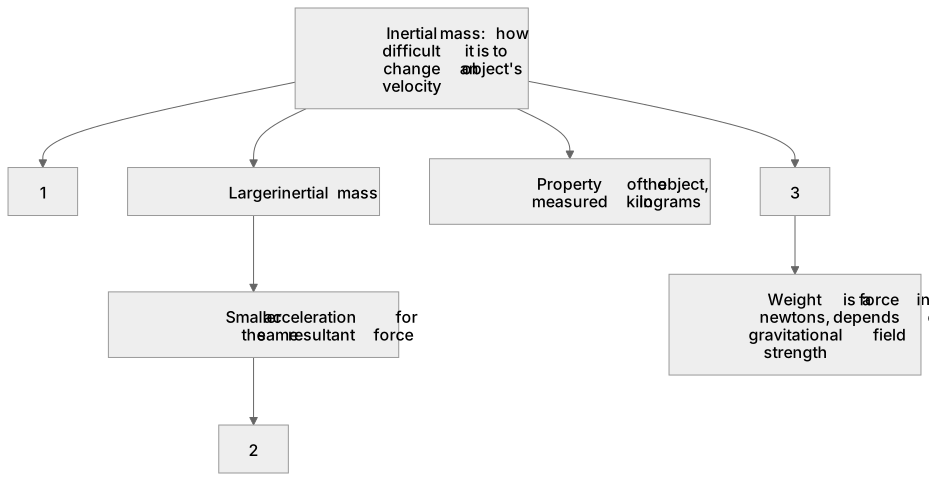
1Box 1
2Box 2
3Box 3
There is more to this lesson
The full lesson goes on to check your understanding and help you earn the marks. Create a free account to carry on, with your progress saved.
A week of Premium from your first lesson · Then the free plan continues · No card, no charge
Test your understanding of Newton's Second Law: (HT only) Inertial mass is a measure of how difficult it is to change the velocity of an object.
Active recall beats re-reading. Take an instant quiz now to test what you’ve learned and lock it into long-term memory.
A week of Premium from your first lesson · Then the free plan continues · No card, no charge