AQA · GCSE · Physics
Course version: 8463 · Version from Sept 2016
(HT only) Inertial mass is defined as the ratio of force over acceleration.
Full specification wording
Newton's Second Law: (HT only) Inertial mass is defined as the ratio of force over acceleration.
This statement gives the quantitative definition of inertial mass: inertial mass equals the resultant force divided by the acceleration it produces, written m = F ÷ a.
Checked against the AQA 8463 specification (opens in a new tab) on .
- Point 8 of 11
Study notes
From the checked teaching notes for this specification point.
The idea
This statement gives the quantitative definition of inertial mass: inertial mass equals the resultant force divided by the acceleration it produces, written m = F ÷ a. The force must be the resultant force in newtons and the acceleration must be in metres per second squared, so the mass comes out in kilograms. For example, if a resultant force of 12 N gives an acceleration of 3 m/s², the inertial mass is 12 N ÷ 3 m/s² = 4 kg. This definition is simply a rearrangement of Newton's second law, F = m a, and it shows that inertial mass is the constant of proportionality linking force and acceleration for a given object.
What earns the marks
- State the definition as inertial mass = resultant force ÷ acceleration, or m = F ÷ a.
- Identify that force must be the resultant force measured in newtons and acceleration in metres per second squared.
- Rearrange F = m a correctly to make mass the subject when carrying out a calculation.
- Substitute values accurately and give the mass in kilograms with an appropriate unit.
- Explain that the ratio is constant for a given object, which is why it defines its inertial mass.
Common mistakes and how to put them right
Using a single applied force instead of the resultant force.
Put it right: The correct approach is to find the vector sum of all forces before dividing by acceleration.
Dividing acceleration by force instead of force by acceleration.
Put it right: The correct form is m = F ÷ a.
Forgetting to convert units, such as using grams or centimetres per second squared.
Put it right: The correct units are newtons and metres per second squared, giving kilograms.
Exam tips
- Write down m = F ÷ a before substituting numbers so the rearrangement is clear and easy to follow.
- Check that the force used is the resultant force by considering whether forces are balanced or unbalanced.
- Include the unit kg with the final answer and round sensibly to match the data given.
Try the lesson
The start of the Newton's Second Law: (HT only) Inertial mass is defined as the ratio of force over acceleration. lesson, made from checked teaching notes for this specification point.
Have a go first
Which of the following correctly describes the definition of inertial mass?
Listen
This statement gives the quantitative definition of inertial mass: inertial mass equals the resultant force divided by the acceleration it produces, written m = F ÷ a. The force must be the resultant force in newtons and the acceleration must be in metres per second squared, so the mass comes out in kilograms. For example, if a resultant force of 12 N gives an acceleration of 3 m/s², the inertial mass is 12 N ÷ 3 m/s² = 4 kg. This definition is simply a rearrangement of Newton's second law, F = m a, and it shows that inertial mass is the constant of proportionality linking force and acceleration for a given object. A strong answer earns marks for these points. State the definition as inertial mass = resultant force ÷ acceleration, or m = F ÷ a. Identify that force must be the resultant force measured in newtons and acceleration in metres per second squared. Rearrange F = m a correctly to make mass the subject when carrying out a calculation. Substitute values accurately and give the mass in kilograms with an appropriate unit. Exam tip: Write down m = F ÷ a before substituting numbers so the rearrangement is clear and easy to follow.
See it
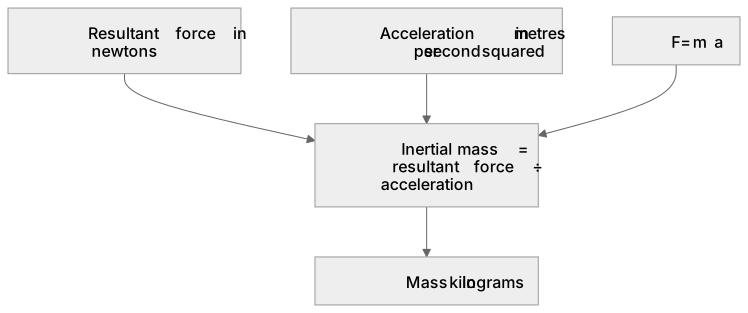
Label the diagram
Some boxes have lost their names. Pick the right name for each number.
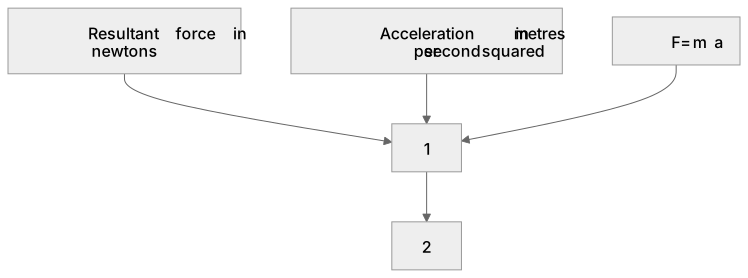
1Box 1
2Box 2
There is more to this lesson
The full lesson goes on to check your understanding and help you earn the marks. Create a free account to carry on, with your progress saved.
A week of Premium from your first lesson · Then the free plan continues · No card, no charge
Test your understanding of Newton's Second Law: (HT only) Inertial mass is defined as the ratio of force over acceleration.
Active recall beats re-reading. Take an instant quiz now to test what you’ve learned and lock it into long-term memory.
A week of Premium from your first lesson · Then the free plan continues · No card, no charge