AQA · GCSE · Physics
Course version: 8463 · Version from Sept 2016
Students should recognise and be able to use the symbol ≈ that indicates…
Full specification wording
Newton's Second Law: Students should recognise and be able to use the symbol ≈ that indicates an approximate value or approximate answer.
In physics, exact values are not always known or required, particularly when dealing with order-of-magnitude estimations.
Checked against the AQA 8463 specification (opens in a new tab) on .
- Point 10 of 11
- 4 key terms
Study notes
From the checked teaching notes for this specification point.
The idea
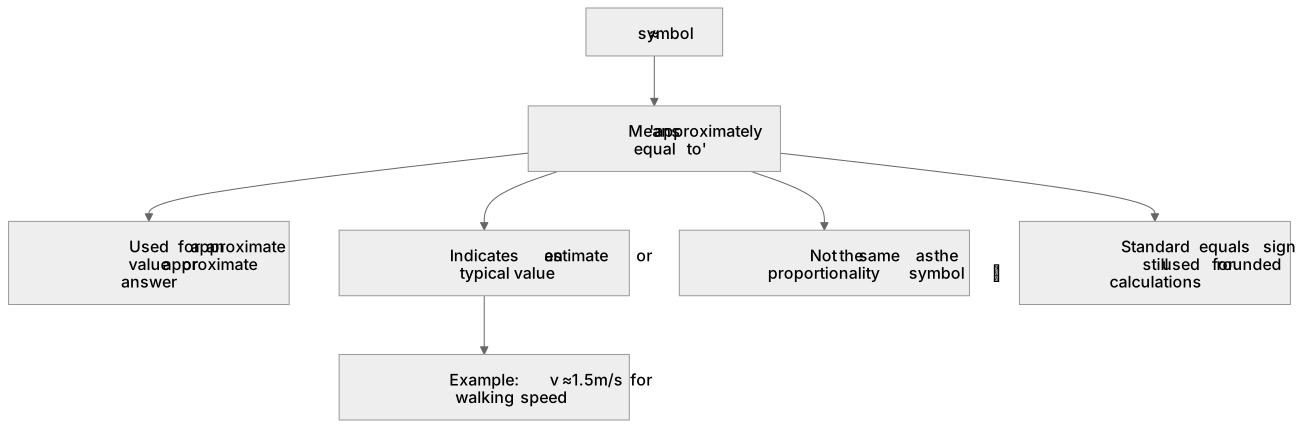
In physics, exact values are not always known or required, particularly when dealing with order-of-magnitude estimations. The symbol ≈ indicates that two values are approximately equal. You will encounter this symbol when a question provides or asks for an estimate rather than a precise calculation. For example, the typical walking speed of a person can be written as v ≈ 1.5 m/s, showing it is a reasonable estimate rather than an exact universal constant. Recognising this symbol helps you understand that a question requires you to apply typical everyday values. Standard calculations rounded to an appropriate number of significant figures should still use the standard equals sign.
What earns the marks
- Identify the ≈ symbol as meaning 'approximately equal to' in the context of estimations.
- Interpret given data containing the ≈ symbol as an indication to use an estimated or typical value.
- Apply the ≈ symbol correctly when stating an estimated physical quantity, such as writing v ≈ 1.5 m/s for walking speed.
- Distinguish between the approximate equals sign in an expression like x ≈ 5 and the proportionality symbol in an expression like a ∝ F.
Common mistakes and how to put them right
Believing that the ≈ symbol must be used every time a calculated answer is rounded to significant figures.
Put it right: The standard equals sign is perfectly acceptable and expected when providing a rounded calculated answer.
Confusing the approximate equals sign with the proportionality symbol.
Put it right: Recognise that an expression like y ≈ 10 means approximately equal to, whereas y ∝ x indicates how one variable changes with respect to another.
Writing the ≈ symbol without a numerical value or variable on the right-hand side.
Put it right: Ensure the symbol always sits between two quantities, such as writing v ≈ 3 m/s rather than leaving the relation empty.
Exam tips
- Look out for the ≈ symbol in question stems, as it often hints that you should use typical estimated values rather than performing a precise calculation.
- When asked to estimate a value from your own knowledge, you can write the ≈ symbol before your numerical answer to demonstrate your understanding of approximation.
Try the lesson
The start of the Newton's Second Law: Students should recognise and be able to use the symbol ≈ that indicates an approximate value or approximate answer. lesson, made from checked teaching notes for this specification point.
Have a go first
Which statement correctly describes the meaning of the symbol ≈ when it is written between two values?
Listen
In physics, exact values are not always known or required, particularly when dealing with order-of-magnitude estimations. The symbol ≈ indicates that two values are approximately equal. You will encounter this symbol when a question provides or asks for an estimate rather than a precise calculation. For example, the typical walking speed of a person can be written as v ≈ 1.5 m/s, showing it is a reasonable estimate rather than an exact universal constant. Recognising this symbol helps you understand that a question requires you to apply typical everyday values. Standard calculations rounded to an appropriate number of significant figures should still use the standard equals sign. A strong answer earns marks for these points. Identify the ≈ symbol as meaning 'approximately equal to' in the context of estimations. Interpret given data containing the ≈ symbol as an indication to use an estimated or typical value. Apply the ≈ symbol correctly when stating an estimated physical quantity, such as writing v ≈ 1.5 m/s for walking speed. Distinguish between the approximate equals sign in an expression like x ≈ 5 and the proportionality symbol in an expression like a ∝ F. A common slip: Believing that the ≈ symbol must be used every time a calculated answer is rounded to significant figures. Instead, the standard equals sign is perfectly acceptable and expected when providing a rounded calculated answer. Exam tip: Look out for the ≈ symbol in question stems, as it often hints that you should use typical estimated values rather than performing a precise calculation.
See it
Key words
Say what each word means before you turn the card.
≈
Try answering aloud or in your head before turning the card.
Estimation
Try answering aloud or in your head before turning the card.
Standard equals sign
Try answering aloud or in your head before turning the card.
Proportionality symbol
Try answering aloud or in your head before turning the card.
See every definition
- ≈
- The symbol that indicates an approximate value or approximate answer, meaning 'approximately equal to'.
- Estimation
- Using an estimated or typical value rather than a precise calculation, as when a question provides or asks for an estimate.
- Standard equals sign
- The sign used for standard calculations rounded to an appropriate number of significant figures, rather than for approximations.
- Proportionality symbol
- The symbol in an expression like a ∝ F, which indicates how one variable changes with respect to another.
Label the diagram
Some boxes have lost their names. Pick the right name for each number.
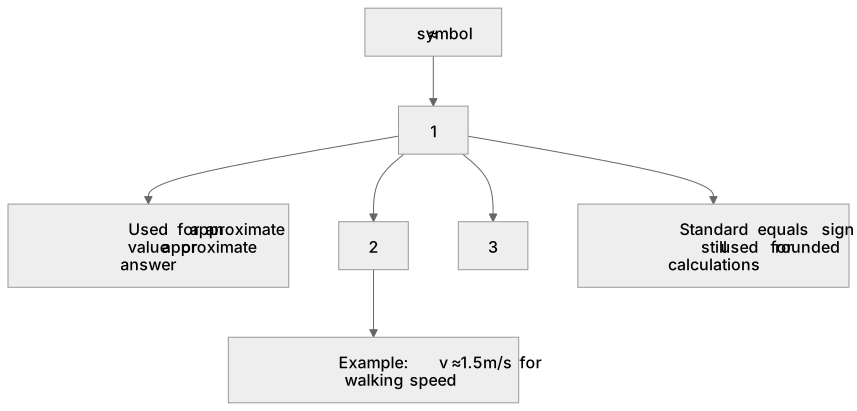
1Box 1
2Box 2
3Box 3
There is more to this lesson
The full lesson goes on to check your understanding and help you earn the marks. Create a free account to carry on, with your progress saved.
A week of Premium from your first lesson · Then the free plan continues · No card, no charge
Test your understanding of Newton's Second Law: Students should recognise and be able to use the symbol ≈ that indicates an approximate value or approximate answer.
Active recall beats re-reading. Take an instant quiz now to test what you’ve learned and lock it into long-term memory.
A week of Premium from your first lesson · Then the free plan continues · No card, no charge