AQA · GCSE · Physics
Course version: 8463 · Version from Sept 2016
Students should be able to estimate the speed, accelerations and forces…
Full specification wording
Newton's Second Law: Students should be able to estimate the speed, accelerations and forces involved in large accelerations for everyday road transport.
Estimating means choosing sensible everyday figures and carrying them through the equations.
Checked against the AQA 8463 specification (opens in a new tab) on .
- Point 9 of 11
Study notes
From the checked teaching notes for this specification point.
The idea
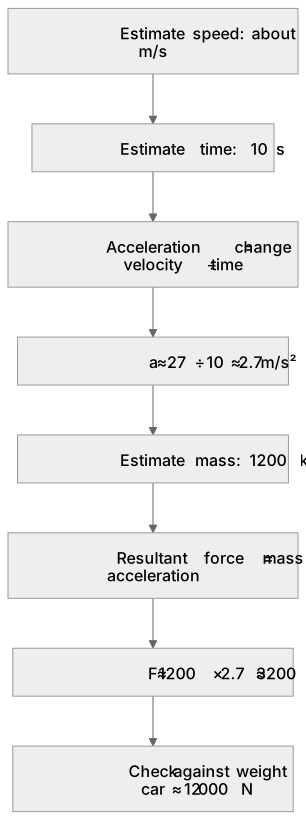
Estimating means choosing sensible everyday figures and carrying them through the equations. A family car has a mass of roughly 1000 to 1500 kg. Motorway speed, 70 mph, is about 31 m/s, and 30 mph is about 13 m/s. A brisk acceleration from rest to 27 m/s in 10 s gives a = 27 ÷ 10 ≈ 2.7 m/s², so the resultant force on a 1200 kg car is about 1200 × 2.7 ≈ 3200 N. Emergency braking is harsher: stopping from 27 m/s in about 3 s gives roughly 9 m/s², needing a force near 11 000 N. Quote estimates to one or two significant figures and show every substitution, because the marks are for the method. Check the size of an estimate against something known: the weight of that car is about 12 000 N, so a braking force near 11 000 N is realistic.
What earns the marks
- A sensible estimate of speed, such as 30 m/s for motorway driving.
- A sensible estimate of mass, such as 1000 kg to 1500 kg for a car.
- Using change in velocity ÷ time to estimate the acceleration.
- Multiplying the estimated mass by the estimated acceleration to give a force in newtons.
- A resultant force of the right order, in the range about 2000 N to 4000 N, for a car of 1000 kg to 1500 kg reaching about 27 m/s in 10 s.
Common mistakes and how to put them right
Estimating the mass of a car as 100 kg, or quoting it in grams.
Leaving the speed in mph inside a calculation that needs metres per second.
Copying the full calculator display into an estimate that is only good to one significant figure.
Writing a bare number with no working, so the method marks cannot be awarded.
Exam tips
- Write down each estimated value with its unit before you calculate anything.
- Use the rough conversion that 1 mph is a little under 0.5 m/s to turn road speeds into m/s.
- Say clearly that the answer is an estimate, and use the approximation symbol when you quote it.
Try the lesson
The start of the Newton's Second Law: Students should be able to estimate the speed, accelerations and forces involved in large accelerations for everyday road transport. lesson, made from checked teaching notes for this specification point.
Have a go first
Which of the following is the most reasonable estimate for the acceleration of a typical family car when joining a fast dual carriageway from rest?
Listen
Estimating means choosing sensible everyday figures and carrying them through the equations. A family car has a mass of roughly 1000 to 1500 kg. Motorway speed, 70 mph, is about 31 m/s, and 30 mph is about 13 m/s. A brisk acceleration from rest to 27 m/s in 10 s gives a = 27 ÷ 10 ≈ 2.7 m/s², so the resultant force on a 1200 kg car is about 1200 × 2.7 ≈ 3200 N. Emergency braking is harsher: stopping from 27 m/s in about 3 s gives roughly 9 m/s², needing a force near 11 000 N. Quote estimates to one or two significant figures and show every substitution, because the marks are for the method. Check the size of an estimate against something known: the weight of that car is about 12 000 N, so a braking force near 11 000 N is realistic. A strong answer earns marks for these points. a sensible estimate of speed, such as 30 m/s for motorway driving. a sensible estimate of mass, such as 1000 kg to 1500 kg for a car. using change in velocity ÷ time to estimate the acceleration. multiplying the estimated mass by the estimated acceleration to give a force in newtons. Exam tip: Write down each estimated value with its unit before you calculate anything.
See it
Put it in order
Put these steps in the order they happen.
- 1. Estimate mass: 1200 kg
- 2. Check against weight of car ≈ 12 000 N
- 3. Resultant force = mass × acceleration
- 4. Estimate speed: about 27 m/s
- 5. Estimate time: 10 s
- 6. F ≈ 1200 × 2.7 ≈ 3200 N
- 7. Acceleration = change in velocity ÷ time
- 8. a ≈ 27 ÷ 10 ≈ 2.7 m/s²
Label the diagram
Some boxes have lost their names. Pick the right name for each number.
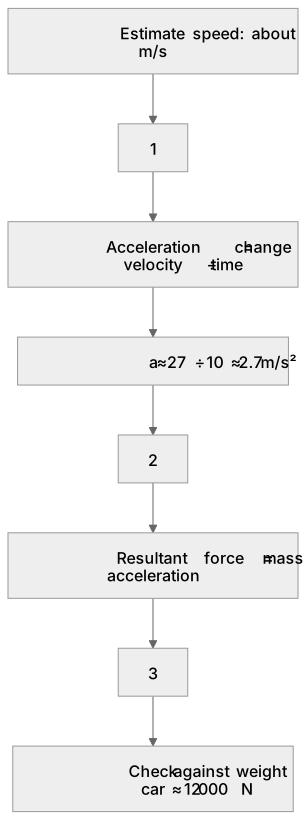
1Box 1
2Box 2
3Box 3
There is more to this lesson
The full lesson goes on to check your understanding and help you earn the marks. Create a free account to carry on, with your progress saved.
A week of Premium from your first lesson · Then the free plan continues · No card, no charge
Test your understanding of Newton's Second Law: Students should be able to estimate the speed, accelerations and forces involved in large accelerations for everyday road transport.
Active recall beats re-reading. Take an instant quiz now to test what you’ve learned and lock it into long-term memory.
A week of Premium from your first lesson · Then the free plan continues · No card, no charge