AQA · GCSE · Physics
Course version: 8463 · Version from Sept 2016
Nuclear fission: All of the fission products have kinetic energy.
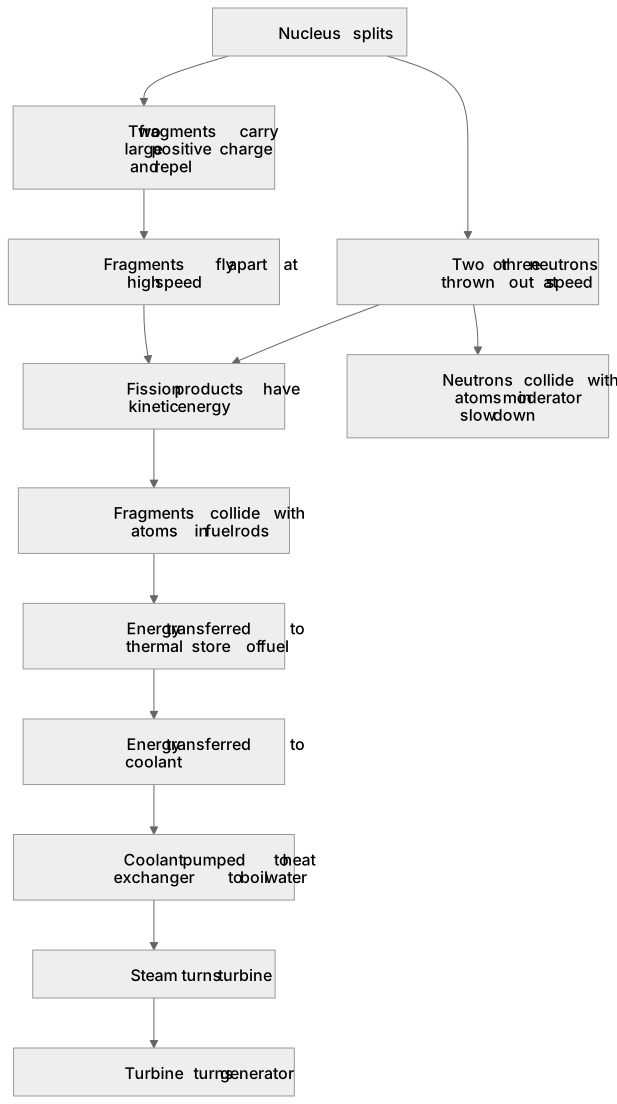
When a nucleus splits, the two fragments carry a large positive charge each and repel violently, flying apart at high speed.
Checked against the AQA 8463 specification (opens in a new tab) on .
- Point 5 of 9
- 4 key terms
Study notes
From the checked teaching notes for this specification point.
The idea
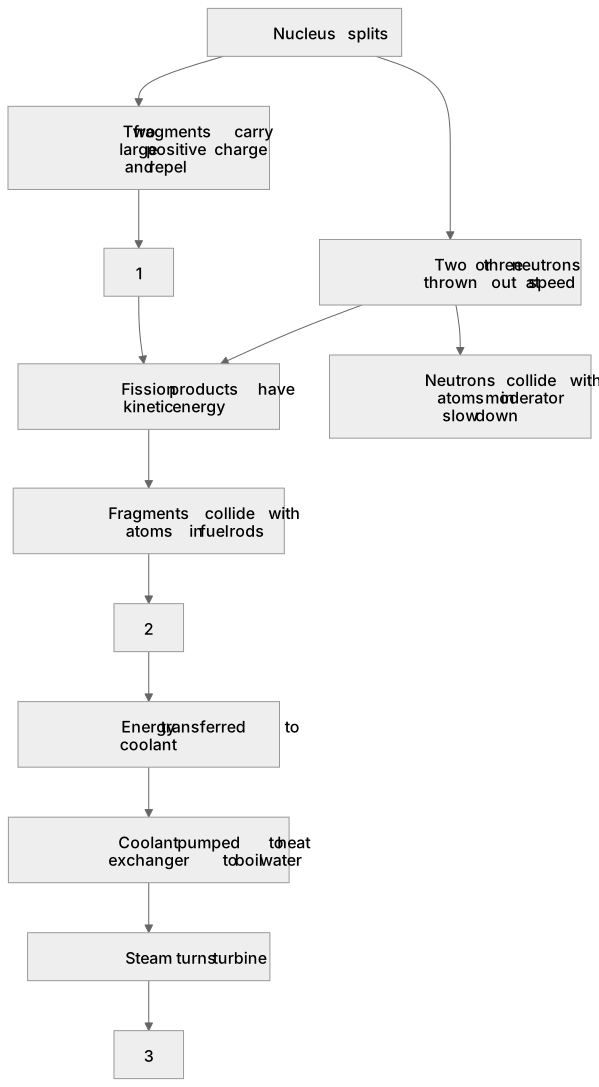
When a nucleus splits, the two fragments carry a large positive charge each and repel violently, flying apart at high speed. The two or three neutrons are also thrown out at speed. All fission products therefore have kinetic energy, which holds most of the energy released. In a reactor, the fast-moving fission fragments collide with surrounding atoms in the fuel rods, transferring energy to the thermal store of the fuel. The neutrons travel further, colliding with atoms in the moderator to slow down. Energy is transferred to the coolant, which is pumped to a heat exchanger to boil water; the steam turns a turbine, which turns a generator. The neutrons must be slowed by the moderator before they can cause the next fission.
What earns the marks
- Stating the two daughter nuclei and the neutrons all move away at high speed.
- Naming the kinetic energy store of the fission products as where most of the released energy goes.
- Describing energy transfer to the thermal store of the fuel as fragments collide with atoms in the fuel rods.
- The heated coolant boiling water to drive a turbine and generator.
Common mistakes and how to put them right
Saying only the neutrons move after the split.
Stating that fission fragments collide with atoms in the moderator, rather than being stopped in the fuel rods.
Confusing the moderator, which slows neutrons, with the control rods, which absorb them.
Exam tips
- Trace the energy through named stores in order; a chain of transfers scores more reliably than a single sentence.
- Keep moderator and control rods distinct, because a question on one is often marked wrong if you describe the other.
Try the lesson
The start of the Nuclear fission: All of the fission products have kinetic energy. lesson, made from checked teaching notes for this specification point.
Have a go first
When a uranium nucleus undergoes fission, what type of energy do all of the fission products have?
Listen
When a nucleus splits, the two fragments carry a large positive charge each and repel violently, flying apart at high speed. The two or three neutrons are also thrown out at speed. All fission products therefore have kinetic energy, which holds most of the energy released. In a reactor, the fast-moving fission fragments collide with surrounding atoms in the fuel rods, transferring energy to the thermal store of the fuel. The neutrons travel further, colliding with atoms in the moderator to slow down. Energy is transferred to the coolant, which is pumped to a heat exchanger to boil water; the steam turns a turbine, which turns a generator. The neutrons must be slowed by the moderator before they can cause the next fission. A strong answer earns marks for these points. stating the two daughter nuclei and the neutrons all move away at high speed. naming the kinetic energy store of the fission products as where most of the released energy goes. describing energy transfer to the thermal store of the fuel as fragments collide with atoms in the fuel rods. the heated coolant boiling water to drive a turbine and generator. Exam tip: Trace the energy through named stores in order; a chain of transfers scores more reliably than a single sentence.
See it
Key words
Say what each word means before you turn the card.
kinetic energy of fragments
Try answering aloud or in your head before turning the card.
energy transfer to thermal store
Try answering aloud or in your head before turning the card.
moderator and coolant
Try answering aloud or in your head before turning the card.
turbine and generator
Try answering aloud or in your head before turning the card.
See every definition
- kinetic energy of fragments
- The two fragments and the two or three neutrons are thrown out at speed, so all fission products have kinetic energy, which holds most of the energy released.
- energy transfer to thermal store
- The fast-moving fission fragments collide with surrounding atoms in the fuel rods, transferring energy to the thermal store of the fuel.
- moderator and coolant
- Neutrons collide with atoms in the moderator to slow down, and energy is transferred to the coolant, which is pumped to a heat exchanger to boil water.
- turbine and generator
- The steam turns a turbine, which turns a generator.
Label the diagram
Some boxes have lost their names. Pick the right name for each number.
1Box 1
2Box 2
3Box 3
There is more to this lesson
The full lesson goes on to check your understanding and help you earn the marks. Create a free account to carry on, with your progress saved.
A week of Premium from your first lesson · Then the free plan continues · No card, no charge
Test your understanding of Nuclear fission: All of the fission products have kinetic energy.
Active recall beats re-reading. Take an instant quiz now to test what you’ve learned and lock it into long-term memory.
A week of Premium from your first lesson · Then the free plan continues · No card, no charge