AQA · GCSE · Physics
Course version: 8463 · Version from Sept 2016
Natural satellites, the moons that orbit planets, are also part of the…
Full specification wording
Our solar system: Natural satellites, the moons that orbit planets, are also part of the solar system.
A satellite is anything in orbit around something else, so the word splits two ways.
Checked against the AQA 8463 specification (opens in a new tab) on .
- Point 2 of 5
- 3 key terms
Study notes
From the checked teaching notes for this specification point.
The idea
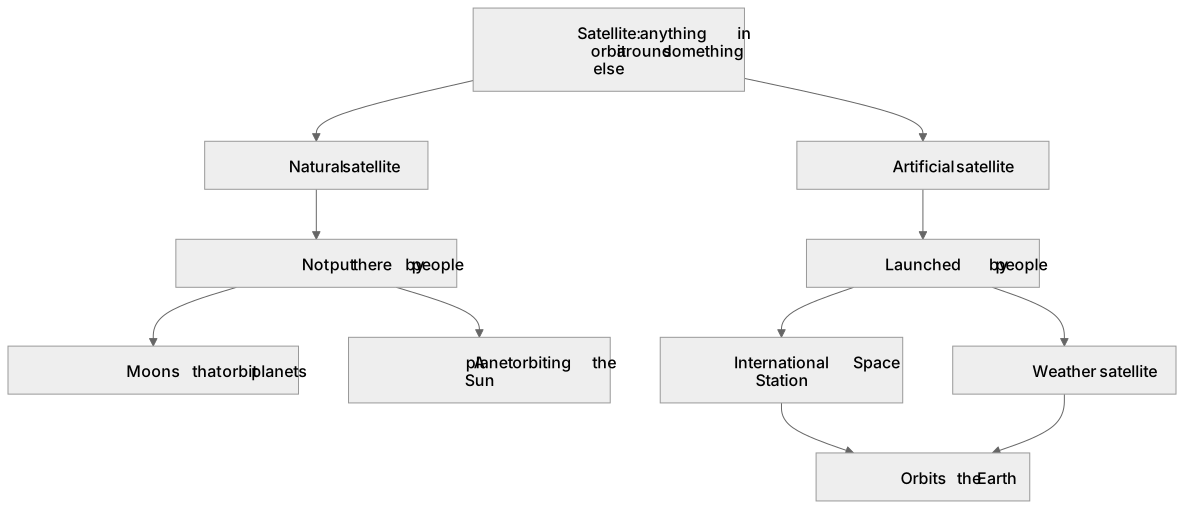
A satellite is anything in orbit around something else, so the word splits two ways. Natural satellites were not put there by people: the moons that orbit planets are natural satellites, and strictly so is a planet orbiting the Sun. Artificial satellites are the ones we launched, such as the International Space Station or a weather satellite, and they orbit the Earth. If a one mark question asks what a moon is, the answer the mark scheme wants is a natural satellite that orbits a planet, and a rock in space or something that goes round the Earth will not do. The number of moons varies enormously: the Earth has one, Mercury and Venus have none, and Jupiter and Saturn have dozens each.
What earns the marks
- Defining a moon as a natural satellite.
- Stating that it orbits a planet.
- Distinguishing a natural satellite from an artificial one by how it came to be in orbit.
- Naming an example of each, such as the Moon and the International Space Station.
Common mistakes and how to put them right
Defining a moon as something that orbits the Earth, which leaves out the moons of every other planet.
Calling the International Space Station a moon because it orbits the Earth.
Saying that moons orbit the Sun.
Writing natural satellite with no mention of what it orbits, which leaves the definition incomplete.
Exam tips
- One mark definitions still need both halves: what the object is, and what it orbits.
- Use the term natural satellite rather than moon when the question is testing vocabulary.
- Name a real example if there is room; it costs one clause and often secures the mark.
Try the lesson
The start of the Our solar system: Natural satellites, the moons that orbit planets, are also part of the solar system. lesson, made from checked teaching notes for this specification point.
Have a go first
Which object is a natural satellite of a planet in our solar system?
Listen
A satellite is anything in orbit around something else, so the word splits two ways. Natural satellites were not put there by people: the moons that orbit planets are natural satellites, and strictly so is a planet orbiting the Sun. Artificial satellites are the ones we launched, such as the International Space Station or a weather satellite, and they orbit the Earth. If a one mark question asks what a moon is, the answer the mark scheme wants is a natural satellite that orbits a planet, and a rock in space or something that goes round the Earth will not do. The number of moons varies enormously: the Earth has one, Mercury and Venus have none, and Jupiter and Saturn have dozens each. A strong answer earns marks for these points. defining a moon as a natural satellite. stating that it orbits a planet. distinguishing a natural satellite from an artificial one by how it came to be in orbit. naming an example of each, such as the Moon and the International Space Station. Exam tip: One mark definitions still need both halves: what the object is, and what it orbits.
See it
Key words
Say what each word means before you turn the card.
natural satellites
Try answering aloud or in your head before turning the card.
artificial satellites
Try answering aloud or in your head before turning the card.
orbiting a planet
Try answering aloud or in your head before turning the card.
See every definition
- natural satellites
- Objects that were not put in orbit by people, such as the moons that orbit planets.
- artificial satellites
- Satellites that we launched, such as the International Space Station or a weather satellite, and they orbit the Earth.
- orbiting a planet
- Going round a planet, which is what a moon does.
Label the diagram
Some boxes have lost their names. Pick the right name for each number.
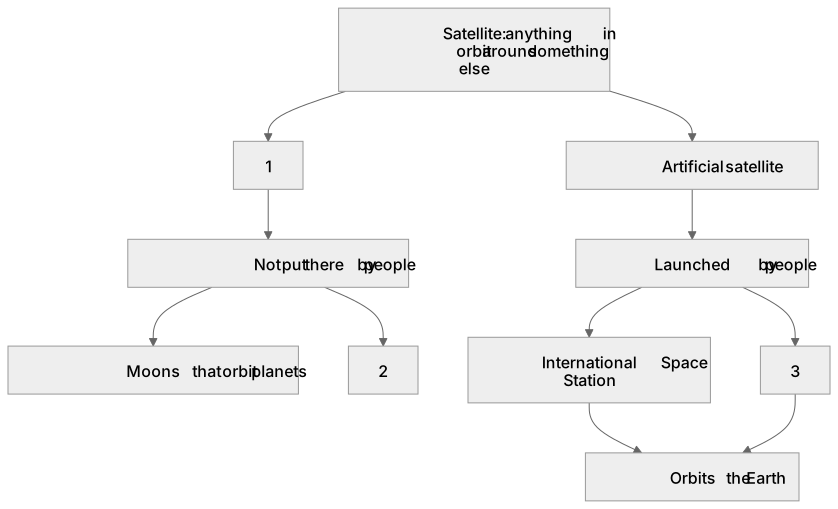
1Box 1
2Box 2
3Box 3
There is more to this lesson
The full lesson goes on to check your understanding and help you earn the marks. Create a free account to carry on, with your progress saved.
A week of Premium from your first lesson · Then the free plan continues · No card, no charge
Test your understanding of Our solar system: Natural satellites, the moons that orbit planets, are also part of the solar system.
Active recall beats re-reading. Take an instant quiz now to test what you’ve learned and lock it into long-term memory.
A week of Premium from your first lesson · Then the free plan continues · No card, no charge