AQA · GCSE · Physics
Course version: 8463 · Version from Sept 2016
Within our solar system there is one star, the Sun, plus the eight planets…
Full specification wording
Our solar system: Within our solar system there is one star, the Sun, plus the eight planets and the dwarf planets that orbit around the Sun.
Our solar system contains exactly one star, the Sun, and everything else in it orbits that star either directly or indirectly.
Checked against the AQA 8463 specification (opens in a new tab) on .
- Point 1 of 5
- 3 key terms
Study notes
From the checked teaching notes for this specification point.
The idea
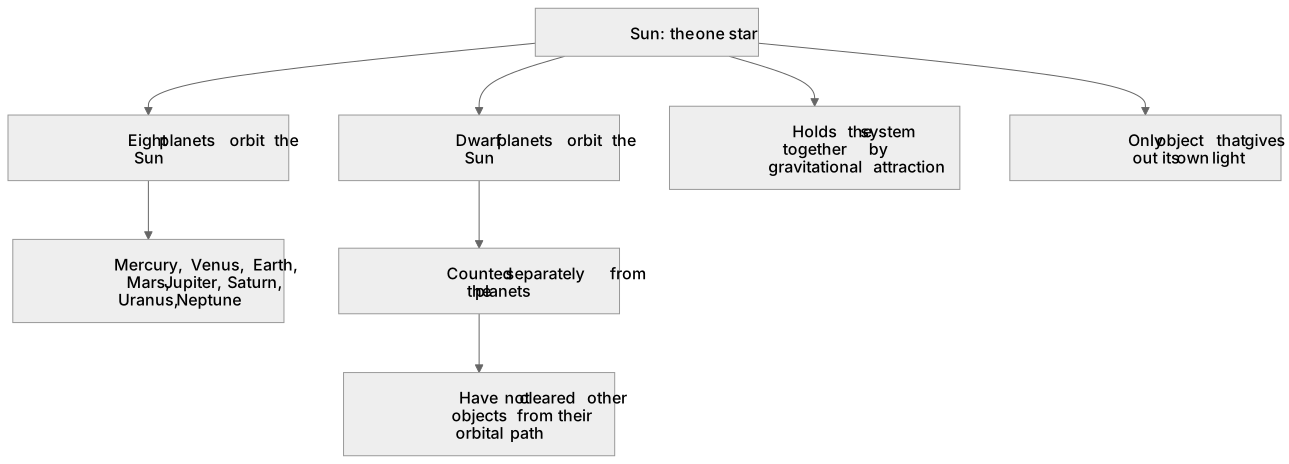
Our solar system contains exactly one star, the Sun, and everything else in it orbits that star either directly or indirectly. Eight planets orbit the Sun: Mercury, Venus, Earth, Mars, Jupiter, Saturn, Uranus and Neptune. Dwarf planets, including Pluto and Ceres, orbit the Sun as well, but they have not cleared other objects out of their orbital path, which is why they are counted separately. Size alone does not decide the label, and exam questions exploit that: the largest dwarf planet is smaller than the smallest planet, yet some moons, such as Ganymede and Titan, are larger than the planet Mercury. The Sun holds the whole system together by gravitational attraction, and it is the only object in it that gives out its own light.
What earns the marks
- One star, the Sun, at the centre of the solar system.
- Eight planets orbiting the Sun.
- Dwarf planets also orbiting the Sun and being counted separately from the planets.
- Using data to show that a moon can be larger than the smallest planet.
Common mistakes and how to put them right
Counting nine planets by including Pluto, which is a dwarf planet.
Concluding from a table that planets are always bigger than moons, when Ganymede and Titan are bigger than Mercury.
Saying dwarf planets orbit planets, when they orbit the Sun.
Describing the Sun as a planet, or as the largest planet.
Exam tips
- If a table of radii is given, quote a specific pair of objects that breaks the claim you are asked about.
- Keep the words star, planet, dwarf planet and moon distinct, because each has its own job in the mark scheme.
- Learn the planets in order, since naming the fifth planet from the Sun is a free mark.
Try the lesson
The start of the Our solar system: Within our solar system there is one star, the Sun, plus the eight planets and the dwarf planets that orbit around the Sun. lesson, made from checked teaching notes for this specification point.
Have a go first
How many stars are there in our solar system?
Listen
Our solar system contains exactly one star, the Sun, and everything else in it orbits that star either directly or indirectly. Eight planets orbit the Sun: Mercury, Venus, Earth, Mars, Jupiter, Saturn, Uranus and Neptune. Dwarf planets, including Pluto and Ceres, orbit the Sun as well, but they have not cleared other objects out of their orbital path, which is why they are counted separately. Size alone does not decide the label, and exam questions exploit that: the largest dwarf planet is smaller than the smallest planet, yet some moons, such as Ganymede and Titan, are larger than the planet Mercury. The Sun holds the whole system together by gravitational attraction, and it is the only object in it that gives out its own light. A strong answer earns marks for these points. one star, the Sun, at the centre of the solar system. eight planets orbiting the Sun. dwarf planets also orbiting the Sun and being counted separately from the planets. using data to show that a moon can be larger than the smallest planet. Exam tip: If a table of radii is given, quote a specific pair of objects that breaks the claim you are asked about.
See it
Key words
Say what each word means before you turn the card.
the Sun as our star
Try answering aloud or in your head before turning the card.
dwarf planets
Try answering aloud or in your head before turning the card.
orbiting the Sun
Try answering aloud or in your head before turning the card.
See every definition
- the Sun as our star
- The Sun is the one star within our solar system and the only object in it that gives out its own light.
- dwarf planets
- These orbit the Sun but have not cleared other objects out of their orbital path, so they are counted separately from the planets.
- orbiting the Sun
- Everything else in the solar system orbits the Sun either directly or indirectly, and the Sun holds the whole system together by gravitational attraction.
Label the diagram
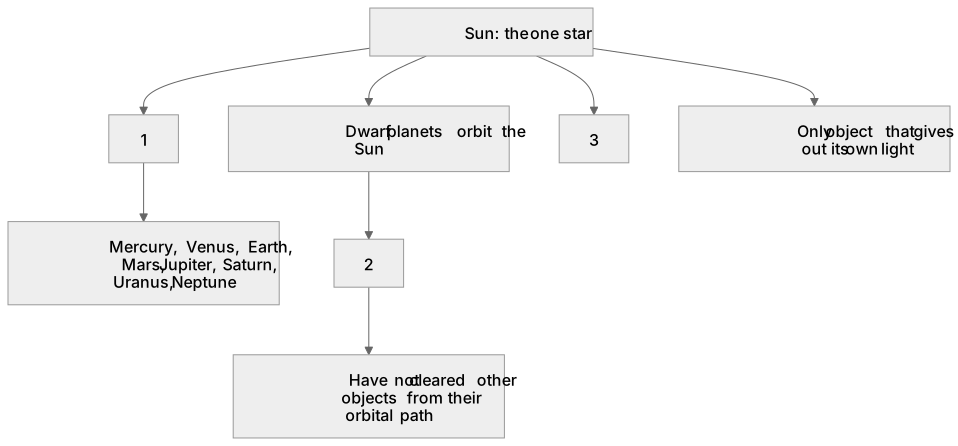
Some boxes have lost their names. Pick the right name for each number.
1Box 1
2Box 2
3Box 3
There is more to this lesson
The full lesson goes on to check your understanding and help you earn the marks. Create a free account to carry on, with your progress saved.
A week of Premium from your first lesson · Then the free plan continues · No card, no charge
Test your understanding of Our solar system: Within our solar system there is one star, the Sun, plus the eight planets and the dwarf planets that orbit around the Sun.
Active recall beats re-reading. Take an instant quiz now to test what you’ve learned and lock it into long-term memory.
A week of Premium from your first lesson · Then the free plan continues · No card, no charge