AQA · GCSE · Physics
Course version: 8463 · Version from Sept 2016
Students should be able to explain: how, at the start of a star's life…
Full specification wording
Our solar system: Students should be able to explain: how, at the start of a star's life cycle, the dust and gas drawn together by gravity causes fusion reactions that fusion reactions lead to an equilibrium between the gravitational collapse of a star and the expansion of a star due to fusion energy.
A star begins as a cloud of dust and gas.
Checked against the AQA 8463 specification (opens in a new tab) on .
- Point 5 of 5
- 3 key terms
Study notes
From the checked teaching notes for this specification point.
The idea
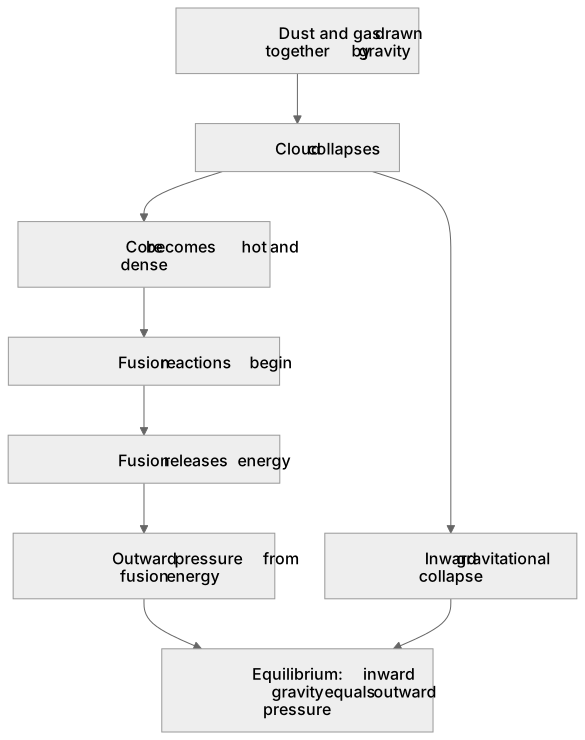
A star begins as a cloud of dust and gas. Gravity draws this matter together, causing the cloud to collapse. As it compresses, gravitational potential energy is transferred to thermal energy, making the core incredibly hot and dense. Once the temperature and pressure are high enough, hydrogen nuclei fuse into helium, releasing vast amounts of energy. This fusion marks the start of the main sequence. During this long, stable period, the star is in equilibrium. Gravity continuously pulls the star's mass inwards, attempting to collapse it. However, the energy released by fusion creates an outward pressure that perfectly balances this inward gravitational pull. The star remains at a constant size until the hydrogen fuel in the core begins to run out, disrupting the balance.
What earns the marks
- Gravity draws dust and gas together, causing the initial cloud to collapse and heat up.
- The core becomes hot and dense enough for hydrogen nuclei to undergo nuclear fusion.
- Gravity produces an inward force that attempts to collapse the star.
- Energy released by nuclear fusion creates an outward pressure.
- The star is in equilibrium because the inward gravitational force equals the outward pressure from fusion.
Common mistakes and how to put them right
Stating that forces balance without identifying gravity and outward pressure from fusion as the specific causes.
Forgetting to explain that the initial collapse of dust and gas causes the temperature to rise enough for fusion.
Confusing nuclear fusion with fission, or describing the star as burning fuel chemically.
Exam tips
- Always mention both gravity and the outward pressure from fusion when explaining a star's equilibrium.
- Explicitly state that the initial collapse under gravity increases the temperature to initiate fusion.
Try the lesson
The start of the Our solar system: Students should be able to explain: how, at the start of a star's life cycle, the dust and gas drawn together by gravity causes fusion reactions that fusion reactions lead to an equilibrium between the gravitational collapse of a star and the expansion of a star due to fusion energy. lesson, made from checked teaching notes for this specification point.
Have a go first
At the start of a star's life cycle, dust and gas are drawn together by gravity. What happens in the core of the star as a result of this?
Listen
A star begins as a cloud of dust and gas. Gravity draws this matter together, causing the cloud to collapse. As it compresses, gravitational potential energy is transferred to thermal energy, making the core incredibly hot and dense. Once the temperature and pressure are high enough, hydrogen nuclei fuse into helium, releasing vast amounts of energy. This fusion marks the start of the main sequence. During this long, stable period, the star is in equilibrium. Gravity continuously pulls the star's mass inwards, attempting to collapse it. However, the energy released by fusion creates an outward pressure that perfectly balances this inward gravitational pull. The star remains at a constant size until the hydrogen fuel in the core begins to run out, disrupting the balance. A strong answer earns marks for these points. Gravity draws dust and gas together, causing the initial cloud to collapse and heat up. The core becomes hot and dense enough for hydrogen nuclei to undergo nuclear fusion. Gravity produces an inward force that attempts to collapse the star. Energy released by nuclear fusion creates an outward pressure. Exam tip: Always mention both gravity and the outward pressure from fusion when explaining a star's equilibrium.
See it
Key words
Say what each word means before you turn the card.
Gravitational collapse
Try answering aloud or in your head before turning the card.
Nuclear fusion
Try answering aloud or in your head before turning the card.
Equilibrium
Try answering aloud or in your head before turning the card.
See every definition
- Gravitational collapse
- Gravity continuously pulls the star's mass inwards, attempting to collapse it, and the initial cloud of dust and gas collapses as gravity draws the matter together.
- Nuclear fusion
- Once the core is hot and dense enough, hydrogen nuclei fuse into helium, releasing vast amounts of energy.
- Equilibrium
- The inward gravitational force equals the outward pressure from fusion, so the star remains at a constant size.
Label the diagram
Some boxes have lost their names. Pick the right name for each number.
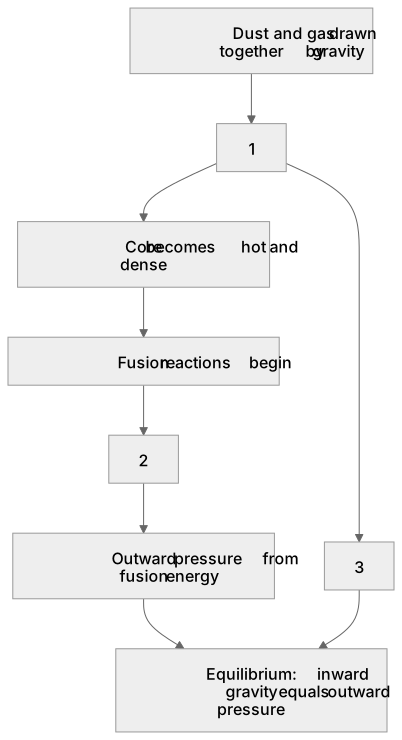
1Box 1
2Box 2
3Box 3
There is more to this lesson
The full lesson goes on to check your understanding and help you earn the marks. Create a free account to carry on, with your progress saved.
A week of Premium from your first lesson · Then the free plan continues · No card, no charge
Test your understanding of Our solar system: Students should be able to explain: how, at the start of a star's life cycle, the dust and gas drawn together by gravity causes fusion reactions that fusion reactions lead to an equilibrium between the gravitational collapse of a star and the expansion of a star due to fusion energy.
Active recall beats re-reading. Take an instant quiz now to test what you’ve learned and lock it into long-term memory.
A week of Premium from your first lesson · Then the free plan continues · No card, no charge