AQA · GCSE · Physics
Course version: 8463 · Version from Sept 2016
The Sun was formed from a cloud of dust and gas (nebula) pulled together…
Full specification wording
Our solar system: The Sun was formed from a cloud of dust and gas (nebula) pulled together by gravitational attraction.
Stars begin as a nebula, a huge cloud of dust and gas that is mostly hydrogen.
Checked against the AQA 8463 specification (opens in a new tab) on .
- Point 4 of 5
- 4 key terms
Study notes
From the checked teaching notes for this specification point.
The idea
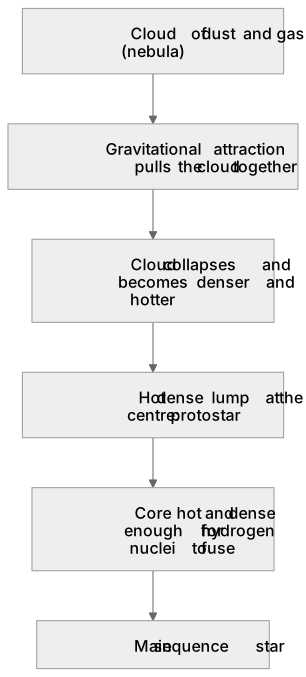
Stars begin as a nebula, a huge cloud of dust and gas that is mostly hydrogen. Gravitational attraction between the particles pulls the cloud inwards, and as it collapses it becomes denser and hotter, because the particles lose gravitational potential energy and gain kinetic energy as they fall together. The hot dense lump at the centre is a protostar. It is not yet a star: only when the core is hot and dense enough for hydrogen nuclei to fuse do fusion reactions begin and the object become a main sequence star. Our own Sun formed in this way about five billion years ago, out of the remains of earlier stars, which is why the solar system contains heavy elements at all.
What earns the marks
- A cloud of dust and gas, or nebula, as the starting point.
- Gravitational attraction pulling the cloud together.
- The temperature rising as the cloud collapses.
- Naming the protostar stage that comes before fusion begins.
Common mistakes and how to put them right
Saying the Sun formed in an explosion rather than by gravitational collapse.
Calling a protostar a star, when fusion has not yet started.
Writing that the nebula was pulled together by magnetism, or by the Big Bang.
Leaving out the heating, so there is no reason given for fusion to start.
Exam tips
- Use the word nebula and then explain it, because the definition is often the second mark.
- Name the stages in order, nebula, protostar, main sequence star, when a sequence is asked for.
- Say that gravity does the pulling and that the temperature rises, not just that the cloud gets smaller.
Try the lesson
The start of the Our solar system: The Sun was formed from a cloud of dust and gas (nebula) pulled together by gravitational attraction. lesson, made from checked teaching notes for this specification point.
Have a go first
The Sun began to form when a cloud of dust and gas was pulled together. Which force caused this cloud to be pulled together?
Listen
Stars begin as a nebula, a huge cloud of dust and gas that is mostly hydrogen. Gravitational attraction between the particles pulls the cloud inwards, and as it collapses it becomes denser and hotter, because the particles lose gravitational potential energy and gain kinetic energy as they fall together. The hot dense lump at the centre is a protostar. It is not yet a star: only when the core is hot and dense enough for hydrogen nuclei to fuse do fusion reactions begin and the object become a main sequence star. Our own Sun formed in this way about five billion years ago, out of the remains of earlier stars, which is why the solar system contains heavy elements at all. A strong answer earns marks for these points. a cloud of dust and gas, or nebula, as the starting point. gravitational attraction pulling the cloud together. the temperature rising as the cloud collapses. naming the protostar stage that comes before fusion begins. Exam tip: Use the word nebula and then explain it, because the definition is often the second mark.
See it
Put it in order
Put these steps in the order they happen.
- 1. Cloud collapses and becomes denser and hotter
- 2. Gravitational attraction pulls the cloud together
- 3. Cloud of dust and gas (nebula)
- 4. Main sequence star
- 5. Core hot and dense enough for hydrogen nuclei to fuse
- 6. Hot dense lump at the centre: protostar
Key words
Say what each word means before you turn the card.
nebula
Try answering aloud or in your head before turning the card.
gravitational attraction
Try answering aloud or in your head before turning the card.
protostar
Try answering aloud or in your head before turning the card.
start of fusion
Try answering aloud or in your head before turning the card.
See every definition
- nebula
- A cloud of dust and gas, mostly hydrogen, from which the Sun was formed.
- gravitational attraction
- The pulling together of the particles of the cloud, which makes it collapse and become denser and hotter.
- protostar
- The hot dense lump at the centre of the collapsing cloud, which is not yet a star because fusion has not started.
- start of fusion
- The point when the core is hot and dense enough for hydrogen nuclei to fuse, and the object becomes a main sequence star.
Label the diagram
Some boxes have lost their names. Pick the right name for each number.
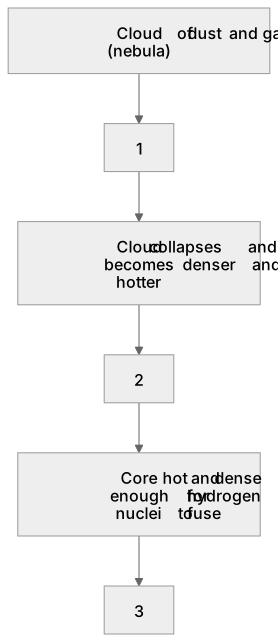
1Box 1
2Box 2
3Box 3
There is more to this lesson
The full lesson goes on to check your understanding and help you earn the marks. Create a free account to carry on, with your progress saved.
A week of Premium from your first lesson · Then the free plan continues · No card, no charge
Test your understanding of Our solar system: The Sun was formed from a cloud of dust and gas (nebula) pulled together by gravitational attraction.
Active recall beats re-reading. Take an instant quiz now to test what you’ve learned and lock it into long-term memory.
A week of Premium from your first lesson · Then the free plan continues · No card, no charge