AQA · GCSE · Physics
Course version: 8463 · Version from Sept 2016
Power is defined as the rate at which energy is transferred or the rate at…
Full specification wording
Power: Power is defined as the rate at which energy is transferred or the rate at which work is done.
Power tells you how fast energy moves, not how much moves.
Checked against the AQA 8463 specification (opens in a new tab) on .
- Point 1 of 3
Study notes
From the checked teaching notes for this specification point.
The idea
Power tells you how fast energy moves, not how much moves. It is defined as the energy transferred per second, or equally the work done per second, and both give P = E ÷ t and P = W ÷ t. One watt is one joule per second, so a 2000 W kettle transfers 2000 J every second. Rearranged, E = P t, which is how energy transferred by an appliance is found from its rating and running time. Two devices can transfer identical amounts of energy and still have very different powers: the faster one has the higher power. Mega and kilo prefixes are common in this content, so a 696 MW wind farm transfers 696 000 000 J each second. Power reappears in the electricity topic through P = V I and P = I² R, which reach the same watts by a different route.
What earns the marks
- A definition in terms of energy transferred per unit time or work done per unit time.
- The equation E = P t or P = E ÷ t written correctly.
- A correct substitution with time in seconds.
- An answer in watts, or in joules when energy is the unknown.
Common mistakes and how to put them right
Defining power as the energy transferred, with the per second left out.
Leaving time in minutes or hours when the equation needs seconds.
Mixing up the symbols P and W, so writing work done where power was asked for.
Treating a more powerful device as one that transfers more energy in total rather than more energy each second.
Exam tips
- Write the equation in words as well as symbols when the question says write down the equation which links the quantities.
- Convert MW and kW to W before substituting, then convert back only if the answer line asks for it.
- Quote the unit watt or joule per second, since a bare number loses the final mark.
Try the lesson
The start of the Power: Power is defined as the rate at which energy is transferred or the rate at which work is done. lesson, made from checked teaching notes for this specification point.
Have a go first
Which statement gives the definition of power?
Listen
Power tells you how fast energy moves, not how much moves. It is defined as the energy transferred per second, or equally the work done per second, and both give P = E ÷ t and P = W ÷ t. One watt is one joule per second, so a 2000 W kettle transfers 2000 J every second. Rearranged, E = P t, which is how energy transferred by an appliance is found from its rating and running time. Two devices can transfer identical amounts of energy and still have very different powers: the faster one has the higher power. Mega and kilo prefixes are common in this content, so a 696 MW wind farm transfers 696 000 000 J each second. Power reappears in the electricity topic through P = V I and P = I² R, which reach the same watts by a different route. A strong answer earns marks for these points. a definition in terms of energy transferred per unit time or work done per unit time. the equation E = P t or P = E ÷ t written correctly. a correct substitution with time in seconds. an answer in watts, or in joules when energy is the unknown. Exam tip: Write the equation in words as well as symbols when the question says write down the equation which links the quantities.
See it
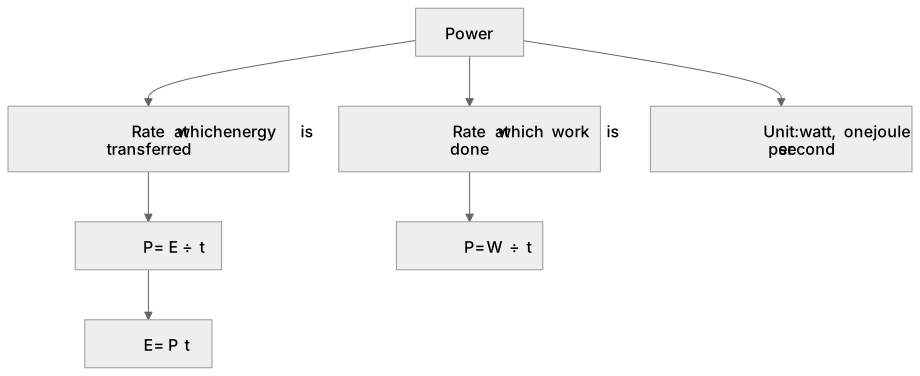
Label the diagram
Some boxes have lost their names. Pick the right name for each number.
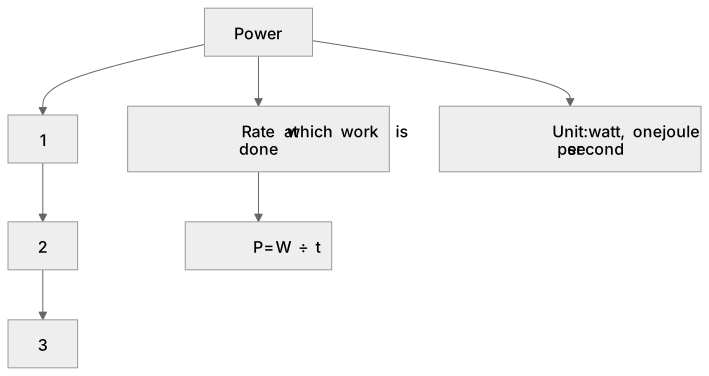
1Box 1
2Box 2
3Box 3
There is more to this lesson
The full lesson goes on to check your understanding and help you earn the marks. Create a free account to carry on, with your progress saved.
A week of Premium from your first lesson · Then the free plan continues · No card, no charge
Test your understanding of Power: Power is defined as the rate at which energy is transferred or the rate at which work is done.
Active recall beats re-reading. Take an instant quiz now to test what you’ve learned and lock it into long-term memory.
A week of Premium from your first lesson · Then the free plan continues · No card, no charge