AQA · GCSE · Physics
Course version: 8463 · Version from Sept 2016
Students should be able to give examples that illustrate the definition of…
Full specification wording
Power: Students should be able to give examples that illustrate the definition of power eg comparing two electric motors that both lift the same weight through the same height but one does it faster than the other.
The clearest illustration of power is two devices doing identical jobs at different speeds.
Checked against the AQA 8463 specification (opens in a new tab) on .
- Point 2 of 3
- 4 key terms
Study notes
From the checked teaching notes for this specification point.
The idea
The clearest illustration of power is two devices doing identical jobs at different speeds. Two motors lift the same weight through the same height, so both do the same work and transfer the same energy; the motor that finishes in half the time has twice the power. The same logic runs through the specification: two kettles that boil identical volumes of water transfer similar energy, but the quicker one has the greater power, and a student running upstairs has a higher power output than one walking the same stairs. Turn it into numbers whenever you can: work done = force × distance, then divide by the time, and the comparison becomes a pair of values in watts.
What earns the marks
- Stating that the same energy is transferred or the same work is done by both devices.
- Identifying the shorter time as the reason for the greater power.
- Supporting the comparison with a calculation using P = E ÷ t.
- A conclusion naming which device is more powerful with its value in watts.
Common mistakes and how to put them right
Claiming the faster motor transfers more energy, when it transfers the same energy in less time.
Comparing powers without first checking that the weight lifted and the height are the same.
Giving the answer as more powerful because it is bigger or uses more electricity, with no reference to time.
Calculating work done with the distance moved sideways rather than the height lifted.
Exam tips
- Anchor the comparison on what is equal first, then name the one thing that differs.
- If the question gives a weight in newtons, work done is weight × height with no extra step for g.
- For a stairs question, remember the runner also gains a kinetic store, so the total power output exceeds the value from height alone.
Try the lesson
The start of the Power: Students should be able to give examples that illustrate the definition of power eg comparing two electric motors that both lift the same weight through the same height but one does it faster than the other. lesson, made from checked teaching notes for this specification point.
Have a go first
Two electric motors lift identical weights through the same height. Motor A takes 4 s and motor B takes 8 s. Which motor has the greater power?
Listen
The clearest illustration of power is two devices doing identical jobs at different speeds. Two motors lift the same weight through the same height, so both do the same work and transfer the same energy; the motor that finishes in half the time has twice the power. The same logic runs through the specification: two kettles that boil identical volumes of water transfer similar energy, but the quicker one has the greater power, and a student running upstairs has a higher power output than one walking the same stairs. Turn it into numbers whenever you can: work done = force × distance, then divide by the time, and the comparison becomes a pair of values in watts. A strong answer earns marks for these points. stating that the same energy is transferred or the same work is done by both devices. identifying the shorter time as the reason for the greater power. supporting the comparison with a calculation using P = E ÷ t. a conclusion naming which device is more powerful with its value in watts. Exam tip: Anchor the comparison on what is equal first, then name the one thing that differs.
See it
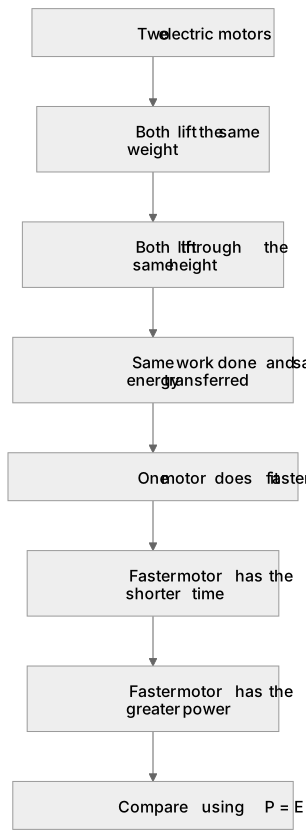
Put it in order
Put these steps in the order they happen.
- 1. One motor does it faster
- 2. Compare using P = E ÷ t
- 3. Faster motor has the shorter time
- 4. Two electric motors
- 5. Both lift the same weight
- 6. Faster motor has the greater power
- 7. Both lift through the same height
- 8. Same work done and same energy transferred
Key words
Say what each word means before you turn the card.
comparing power
Try answering aloud or in your head before turning the card.
same energy different time
Try answering aloud or in your head before turning the card.
work done against gravity
Try answering aloud or in your head before turning the card.
power output in watts
Try answering aloud or in your head before turning the card.
See every definition
- comparing power
- Two devices doing identical jobs at different speeds show that the one finishing in less time has the greater power.
- same energy different time
- Both motors do the same work and transfer the same energy, but the motor that finishes in half the time has twice the power.
- work done against gravity
- Work done = force × distance, and for a weight lifted the work done is weight × height with no extra step for g.
- power output in watts
- Dividing the work done by the time gives a pair of values in watts, so the comparison becomes numbers.
Label the diagram
Some boxes have lost their names. Pick the right name for each number.
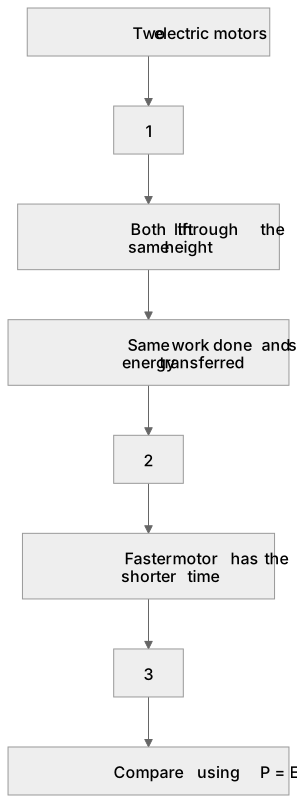
1Box 1
2Box 2
3Box 3
There is more to this lesson
The full lesson goes on to check your understanding and help you earn the marks. Create a free account to carry on, with your progress saved.
A week of Premium from your first lesson · Then the free plan continues · No card, no charge
Test your understanding of Power: Students should be able to give examples that illustrate the definition of power eg comparing two electric motors that both lift the same weight through the same height but one does it faster than the other.
Active recall beats re-reading. Take an instant quiz now to test what you’ve learned and lock it into long-term memory.
A week of Premium from your first lesson · Then the free plan continues · No card, no charge