AQA · GCSE · Physics
Course version: 8463 · Version from Sept 2016
Students should be able to explain how the power transfer in any circuit…
Full specification wording
Power: Students should be able to explain how the power transfer in any circuit device is related to the potential difference across it and the current through it, and to the energy changes over time: power = potential di f f erence × current P = V I power = current × resistance P = I R power, P, in watts, W potential difference, V, in volts, V current, I, in amperes, A (amp is acceptable for ampere) resistance, R, in ohms, Ω
Power is the energy transferred each second.
Checked against the AQA 8463 specification (opens in a new tab) on .
- Point 3 of 3
- 3 key terms
Study notes
From the checked teaching notes for this specification point.
The idea
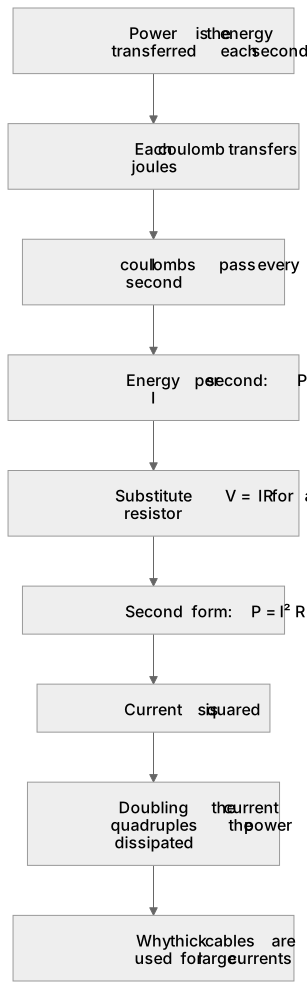
Power is the energy transferred each second. Each coulomb passing through a device transfers V joules, and I coulombs pass every second, so the energy per second is P = V I. Substituting V = I R for a resistor gives the second form, P = I² R. Note that the current is squared, so doubling the current quadruples the power dissipated, which is why thick cables are used for large currents. Choose the equation that matches the data: P = V I when you are given potential difference and current, P = I² R when you are given current and resistance. A 230 V kettle drawing 8.7 A transfers 230 × 8.7 = 2001 W, about 2 kW, and a 3 A current in a 5 Ω element gives P = 3² × 5 = 45 W.
What earns the marks
- Selecting P = V I or P = I² R to match the quantities given.
- Correct substitution of the values into the chosen equation.
- The calculated power with the unit watts, W.
- A correct rearrangement, such as I = P ÷ V, when the power is the quantity supplied.
Common mistakes and how to put them right
Using P = I R instead of P = I² R because the square is easy to miss in printed text.
Forgetting to square the current, so a 3 A current in 5 Ω is given as 15 W.
Mixing kilowatts and watts in the same calculation without converting.
Quoting the answer in joules because power and energy have been confused.
Exam tips
- Write the equation, substitute, then evaluate; the substitution mark is awarded even when the arithmetic slips.
- Check the equation sheet for the squared term, because the printed specification line is easy to misread.
- Convert kilowatts to watts before substituting, and state the unit with every answer.
Try the lesson
The start of the Power: Students should be able to explain how the power transfer in any circuit device is related to the potential difference across it and the current through it, and to the energy changes over time: power = potential di f f erence × current P = V I power = current × resistance P = I R power, P, in watts, W potential difference, V, in volts, V current, I, in amperes, A (amp is acceptable for ampere) resistance, R, in ohms, Ω lesson, made from checked teaching notes for this specification point.
Have a go first
A lamp is connected to a 12 V supply and a current of 2 A flows through it. Using P = V I, what is the power transferred by the lamp?
Listen
Power is the energy transferred each second. Each coulomb passing through a device transfers V joules, and I coulombs pass every second, so the energy per second is P = V I. Substituting V = I R for a resistor gives the second form, P = I² R. Note that the current is squared, so doubling the current quadruples the power dissipated, which is why thick cables are used for large currents. Choose the equation that matches the data: P = V I when you are given potential difference and current, P = I² R when you are given current and resistance. A 230 V kettle drawing 8.7 A transfers 230 × 8.7 = 2001 W, about 2 kW, and a 3 A current in a 5 Ω element gives P = 3² × 5 = 45 W. A strong answer earns marks for these points. selecting P = V I or P = I² R to match the quantities given. correct substitution of the values into the chosen equation. the calculated power with the unit watts, W. a correct rearrangement, such as I = P ÷ V, when the power is the quantity supplied. Exam tip: Write the equation, substitute, then evaluate; the substitution mark is awarded even when the arithmetic slips.
See it
Key words
Say what each word means before you turn the card.
power
Try answering aloud or in your head before turning the card.
P = V I
Try answering aloud or in your head before turning the card.
P = I² R
Try answering aloud or in your head before turning the card.
See every definition
- power
- The energy transferred each second, measured in watts, W.
- P = V I
- Power equals potential difference multiplied by current, used when you are given potential difference and current.
- P = I² R
- Power equals current squared multiplied by resistance, used when you are given current and resistance.
Label the diagram
Some boxes have lost their names. Pick the right name for each number.
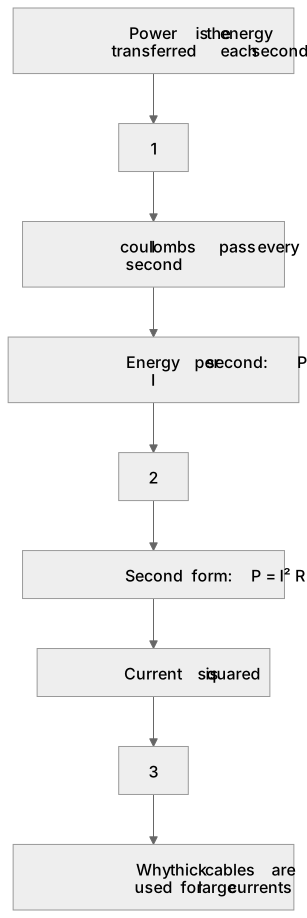
1Box 1
2Box 2
3Box 3
There is more to this lesson
The full lesson goes on to check your understanding and help you earn the marks. Create a free account to carry on, with your progress saved.
A week of Premium from your first lesson · Then the free plan continues · No card, no charge
Test your understanding of Power: Students should be able to explain how the power transfer in any circuit device is related to the potential difference across it and the current through it, and to the energy changes over time: power = potential di f f erence × current P = V I power = current × resistance P = I R power, P, in watts, W potential difference, V, in volts, V current, I, in amperes, A (amp is acceptable for ampere) resistance, R, in ohms, Ω
Active recall beats re-reading. Take an instant quiz now to test what you’ve learned and lock it into long-term memory.
A week of Premium from your first lesson · Then the free plan continues · No card, no charge