AQA · GCSE · Physics
Course version: 8463 · Version from Sept 2016
A partially (or totally) submerged object experiences a greater pressure…
Full specification wording
Pressure in a fluid 2 (HT only): A partially (or totally) submerged object experiences a greater pressure on the bottom surface than on the top surface.
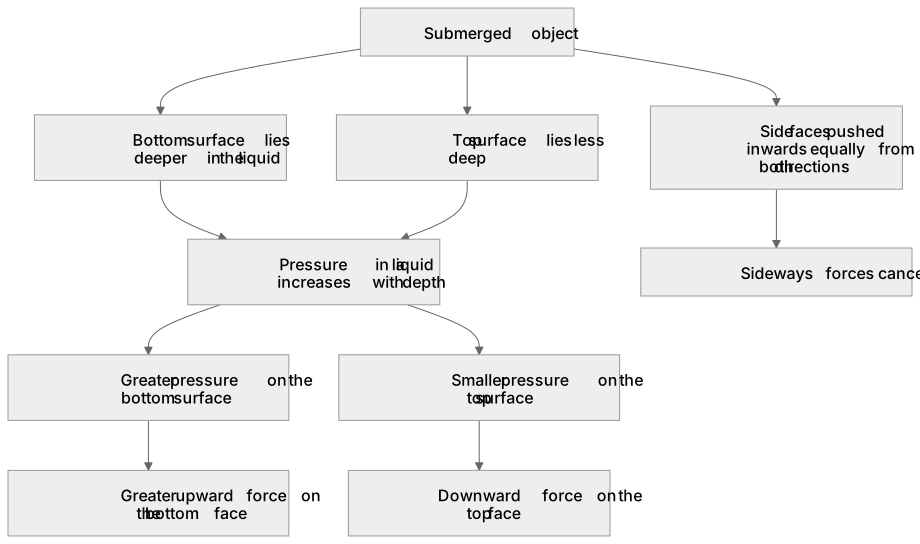
Pressure in a liquid grows with depth, so the lower face of a submerged block sits deeper than the upper face and the liquid pushes harder on it.
Checked against the AQA 8463 specification (opens in a new tab) on .
- Point 3 of 6
- 4 key terms
Study notes
From the checked teaching notes for this specification point.
The idea
Pressure in a liquid grows with depth, so the lower face of a submerged block sits deeper than the upper face and the liquid pushes harder on it. Both pushes are normal to their faces, up on the bottom and down on the top, and the difference between them depends on the vertical height of the block and the density of the liquid, not on how deep the block is overall. The side faces are pushed inwards equally from both directions, so those forces cancel. A brick a tenth of a metre tall lying on the floor of a pool has about one kilopascal more pressure on its underside than on its top, and multiplying that difference by the area of the face gives the extra upward force.
What earns the marks
- The bottom surface lying deeper in the liquid than the top surface.
- Pressure in a liquid increasing with depth.
- The greater pressure producing a greater upward force on the bottom face.
- The horizontal forces on the side faces cancelling.
Common mistakes and how to put them right
Claiming the pressure difference depends on how deep the whole object is rather than on its height.
Forgetting that the liquid also pushes down on the top surface.
Saying the side faces experience no pressure at all.
Confusing the pressure difference between the faces with the total pressure at the bottom.
Exam tips
- Draw the arrows: a long one pointing up on the base and a short one pointing down on the top.
- Say greater depth, so greater pressure, in as many words; it is the linking mark.
Try the lesson
The start of the Pressure in a fluid 2 (HT only): A partially (or totally) submerged object experiences a greater pressure on the bottom surface than on the top surface. lesson, made from checked teaching notes for this specification point.
Have a go first
A cube is totally submerged in water. Why is the water pressure on its bottom face greater than on its top face?
Listen
Pressure in a liquid grows with depth, so the lower face of a submerged block sits deeper than the upper face and the liquid pushes harder on it. Both pushes are normal to their faces, up on the bottom and down on the top, and the difference between them depends on the vertical height of the block and the density of the liquid, not on how deep the block is overall. The side faces are pushed inwards equally from both directions, so those forces cancel. A brick a tenth of a metre tall lying on the floor of a pool has about one kilopascal more pressure on its underside than on its top, and multiplying that difference by the area of the face gives the extra upward force. A strong answer earns marks for these points. the bottom surface lying deeper in the liquid than the top surface. pressure in a liquid increasing with depth. the greater pressure producing a greater upward force on the bottom face. the horizontal forces on the side faces cancelling. Exam tip: Draw the arrows: a long one pointing up on the base and a short one pointing down on the top.
See it
Key words
Say what each word means before you turn the card.
submerged object
Try answering aloud or in your head before turning the card.
pressure with depth
Try answering aloud or in your head before turning the card.
cancelling side forces
Try answering aloud or in your head before turning the card.
pressure difference
Try answering aloud or in your head before turning the card.
See every definition
- submerged object
- An object that is partially or totally under a liquid, experiencing a greater pressure on its bottom surface than on its top surface.
- pressure with depth
- Pressure in a liquid grows with depth, so the lower face of a submerged block sits deeper than the upper face and the liquid pushes harder on it.
- cancelling side forces
- The side faces are pushed inwards equally from both directions, so those forces cancel.
- pressure difference
- The difference between the pushes on the bottom and top faces depends on the vertical height of the block and the density of the liquid, not on how deep the block is overall.
Label the diagram
Some boxes have lost their names. Pick the right name for each number.
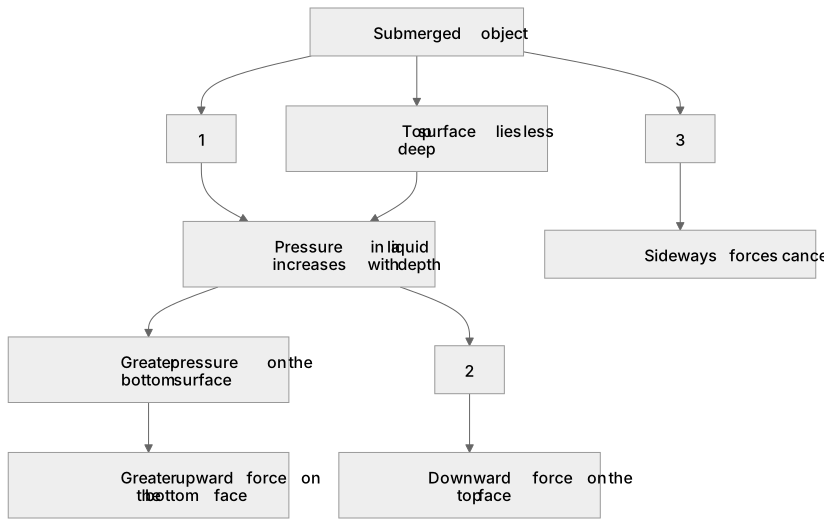
1Box 1
2Box 2
3Box 3
There is more to this lesson
The full lesson goes on to check your understanding and help you earn the marks. Create a free account to carry on, with your progress saved.
A week of Premium from your first lesson · Then the free plan continues · No card, no charge
Test your understanding of Pressure in a fluid 2 (HT only): A partially (or totally) submerged object experiences a greater pressure on the bottom surface than on the top surface.
Active recall beats re-reading. Take an instant quiz now to test what you’ve learned and lock it into long-term memory.
A week of Premium from your first lesson · Then the free plan continues · No card, no charge