AQA · GCSE · Physics
Course version: 8463 · Version from Sept 2016
The pressure due to a column of liquid can be calculated using the…
Full specification wording
Pressure in a fluid 2 (HT only): The pressure due to a column of liquid can be calculated using the equation: pressure = height of the column × density of the liquid × gravitational field strength [ p = h ρ g ] pressure, p, in pascals, Pa height of the column, h, in metres, m density, ρ, in kilograms per metre cubed, kg/m gravitational field strength, g, in newtons per kilogram, N/kg (In any calculation the value of the gravitational field strength (g) will be given.) Students should be able to explain why, in a liquid, pressure at a point increases with the height of the column of liquid above that point and with the density of the liquid.
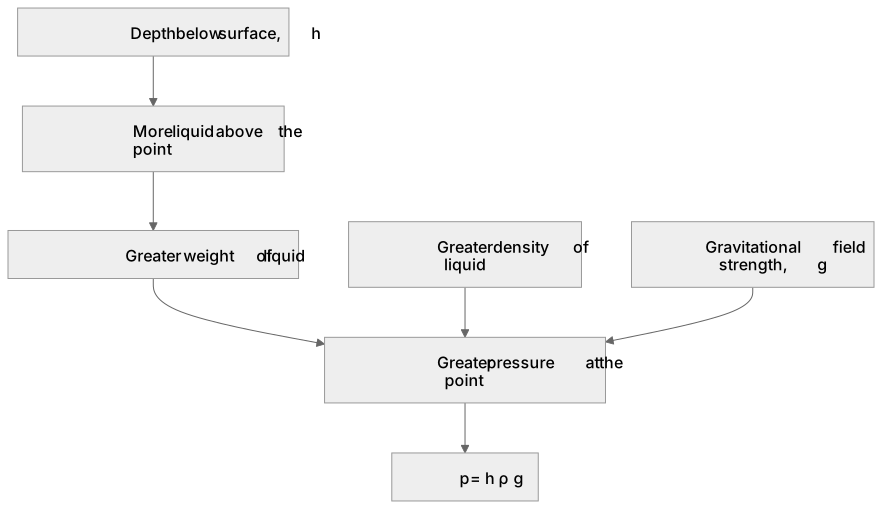
The pressure at a depth in a liquid comes from the weight of the liquid above, so it depends on how deep you are, on how dense the liquid is and on the gravitational field strength.
Checked against the AQA 8463 specification (opens in a new tab) on .
- Point 1 of 6
- 4 key terms
Study notes
From the checked teaching notes for this specification point.
The idea
The pressure at a depth in a liquid comes from the weight of the liquid above, so it depends on how deep you are, on how dense the liquid is and on the gravitational field strength. It does not depend on the width of the container or on the total volume: a narrow tube and a wide tank filled to the same depth give the same pressure at the bottom, because a wider column of liquid has more weight but spreads it over proportionally more area. Every value must be in base units, so a depth in centimetres becomes metres and a density in grams per cubic centimetre becomes kilograms per cubic metre. At 3.0 m down in water of density 1000 kg/m³, with g taken as 9.8 N/kg, the pressure due to the water is about 29 kPa, on top of atmospheric pressure.
What earns the marks
- The equation pressure = height of the column × density × gravitational field strength.
- The height taken as the depth below the surface of the liquid.
- Density in kilograms per cubic metre and depth in metres.
- The calculated pressure in pascals or kilopascals.
Common mistakes and how to put them right
Using the height of the container rather than the depth below the liquid surface.
Assuming a wider tank gives a greater pressure at the same depth.
Leaving the density in grams per cubic centimetre.
Measuring the depth upwards from the bottom of the container.
Exam tips
- Measure the height downwards from the surface of the liquid to the point in question.
- For an explain question, write more liquid above, so greater weight, so greater pressure.
Try the lesson
The start of the Pressure in a fluid 2 (HT only): The pressure due to a column of liquid can be calculated using the equation: pressure = height of the column × density of the liquid × gravitational field strength [ p = h ρ g ] pressure, p, in pascals, Pa height of the column, h, in metres, m density, ρ, in kilograms per metre cubed, kg/m gravitational field strength, g, in newtons per kilogram, N/kg (In any calculation the value of the gravitational field strength (g) will be given.) Students should be able to explain why, in a liquid, pressure at a point increases with the height of the column of liquid above that point and with the density of the liquid. lesson, made from checked teaching notes for this specification point.
Have a go first
A vertical column of water is 3.0 m high. The density of water is 1000 kg/m³ and g = 9.8 N/kg. Using p = h ρ g, calculate the pressure at the bottom of the column.
Listen
The pressure at a depth in a liquid comes from the weight of the liquid above, so it depends on how deep you are, on how dense the liquid is and on the gravitational field strength. It does not depend on the width of the container or on the total volume: a narrow tube and a wide tank filled to the same depth give the same pressure at the bottom, because a wider column of liquid has more weight but spreads it over proportionally more area. Every value must be in base units, so a depth in centimetres becomes metres and a density in grams per cubic centimetre becomes kilograms per cubic metre. At 3.0 m down in water of density 1000 kg/m³, with g taken as 9.8 N/kg, the pressure due to the water is about 29 kPa, on top of atmospheric pressure. A strong answer earns marks for these points. the equation pressure = height of the column × density × gravitational field strength. the height taken as the depth below the surface of the liquid. density in kilograms per cubic metre and depth in metres. the calculated pressure in pascals or kilopascals. Exam tip: Measure the height downwards from the surface of the liquid to the point in question.
See it
Key words
Say what each word means before you turn the card.
pressure with depth
Try answering aloud or in your head before turning the card.
density
Try answering aloud or in your head before turning the card.
gravitational field strength
Try answering aloud or in your head before turning the card.
column of liquid
Try answering aloud or in your head before turning the card.
See every definition
- pressure with depth
- Pressure at a point in a liquid increases with the height of the column of liquid above that point and with the density of the liquid.
- density
- Measured in kilograms per metre cubed, kg/m, it is multiplied by the height of the column and the gravitational field strength to give the pressure.
- gravitational field strength
- Measured in newtons per kilogram, N/kg, its value will be given in any calculation.
- column of liquid
- Its height, h, in metres, m, is multiplied by the density of the liquid and the gravitational field strength to give the pressure.
Label the diagram
Some boxes have lost their names. Pick the right name for each number.
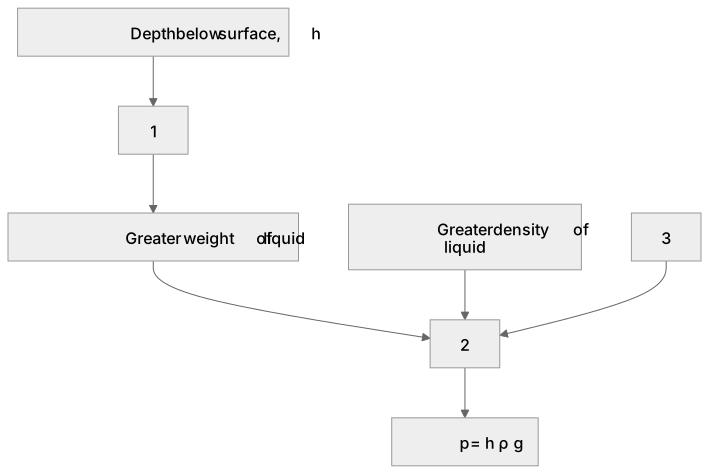
1Box 1
2Box 2
3Box 3
There is more to this lesson
The full lesson goes on to check your understanding and help you earn the marks. Create a free account to carry on, with your progress saved.
A week of Premium from your first lesson · Then the free plan continues · No card, no charge
Test your understanding of Pressure in a fluid 2 (HT only): The pressure due to a column of liquid can be calculated using the equation: pressure = height of the column × density of the liquid × gravitational field strength [ p = h ρ g ] pressure, p, in pascals, Pa height of the column, h, in metres, m density, ρ, in kilograms per metre cubed, kg/m gravitational field strength, g, in newtons per kilogram, N/kg (In any calculation the value of the gravitational field strength (g) will be given.) Students should be able to explain why, in a liquid, pressure at a point increases with the height of the column of liquid above that point and with the density of the liquid.
Active recall beats re-reading. Take an instant quiz now to test what you’ve learned and lock it into long-term memory.
A week of Premium from your first lesson · Then the free plan continues · No card, no charge