AQA · GCSE · Physics
Course version: 8463 · Version from Sept 2016
Required practical activity 10: investigate how the amount of infrared…
Full specification wording
Properties of electromagnetic waves 1: Required practical activity 10: investigate how the amount of infrared radiation absorbed or radiated by a surface depends on the nature of that surface.
The standard version uses a Leslie cube: a metal cube with four faces, matt black, shiny black, matt white and shiny silver, filled with hot water.
Checked against the AQA 8463 specification (opens in a new tab) on .
- Point 5 of 5
- 4 key terms
Study notes
From the checked teaching notes for this specification point.
The idea
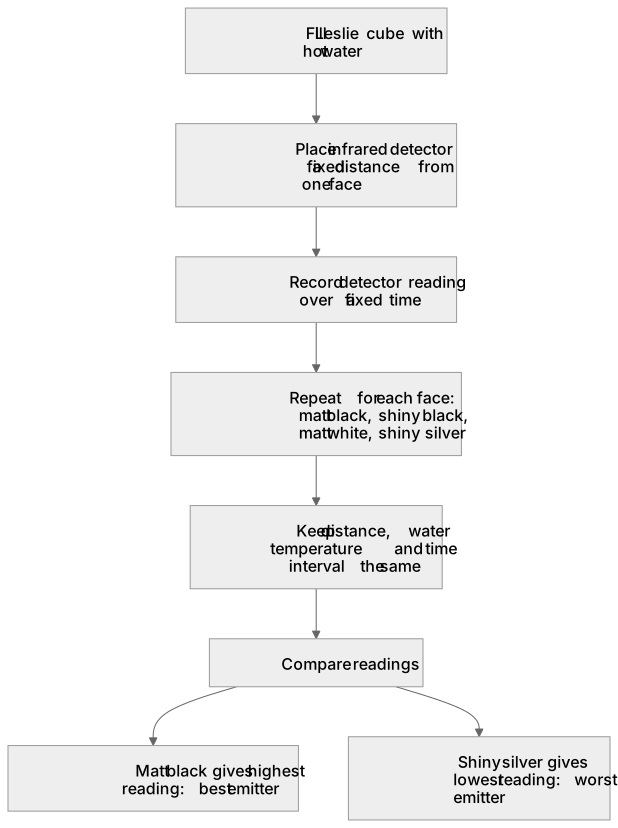
The standard version uses a Leslie cube: a metal cube with four faces, matt black, shiny black, matt white and shiny silver, filled with hot water. An infrared detector is placed a fixed distance from each face in turn and the reading recorded. The matt black face gives the highest reading and the shiny silver face the lowest, showing that a matt black surface is the best emitter of infrared and a shiny silver one the worst. The absorption version uses flasks or metal plates with different surfaces the same distance from a heater, measuring the temperature rise over a fixed time; the matt black one warms fastest. The control variables matter: the same water temperature, the same distance, the same starting temperature and the same time interval.
What earns the marks
- Keeping the distance between the detector and the surface the same for every face.
- Using the same temperature of water, or the same heater setting, throughout.
- Measuring the detector reading, or the temperature rise, over the same fixed time.
- The conclusion that a matt black surface emits and absorbs infrared better than a shiny silver one.
Common mistakes and how to put them right
Changing the distance between the detector and the cube between readings.
Taking the readings before all the faces have reached the same temperature.
Concluding that black surfaces attract heat rather than being better absorbers and emitters of infrared.
Quoting the colour alone and ignoring whether the surface is matt or shiny.
Exam tips
- Name the control variables explicitly, because six mark method questions are marked on them.
- Say which variable you change, which you measure and what you keep the same, in that order.
- Use the words emitter and absorber rather than gives off heat and takes in heat.
Try the lesson
The start of the Properties of electromagnetic waves 1: Required practical activity 10: investigate how the amount of infrared radiation absorbed or radiated by a surface depends on the nature of that surface. lesson, made from checked teaching notes for this specification point.
Have a go first
In a required practical, a student places a thermometer in a black can and an identical thermometer in a shiny silver can. Both cans contain the same volume of hot water at the same starting temperature. After 10 minutes, which thermometer shows the lower temperature and why?
Listen
The standard version uses a Leslie cube: a metal cube with four faces, matt black, shiny black, matt white and shiny silver, filled with hot water. An infrared detector is placed a fixed distance from each face in turn and the reading recorded. The matt black face gives the highest reading and the shiny silver face the lowest, showing that a matt black surface is the best emitter of infrared and a shiny silver one the worst. The absorption version uses flasks or metal plates with different surfaces the same distance from a heater, measuring the temperature rise over a fixed time; the matt black one warms fastest. The control variables matter: the same water temperature, the same distance, the same starting temperature and the same time interval. A strong answer earns marks for these points. keeping the distance between the detector and the surface the same for every face. using the same temperature of water, or the same heater setting, throughout. measuring the detector reading, or the temperature rise, over the same fixed time. the conclusion that a matt black surface emits and absorbs infrared better than a shiny silver one. Exam tip: Name the control variables explicitly, because six mark method questions are marked on them.
See it
Key words
Say what each word means before you turn the card.
Leslie cube
Try answering aloud or in your head before turning the card.
matt black best emitter
Try answering aloud or in your head before turning the card.
shiny silver worst
Try answering aloud or in your head before turning the card.
control variables
Try answering aloud or in your head before turning the card.
See every definition
- Leslie cube
- A metal cube with four faces, matt black, shiny black, matt white and shiny silver, filled with hot water.
- matt black best emitter
- The matt black face gives the highest reading, showing that a matt black surface is the best emitter of infrared.
- shiny silver worst
- The shiny silver face gives the lowest reading, showing that a shiny silver surface is the worst emitter of infrared.
- control variables
- The same water temperature, the same distance, the same starting temperature and the same time interval.
Label the diagram
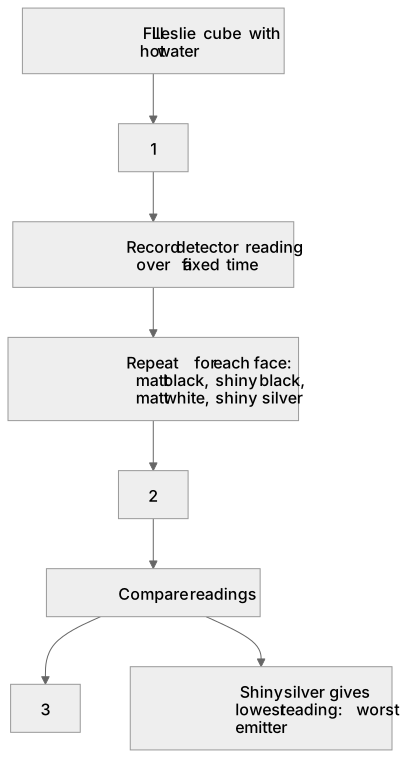
Some boxes have lost their names. Pick the right name for each number.
1Box 1
2Box 2
3Box 3
There is more to this lesson
The full lesson goes on to check your understanding and help you earn the marks. Create a free account to carry on, with your progress saved.
A week of Premium from your first lesson · Then the free plan continues · No card, no charge
Test your understanding of Properties of electromagnetic waves 1: Required practical activity 10: investigate how the amount of infrared radiation absorbed or radiated by a surface depends on the nature of that surface.
Active recall beats re-reading. Take an instant quiz now to test what you’ve learned and lock it into long-term memory.
A week of Premium from your first lesson · Then the free plan continues · No card, no charge