AQA · GCSE · Physics
Course version: 8463 · Version from Sept 2016
(HT only) Students should be able to use wave front diagrams to explain…
Full specification wording
Properties of electromagnetic waves 1: (HT only) Students should be able to use wave front diagrams to explain refraction in terms of the change of speed that happens when a wave travels from one medium to a different medium.
This is Higher tier.
Checked against the AQA 8463 specification (opens in a new tab) on .
- Point 4 of 5
- 3 key terms
Study notes
From the checked teaching notes for this specification point.
The idea
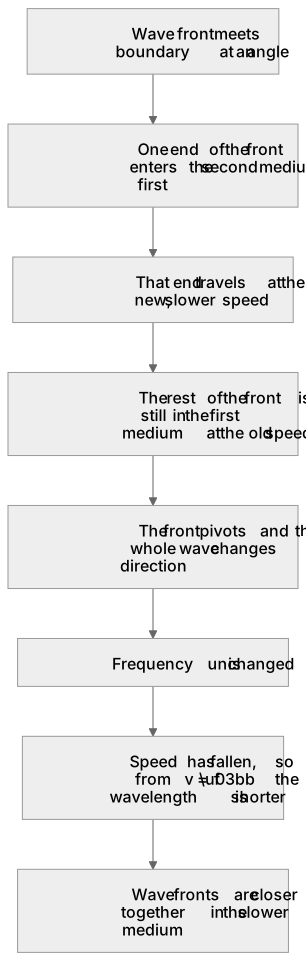
This is Higher tier. A wave front diagram draws the wave as a set of parallel lines, each one a crest, travelling at right angles to the fronts. When a front meets a boundary at an angle, one end of it crosses into the second medium while the other end is still in the first. That end immediately travels at the new, slower speed while the rest is still going at the old speed, so the front pivots and the whole wave changes direction. Inside the slower medium the fronts are closer together, because the frequency is unchanged and the speed has fallen, so from v = f λ the wavelength must be shorter. Wave fronts therefore explain refraction as the consequence of one part of the wave slowing before another.
What earns the marks
- Saying that different parts of the wave front enter the second medium at different times.
- Stating that the speed of the wave is less in the second medium.
- Saying that one part of the wave front changes speed before the other parts, so the front turns.
- Showing the wave fronts closer together in the slower medium while the frequency is unchanged.
Common mistakes and how to put them right
Drawing the wave fronts the same distance apart in both media.
Saying the frequency drops in the slower medium instead of the wavelength.
Describing the change of direction without saying why one part of the front slows first.
Drawing the fronts along the direction of travel rather than at right angles to it.
Exam tips
- Wave fronts are always perpendicular to the direction of travel; draw the direction arrow as a check.
- Use the sentence one part of the wave front changes speed before the other as the core of your answer.
- If the question is worth three marks, expect one for the timing, one for the speed change and one for the turning.
Try the lesson
The start of the Properties of electromagnetic waves 1: (HT only) Students should be able to use wave front diagrams to explain refraction in terms of the change of speed that happens when a wave travels from one medium to a different medium. lesson, made from checked teaching notes for this specification point.
Have a go first
A wave front diagram shows water waves travelling from deep water into shallow water. The waves travel more slowly in the shallow water. How does the wave front diagram show this decrease in speed?
Listen
This is Higher tier. A wave front diagram draws the wave as a set of parallel lines, each one a crest, travelling at right angles to the fronts. When a front meets a boundary at an angle, one end of it crosses into the second medium while the other end is still in the first. That end immediately travels at the new, slower speed while the rest is still going at the old speed, so the front pivots and the whole wave changes direction. Inside the slower medium the fronts are closer together, because the frequency is unchanged and the speed has fallen, so from v = f λ the wavelength must be shorter. Wave fronts therefore explain refraction as the consequence of one part of the wave slowing before another. A strong answer earns marks for these points. saying that different parts of the wave front enter the second medium at different times. stating that the speed of the wave is less in the second medium. saying that one part of the wave front changes speed before the other parts, so the front turns. showing the wave fronts closer together in the slower medium while the frequency is unchanged. Exam tip: Wave fronts are always perpendicular to the direction of travel; draw the direction arrow as a check.
See it
Put it in order
Put these steps in the order they happen.
- 1. The front pivots and the whole wave changes direction
- 2. Wave fronts are closer together in the slower medium
- 3. Frequency is unchanged
- 4. Wave front meets boundary at an angle
- 5. One end of the front enters the second medium first
- 6. Speed has fallen, so from v = f \u03bb the wavelength is shorter
- 7. That end travels at the new, slower speed
- 8. The rest of the front is still in the first medium at the old speed
Key words
Say what each word means before you turn the card.
wave fronts
Try answering aloud or in your head before turning the card.
spacing and wavelength
Try answering aloud or in your head before turning the card.
explaining refraction
Try answering aloud or in your head before turning the card.
See every definition
- wave fronts
- A set of parallel lines, each one a crest, travelling at right angles to the fronts.
- spacing and wavelength
- Inside the slower medium the fronts are closer together, because the frequency is unchanged and the speed has fallen, so the wavelength must be shorter.
- explaining refraction
- Refraction is the consequence of one part of the wave slowing before another, so the front pivots and the whole wave changes direction.
Label the diagram
Some boxes have lost their names. Pick the right name for each number.
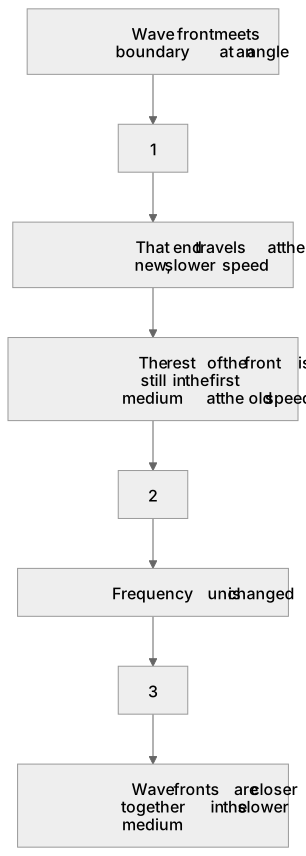
1Box 1
2Box 2
3Box 3
There is more to this lesson
The full lesson goes on to check your understanding and help you earn the marks. Create a free account to carry on, with your progress saved.
A week of Premium from your first lesson · Then the free plan continues · No card, no charge
Test your understanding of Properties of electromagnetic waves 1: (HT only) Students should be able to use wave front diagrams to explain refraction in terms of the change of speed that happens when a wave travels from one medium to a different medium.
Active recall beats re-reading. Take an instant quiz now to test what you’ve learned and lock it into long-term memory.
A week of Premium from your first lesson · Then the free plan continues · No card, no charge