AQA · GCSE · Physics
Course version: 8463 · Version from Sept 2016
Students should be able to construct ray diagrams to illustrate the…
Full specification wording
Properties of electromagnetic waves 1: Students should be able to construct ray diagrams to illustrate the refraction of a wave at the boundary between two different media.
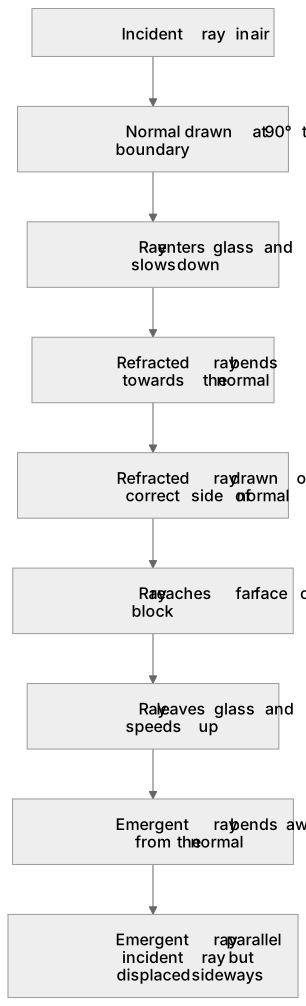
Draw the normal first, as a dashed line at 90° to the boundary at the point where the ray meets it.
Checked against the AQA 8463 specification (opens in a new tab) on .
- Point 3 of 5
- 4 key terms
Study notes
From the checked teaching notes for this specification point.
The idea
Draw the normal first, as a dashed line at 90° to the boundary at the point where the ray meets it. As the ray enters the glass it slows down, so it bends towards the normal and the angle of refraction inside the glass is smaller than the angle of incidence in the air. Draw that refracted ray with a ruler from the same point. At the far face the ray leaves the glass, speeds up and bends away from the normal by the same amount, so for a rectangular block the emerging ray is parallel to the original incident ray but displaced sideways. It is not a straight continuation of the incident ray. Label the incident, refracted and emergent rays and put arrows on them to show the direction of travel.
What earns the marks
- The ray shown refracting towards the normal as it enters the glass block.
- The refracted ray drawn on the correct side of the normal.
- The emergent ray drawn parallel to the incident ray and not as a continuation of it.
- A normal drawn at 90° to the surface at the point where the ray enters.
Common mistakes and how to put them right
Continuing the incident ray straight through the block, so no refraction is shown at all.
Bending the ray away from the normal as it enters the glass.
Drawing the emergent ray parallel to the refracted ray inside the block rather than to the incident ray.
Omitting the normal, so the angles cannot be judged.
Exam tips
- Draw the normal at both faces; most lost marks here come from a missing or misplaced normal.
- Use a ruler and keep the lines long enough for the examiner to see the angle clearly.
- Remember the two bends are opposite, which is what makes the emergent ray parallel to the incident one.
Try the lesson
The start of the Properties of electromagnetic waves 1: Students should be able to construct ray diagrams to illustrate the refraction of a wave at the boundary between two different media. lesson, made from checked teaching notes for this specification point.
Have a go first
A student is constructing a ray diagram to show light refracting as it passes from air into a glass block. Where must the student draw the normal line?
Listen
Draw the normal first, as a dashed line at 90° to the boundary at the point where the ray meets it. As the ray enters the glass it slows down, so it bends towards the normal and the angle of refraction inside the glass is smaller than the angle of incidence in the air. Draw that refracted ray with a ruler from the same point. At the far face the ray leaves the glass, speeds up and bends away from the normal by the same amount, so for a rectangular block the emerging ray is parallel to the original incident ray but displaced sideways. It is not a straight continuation of the incident ray. Label the incident, refracted and emergent rays and put arrows on them to show the direction of travel. A strong answer earns marks for these points. the ray shown refracting towards the normal as it enters the glass block. the refracted ray drawn on the correct side of the normal. the emergent ray drawn parallel to the incident ray and not as a continuation of it. a normal drawn at 90° to the surface at the point where the ray enters. Exam tip: Draw the normal at both faces; most lost marks here come from a missing or misplaced normal.
See it
Key words
Say what each word means before you turn the card.
ray diagram
Try answering aloud or in your head before turning the card.
normal at each face
Try answering aloud or in your head before turning the card.
bending towards the normal
Try answering aloud or in your head before turning the card.
parallel emergent ray
Try answering aloud or in your head before turning the card.
See every definition
- ray diagram
- A drawing used to illustrate the refraction of a wave at the boundary between two different media.
- normal at each face
- A dashed line drawn at 90° to the boundary at the point where the ray meets it, needed at both faces.
- bending towards the normal
- What the ray does as it enters the glass and slows down, making the angle of refraction inside the glass smaller than the angle of incidence in the air.
- parallel emergent ray
- The ray leaving the glass, which speeds up and bends away from the normal by the same amount, so for a rectangular block it is parallel to the original incident ray but displaced sideways.
Label the diagram
Some boxes have lost their names. Pick the right name for each number.
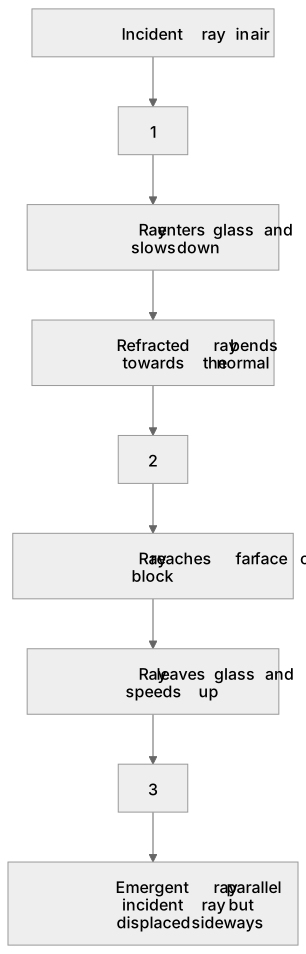
1Box 1
2Box 2
3Box 3
There is more to this lesson
The full lesson goes on to check your understanding and help you earn the marks. Create a free account to carry on, with your progress saved.
A week of Premium from your first lesson · Then the free plan continues · No card, no charge
Test your understanding of Properties of electromagnetic waves 1: Students should be able to construct ray diagrams to illustrate the refraction of a wave at the boundary between two different media.
Active recall beats re-reading. Take an instant quiz now to test what you’ve learned and lock it into long-term memory.
A week of Premium from your first lesson · Then the free plan continues · No card, no charge