AQA · GCSE · Physics
Course version: 8463 · Version from Sept 2016
X-rays and gamma rays are ionising radiation that can cause the mutation…
Full specification wording
Properties of electromagnetic waves 2: X-rays and gamma rays are ionising radiation that can cause the mutation of genes and cancer.
X-rays and gamma rays have the highest frequencies in the spectrum, so each one carries enough energy to knock an electron off an atom it passes; that is what ionising means.
Checked against the AQA 8463 specification (opens in a new tab) on .
- Point 11 of 11
Study notes
From the checked teaching notes for this specification point.
The idea
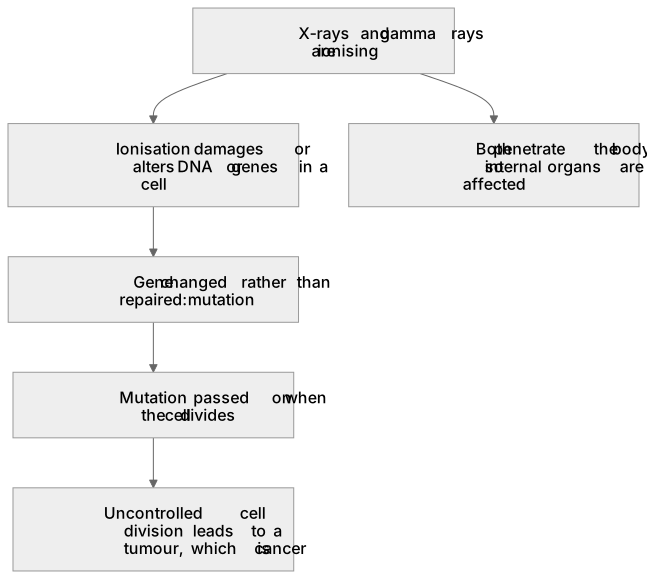
X-rays and gamma rays have the highest frequencies in the spectrum, so each one carries enough energy to knock an electron off an atom it passes; that is what ionising means. Inside a cell, the ions and reactive fragments produced can break or alter a strand of DNA. If a gene is changed rather than repaired, the mutation is passed on when the cell divides and can lead to a tumour, which is cancer. Because both radiations penetrate deeply, the damage is not limited to the skin. That is why radiographers stand behind lead screens and why medical doses are kept as low as possible, and it is also why the same penetrating, ionising property is used deliberately in radiotherapy to kill cancer cells.
What earns the marks
- Stating that X-rays and gamma rays are ionising.
- Explaining that ionisation can damage or alter the DNA or genes in a cell.
- Linking a mutation to uncontrolled cell division and cancer.
- Stating that both penetrate the body, so internal organs are affected.
Common mistakes and how to put them right
Saying an X-ray scan is not dangerous because it is quick, with no mention of dose.
Describing ionisation as heating the cell.
Saying gamma rays cure cancer without noting that they can also cause it.
Claiming X-rays come from the nucleus in the way gamma rays do.
Exam tips
- Spell out the chain: ionisation, damage to DNA, mutation, cancer; each step can carry a mark.
- Mention the precaution as well as the hazard when the question is set in a hospital.
- Keep X-rays and gamma rays together for hazard questions, but remember they are produced differently.
Try the lesson
The start of the Properties of electromagnetic waves 2: X-rays and gamma rays are ionising radiation that can cause the mutation of genes and cancer. lesson, made from checked teaching notes for this specification point.
Have a go first
What type of radiation are X-rays and gamma rays?
Listen
X-rays and gamma rays have the highest frequencies in the spectrum, so each one carries enough energy to knock an electron off an atom it passes; that is what ionising means. Inside a cell, the ions and reactive fragments produced can break or alter a strand of DNA. If a gene is changed rather than repaired, the mutation is passed on when the cell divides and can lead to a tumour, which is cancer. Because both radiations penetrate deeply, the damage is not limited to the skin. That is why radiographers stand behind lead screens and why medical doses are kept as low as possible, and it is also why the same penetrating, ionising property is used deliberately in radiotherapy to kill cancer cells. A strong answer earns marks for these points. stating that X-rays and gamma rays are ionising. explaining that ionisation can damage or alter the DNA or genes in a cell. linking a mutation to uncontrolled cell division and cancer. stating that both penetrate the body, so internal organs are affected. Exam tip: Spell out the chain: ionisation, damage to DNA, mutation, cancer; each step can carry a mark.
See it
Label the diagram
Some boxes have lost their names. Pick the right name for each number.
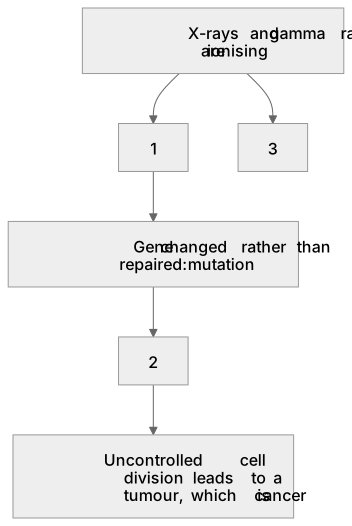
1Box 1
2Box 2
3Box 3
There is more to this lesson
The full lesson goes on to check your understanding and help you earn the marks. Create a free account to carry on, with your progress saved.
A week of Premium from your first lesson · Then the free plan continues · No card, no charge
Test your understanding of Properties of electromagnetic waves 2: X-rays and gamma rays are ionising radiation that can cause the mutation of genes and cancer.
Active recall beats re-reading. Take an instant quiz now to test what you’ve learned and lock it into long-term memory.
A week of Premium from your first lesson · Then the free plan continues · No card, no charge