AQA · GCSE · Physics
Course version: 8463 · Version from Sept 2016
(Physics only) Students should be able to show how changes in velocity,…
Full specification wording
Properties of waves: (Physics only) Students should be able to show how changes in velocity, frequency and wavelength, in transmission of sound waves from one medium to another, are inter-related.
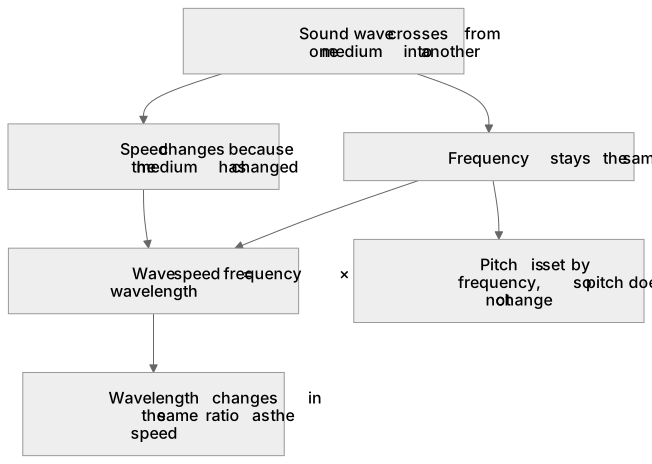
When a sound wave crosses from one medium into another, its frequency does not change, because the frequency is fixed by the source that made it.
Checked against the AQA 8463 specification (opens in a new tab) on .
- Point 6 of 7
- 4 key terms
Study notes
From the checked teaching notes for this specification point.
The idea
When a sound wave crosses from one medium into another, its frequency does not change, because the frequency is fixed by the source that made it. What changes is the speed, because the speed depends on the medium: sound travels at about 330 m/s in air, roughly 1500 m/s in water and faster still in solids, where the particles are closer together. Since wave speed = frequency × wavelength, holding the frequency fixed forces the wavelength to change in the same ratio as the speed. A 500 Hz note has a wavelength of 330 ÷ 500 = 0.66 m in air, but 1500 ÷ 500 = 3.0 m in water, over four times longer. Pitch is set by frequency, so a note played underwater sounds the same pitch to a diver even though its wavelength there is far longer.
What earns the marks
- Stating that the frequency stays the same when the sound crosses the boundary.
- Stating that the speed changes because the medium has changed.
- Using wave speed = frequency × wavelength to link the change of speed to the change of wavelength.
- A correct calculation of the new wavelength, with the unit m.
Common mistakes and how to put them right
Saying the frequency changes at the boundary and the wavelength stays the same.
Claiming sound slows down when it passes from air into water.
Pairing the speed in one medium with the wavelength in the other inside the same substitution.
Assuming the pitch of the note changes when it enters a new medium.
Exam tips
- Start these answers with 'the frequency is unchanged'; everything else follows from it.
- Set the two situations out side by side, each with its own speed and wavelength.
- State the ratio as well as the numbers, such as 'the speed is about 4.5 times greater, so the wavelength is too'.
Try the lesson
The start of the Properties of waves: (Physics only) Students should be able to show how changes in velocity, frequency and wavelength, in transmission of sound waves from one medium to another, are inter-related. lesson, made from checked teaching notes for this specification point.
Have a go first
A sound wave passes from air into water. Which property of the sound wave stays the same as it crosses the boundary?
Listen
When a sound wave crosses from one medium into another, its frequency does not change, because the frequency is fixed by the source that made it. What changes is the speed, because the speed depends on the medium: sound travels at about 330 m/s in air, roughly 1500 m/s in water and faster still in solids, where the particles are closer together. Since wave speed = frequency × wavelength, holding the frequency fixed forces the wavelength to change in the same ratio as the speed. A 500 Hz note has a wavelength of 330 ÷ 500 = 0.66 m in air, but 1500 ÷ 500 = 3.0 m in water, over four times longer. Pitch is set by frequency, so a note played underwater sounds the same pitch to a diver even though its wavelength there is far longer. A strong answer earns marks for these points. stating that the frequency stays the same when the sound crosses the boundary. stating that the speed changes because the medium has changed. using wave speed = frequency × wavelength to link the change of speed to the change of wavelength. a correct calculation of the new wavelength, with the unit m. Exam tip: Start these answers with 'the frequency is unchanged'; everything else follows from it.
See it
Key words
Say what each word means before you turn the card.
crossing a boundary
Try answering aloud or in your head before turning the card.
frequency unchanged
Try answering aloud or in your head before turning the card.
speed in different media
Try answering aloud or in your head before turning the card.
wavelength change
Try answering aloud or in your head before turning the card.
See every definition
- crossing a boundary
- When a sound wave crosses from one medium into another, its frequency does not change, because the frequency is fixed by the source that made it.
- frequency unchanged
- The frequency stays the same when the sound crosses the boundary, because it is fixed by the source that made it.
- speed in different media
- The speed changes because the medium has changed, since the speed depends on the medium.
- wavelength change
- Since wave speed = frequency × wavelength, holding the frequency fixed forces the wavelength to change in the same ratio as the speed.
Label the diagram
Some boxes have lost their names. Pick the right name for each number.
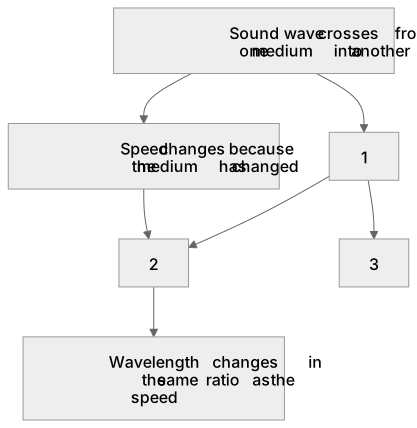
1Box 1
2Box 2
3Box 3
There is more to this lesson
The full lesson goes on to check your understanding and help you earn the marks. Create a free account to carry on, with your progress saved.
A week of Premium from your first lesson · Then the free plan continues · No card, no charge
Test your understanding of Properties of waves: (Physics only) Students should be able to show how changes in velocity, frequency and wavelength, in transmission of sound waves from one medium to another, are inter-related.
Active recall beats re-reading. Take an instant quiz now to test what you’ve learned and lock it into long-term memory.
A week of Premium from your first lesson · Then the free plan continues · No card, no charge