AQA · GCSE · Physics
Course version: 8463 · Version from Sept 2016
Period = f requency T = f period, T, in seconds, s frequency, f, in hertz,…
Full specification wording
Properties of waves: period = f requency T = f period, T, in seconds, s frequency, f, in hertz, Hz The wave speed is the speed at which the energy is transferred (or the wave moves) through the medium.
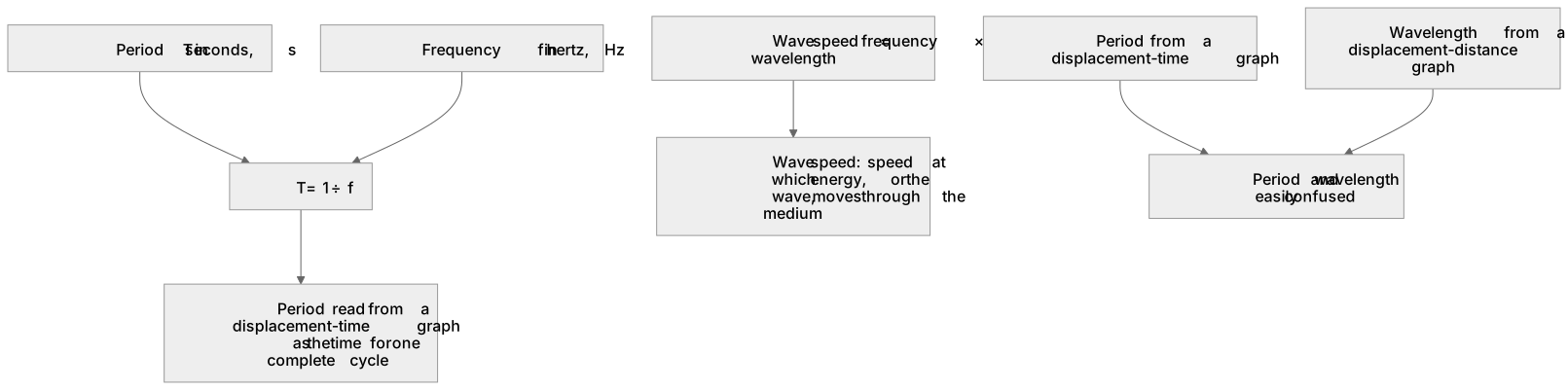
Period and frequency are reciprocals: T = 1 ÷ f, with the period in seconds and the frequency in hertz.
Checked against the AQA 8463 specification (opens in a new tab) on .
- Point 5 of 7
- 4 key terms
Study notes
From the checked teaching notes for this specification point.
The idea
Period and frequency are reciprocals: T = 1 ÷ f, with the period in seconds and the frequency in hertz. A 50 Hz wave has a period of 1 ÷ 50 = 0.02 s, and a wave with a period of 0.004 s has a frequency of 250 Hz. The period is read from a displacement-time graph as the time for one complete cycle. Wave speed is a different quantity: it is the speed at which the energy, or the wave itself, moves through the medium, measured in m/s, and it is found from wave speed = frequency × wavelength. Sound in air travels at about 330 m/s, while light travels at 3 × 10⁸ m/s. Period and wavelength are easily confused because both are read from a graph: the period comes from a displacement-time graph, the wavelength from a displacement-distance graph.
What earns the marks
- Writing period = 1 ÷ frequency.
- A correct substitution, such as T = 1 ÷ 50.
- The period given in seconds.
- Describing wave speed as the speed at which energy, or the wave, moves through the medium.
- Using wave speed = frequency × wavelength.
Common mistakes and how to put them right
Reading the printed formula as T = f and multiplying rather than taking the reciprocal.
Quoting a period in hertz or a frequency in seconds.
Using the speed of light in a calculation about a sound wave.
Dividing frequency by wavelength instead of multiplying when finding the wave speed.
Exam tips
- Write the reciprocal as a fraction on the page; it makes an inverted substitution obvious.
- Check the size of your answer: a period of many seconds implies a frequency well below 1 Hz.
- State which medium a speed applies to; wave speed changes from one medium to another.
Try the lesson
The start of the Properties of waves: period = f requency T = f period, T, in seconds, s frequency, f, in hertz, Hz The wave speed is the speed at which the energy is transferred (or the wave moves) through the medium. lesson, made from checked teaching notes for this specification point.
Have a go first
A loudspeaker produces a sound wave with a frequency of 50 Hz. What is the period of this sound wave?
Listen
Period and frequency are reciprocals: T = 1 ÷ f, with the period in seconds and the frequency in hertz. A 50 Hz wave has a period of 1 ÷ 50 = 0.02 s, and a wave with a period of 0.004 s has a frequency of 250 Hz. The period is read from a displacement-time graph as the time for one complete cycle. Wave speed is a different quantity: it is the speed at which the energy, or the wave itself, moves through the medium, measured in m/s, and it is found from wave speed = frequency × wavelength. Sound in air travels at about 330 m/s, while light travels at 3 × 10⁸ m/s. Period and wavelength are easily confused because both are read from a graph: the period comes from a displacement-time graph, the wavelength from a displacement-distance graph. A strong answer earns marks for these points. writing period = 1 ÷ frequency. a correct substitution, such as T = 1 ÷ 50. the period given in seconds. describing wave speed as the speed at which energy, or the wave, moves through the medium. Exam tip: Write the reciprocal as a fraction on the page; it makes an inverted substitution obvious.
See it
Key words
Say what each word means before you turn the card.
period
Try answering aloud or in your head before turning the card.
frequency
Try answering aloud or in your head before turning the card.
reciprocal relationship
Try answering aloud or in your head before turning the card.
wave speed
Try answering aloud or in your head before turning the card.
See every definition
- period
- The time for one complete cycle, measured in seconds, s, and read from a displacement-time graph.
- frequency
- Measured in hertz, Hz, and related to the period as its reciprocal.
- reciprocal relationship
- Period and frequency are reciprocals: T = 1 ÷ f.
- wave speed
- The speed at which the energy is transferred (or the wave moves) through the medium.
Label the diagram
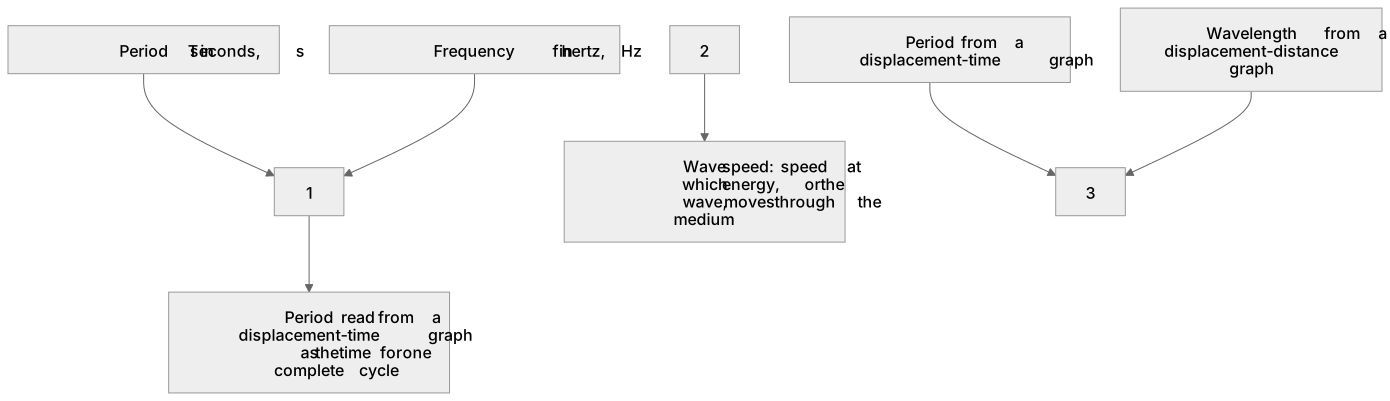
Some boxes have lost their names. Pick the right name for each number.
1Box 1
2Box 2
3Box 3
There is more to this lesson
The full lesson goes on to check your understanding and help you earn the marks. Create a free account to carry on, with your progress saved.
A week of Premium from your first lesson · Then the free plan continues · No card, no charge
Test your understanding of Properties of waves: period = f requency T = f period, T, in seconds, s frequency, f, in hertz, Hz The wave speed is the speed at which the energy is transferred (or the wave moves) through the medium.
Active recall beats re-reading. Take an instant quiz now to test what you’ve learned and lock it into long-term memory.
A week of Premium from your first lesson · Then the free plan continues · No card, no charge