AQA · GCSE · Physics
Course version: 8463 · Version from Sept 2016
Students should understand that it is important for the findings of…
Full specification wording
Radioactive contamination: Students should understand that it is important for the findings of studies into the effects of radiation on humans to be published and shared with other scientists so that the findings can be checked by peer review.
Findings about how radiation affects people carry real consequences, so they are published rather than kept in-house.
Checked against the AQA 8463 specification (opens in a new tab) on .
- Point 8 of 8
- 4 key terms
Study notes
From the checked teaching notes for this specification point.
The idea
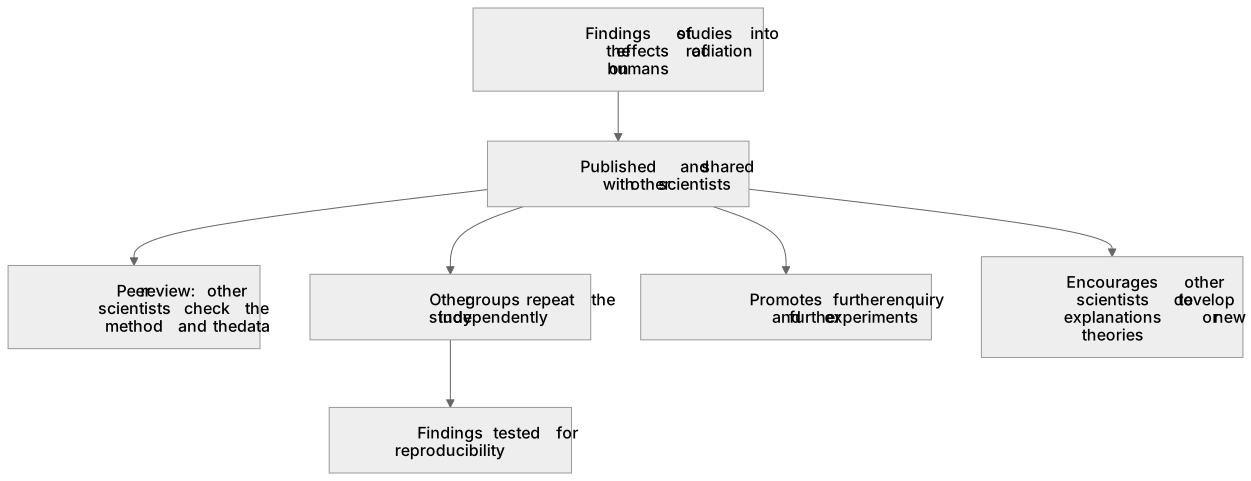
Findings about how radiation affects people carry real consequences, so they are published rather than kept in-house. Publication lets other scientists peer review the work: they read the method and the data, look for flaws in the design and check whether the conclusions genuinely follow from the results. It also lets other groups repeat the study independently, which tests whether the findings are reproducible rather than a product of one team's equipment, sample or bias. A single result that nobody can reproduce is not treated as established. Publication also promotes further enquiry, prompting new experiments and new explanations. This is how a claim that challenges accepted theory gets tested rather than simply accepted or dismissed.
What earns the marks
- Publication allowing peer review of the data and method by other scientists.
- Allowing other scientists to repeat the work and assess the reproducibility of the data.
- Promoting further enquiry or further experiments.
- Encouraging other scientists to develop explanations or new theories for the findings.
Common mistakes and how to put them right
Writing 'so everyone knows about it' without naming any checking process.
Saying peer review proves the results are correct rather than checking them.
Confusing peer review with repeating a reading yourself to calculate a mean.
Claiming that once published a finding cannot be challenged.
Arguing the scientists should withhold unexplained results until they can explain them.
Exam tips
- Give two distinct reasons when two are asked for; 'checked by others' and 'repeated by others' count as one idea if not clearly separated.
- Use the term 'peer review' explicitly, since it is the phrase the mark scheme rewards.
- Keep the answer about the process of science, not about the dangers of radiation, even though radiation is the topic.
Try the lesson
The start of the Radioactive contamination: Students should understand that it is important for the findings of studies into the effects of radiation on humans to be published and shared with other scientists so that the findings can be checked by peer review. lesson, made from checked teaching notes for this specification point.
Have a go first
Why is it important that scientists publish their findings about the effects of radiation on humans?
Listen
Findings about how radiation affects people carry real consequences, so they are published rather than kept in-house. Publication lets other scientists peer review the work: they read the method and the data, look for flaws in the design and check whether the conclusions genuinely follow from the results. It also lets other groups repeat the study independently, which tests whether the findings are reproducible rather than a product of one team's equipment, sample or bias. A single result that nobody can reproduce is not treated as established. Publication also promotes further enquiry, prompting new experiments and new explanations. This is how a claim that challenges accepted theory gets tested rather than simply accepted or dismissed. A strong answer earns marks for these points. publication allowing peer review of the data and method by other scientists. allowing other scientists to repeat the work and assess the reproducibility of the data. promoting further enquiry or further experiments. encouraging other scientists to develop explanations or new theories for the findings. Exam tip: Give two distinct reasons when two are asked for; 'checked by others' and 'repeated by others' count as one idea if not clearly separated.
See it
Key words
Say what each word means before you turn the card.
peer review
Try answering aloud or in your head before turning the card.
reproducibility
Try answering aloud or in your head before turning the card.
further enquiry
Try answering aloud or in your head before turning the card.
publishing unexpected results
Try answering aloud or in your head before turning the card.
See every definition
- peer review
- Other scientists read the method and the data, look for flaws in the design and check whether the conclusions genuinely follow from the results.
- reproducibility
- Other groups repeat the study independently, which tests whether the findings are reproducible rather than a product of one team's equipment, sample or bias.
- further enquiry
- Publication promotes further enquiry, prompting new experiments and new explanations.
- publishing unexpected results
- Findings are published rather than kept in-house, so that a claim that challenges accepted theory gets tested rather than simply accepted or dismissed.
Label the diagram
Some boxes have lost their names. Pick the right name for each number.
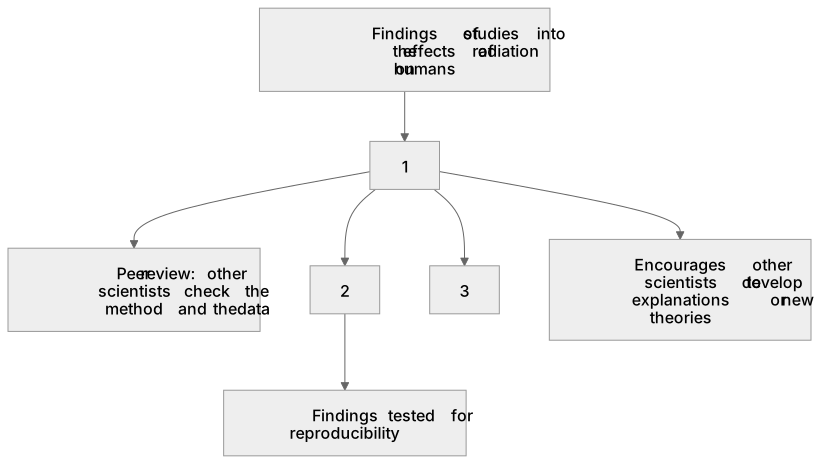
1Box 1
2Box 2
3Box 3
There is more to this lesson
The full lesson goes on to check your understanding and help you earn the marks. Create a free account to carry on, with your progress saved.
A week of Premium from your first lesson · Then the free plan continues · No card, no charge
Test your understanding of Radioactive contamination: Students should understand that it is important for the findings of studies into the effects of radiation on humans to be published and shared with other scientists so that the findings can be checked by peer review.
Active recall beats re-reading. Take an instant quiz now to test what you’ve learned and lock it into long-term memory.
A week of Premium from your first lesson · Then the free plan continues · No card, no charge