AQA · GCSE · Physics
Course version: 8463 · Version from Sept 2016
(HT only) A single force can be resolved into two components acting at…
Full specification wording
Resultant forces: (HT only) A single force can be resolved into two components acting at right angles to each other.
Higher tier only.
Checked against the AQA 8463 specification (opens in a new tab) on .
- Point 5 of 7
- 4 key terms
Study notes
From the checked teaching notes for this specification point.
The idea
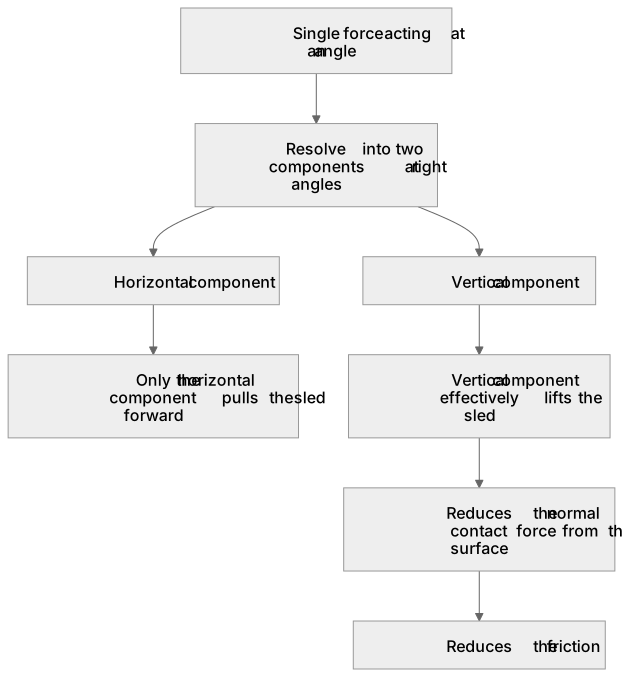
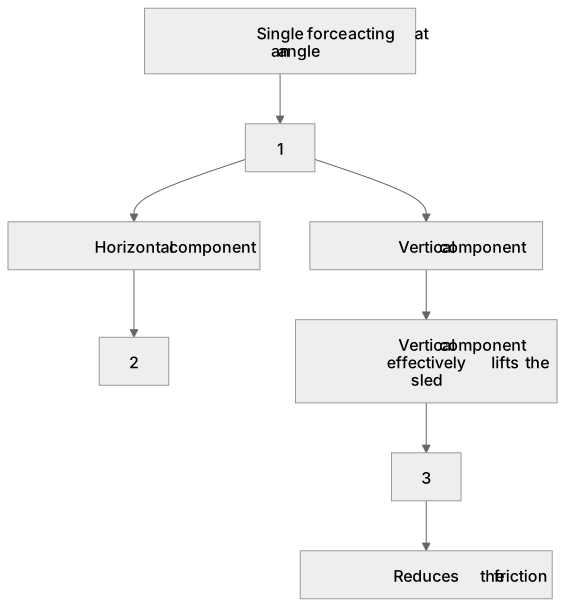
Higher tier only. A single force acting at an angle can be replaced by two components at right angles to each other, usually one horizontal and one vertical. Draw the force as the diagonal of a rectangle whose sides run along the two chosen directions, and the two sides are the components. Each component is smaller than the original force. Resolving explains real situations: a sled pulled by a rope at an angle is only driven forward by the horizontal component of the pull, while the vertical component effectively lifts the sled and so reduces the normal contact force from the surface, which in turn reduces the friction. On a scale drawing, the components are measured from the rectangle using the stated scale.
What earns the marks
- Splitting the single force into two components at right angles to each other.
- Identifying which component does the useful job, such as only the horizontal component pulling the sled forward.
- The effect of the other component, such as the vertical component effectively lifting the sled.
- The consequence of that, a reduction in the force of the surface on the object.
- A scale drawing in which the two components form the sides of a rectangle with the original force as its diagonal.
Common mistakes and how to put them right
Halving the force to get each component.
Drawing two components that are not at right angles to each other.
Making a component longer than the original force.
Forgetting that the vertical component changes the normal contact force and therefore the friction.
Resolving along directions that do not match the ones the question is interested in.
Exam tips
- Choose your two directions to match the question, usually along the motion and at right angles to it.
- Sketch the rectangle even when you only need one component; it keeps the geometry honest.
- Say what each component physically does, because the marks are for the consequences, not the drawing alone.
Try the lesson
The start of the Resultant forces: (HT only) A single force can be resolved into two components acting at right angles to each other. lesson, made from checked teaching notes for this specification point.
Have a go first
A student uses a scale drawing to resolve a single diagonal force of 50 N into horizontal and vertical components. Which statement correctly describes these components?
Listen
Higher tier only. A single force acting at an angle can be replaced by two components at right angles to each other, usually one horizontal and one vertical. Draw the force as the diagonal of a rectangle whose sides run along the two chosen directions, and the two sides are the components. Each component is smaller than the original force. Resolving explains real situations: a sled pulled by a rope at an angle is only driven forward by the horizontal component of the pull, while the vertical component effectively lifts the sled and so reduces the normal contact force from the surface, which in turn reduces the friction. On a scale drawing, the components are measured from the rectangle using the stated scale. A strong answer earns marks for these points. splitting the single force into two components at right angles to each other. identifying which component does the useful job, such as only the horizontal component pulling the sled forward. the effect of the other component, such as the vertical component effectively lifting the sled. the consequence of that, a reduction in the force of the surface on the object. Exam tip: Choose your two directions to match the question, usually along the motion and at right angles to it.
See it
Key words
Say what each word means before you turn the card.
resolving a force
Try answering aloud or in your head before turning the card.
perpendicular components
Try answering aloud or in your head before turning the card.
horizontal and vertical
Try answering aloud or in your head before turning the card.
effect on normal contact force
Try answering aloud or in your head before turning the card.
See every definition
- resolving a force
- Splitting a single force into two components acting at right angles to each other.
- perpendicular components
- Two components at right angles to each other that replace a single force acting at an angle.
- horizontal and vertical
- The two directions usually chosen for the components, with the force drawn as the diagonal of a rectangle whose sides run along them.
- effect on normal contact force
- The vertical component effectively lifts the sled and so reduces the normal contact force from the surface, which in turn reduces the friction.
Label the diagram
Some boxes have lost their names. Pick the right name for each number.
1Box 1
2Box 2
3Box 3
There is more to this lesson
The full lesson goes on to check your understanding and help you earn the marks. Create a free account to carry on, with your progress saved.
A week of Premium from your first lesson · Then the free plan continues · No card, no charge
Test your understanding of Resultant forces: (HT only) A single force can be resolved into two components acting at right angles to each other.
Active recall beats re-reading. Take an instant quiz now to test what you’ve learned and lock it into long-term memory.
A week of Premium from your first lesson · Then the free plan continues · No card, no charge