AQA · GCSE · Physics
Course version: 8463 · Version from Sept 2016
The two component forces together have the same effect as the single force.
Full specification wording
Resultant forces: The two component forces together have the same effect as the single force.
The two components are not an approximation: together they have exactly the same effect on the object as the single force they came from.
Checked against the AQA 8463 specification (opens in a new tab) on .
- Point 6 of 7
- 4 key terms
Study notes
From the checked teaching notes for this specification point.
The idea
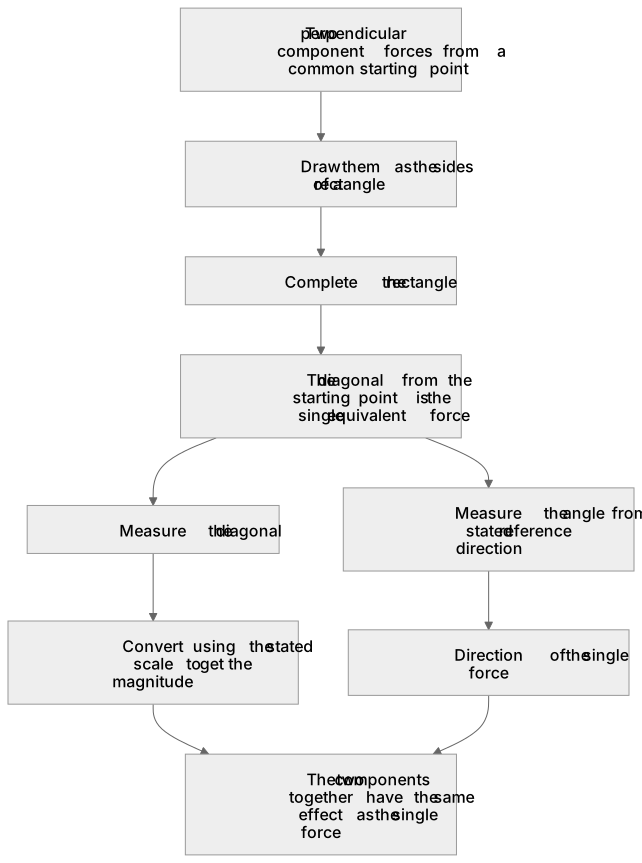
The two components are not an approximation: together they have exactly the same effect on the object as the single force they came from. That is why you may replace a force by its components, work with them separately, and still be describing the same physics. It also works in reverse. Given two perpendicular forces, draw them as the sides of a rectangle from a common starting point, complete the rectangle, and the diagonal from that point is the single force equivalent to both. Measure the diagonal and convert it with the stated scale to get the magnitude, then measure the angle from a stated reference direction to get the direction. The components can never simply be added as numbers.
What earns the marks
- Stating that the two perpendicular components together have the same effect as the original single force.
- Constructing the original force as the diagonal of the rectangle drawn on the two components.
- Measuring that diagonal and converting it to a force using the stated scale.
- Giving the direction as an angle measured from a stated reference line.
Common mistakes and how to put them right
Adding the two component magnitudes arithmetically to get the original force.
Drawing the single force as one side of the rectangle rather than as the diagonal.
Omitting the angle, so the answer is not a complete vector.
Measuring the diagonal but forgetting to apply the scale.
Measuring the angle from an unstated or inconsistent reference direction.
Exam tips
- Say which direction your angle is measured from, for example 'above the horizontal', or the direction mark cannot be awarded.
- Use a set square or the corner of a ruler to keep the rectangle's angles at 90 degrees.
- Check that your diagonal is longer than either side; if it is not, the drawing is wrong.
Try the lesson
The start of the Resultant forces: The two component forces together have the same effect as the single force. lesson, made from checked teaching notes for this specification point.
Have a go first
A single force of 100 N acts on a box. It is resolved into a horizontal component of 80 N and a vertical component of 60 N. What is the resultant of these two component forces?
Listen
The two components are not an approximation: together they have exactly the same effect on the object as the single force they came from. That is why you may replace a force by its components, work with them separately, and still be describing the same physics. It also works in reverse. Given two perpendicular forces, draw them as the sides of a rectangle from a common starting point, complete the rectangle, and the diagonal from that point is the single force equivalent to both. Measure the diagonal and convert it with the stated scale to get the magnitude, then measure the angle from a stated reference direction to get the direction. The components can never simply be added as numbers. A strong answer earns marks for these points. stating that the two perpendicular components together have the same effect as the original single force. constructing the original force as the diagonal of the rectangle drawn on the two components. measuring that diagonal and converting it to a force using the stated scale. giving the direction as an angle measured from a stated reference line. Exam tip: Say which direction your angle is measured from, for example 'above the horizontal', or the direction mark cannot be awarded.
See it
Key words
Say what each word means before you turn the card.
components equivalent to the force
Try answering aloud or in your head before turning the card.
rectangle construction
Try answering aloud or in your head before turning the card.
diagonal is the resultant
Try answering aloud or in your head before turning the card.
scale conversion
Try answering aloud or in your head before turning the card.
See every definition
- components equivalent to the force
- The two component forces together have the same effect as the single force.
- rectangle construction
- Given two perpendicular forces, draw them as the sides of a rectangle from a common starting point and complete the rectangle.
- diagonal is the resultant
- The diagonal from that point is the single force equivalent to both.
- scale conversion
- Measure the diagonal and convert it with the stated scale to get the magnitude.
Label the diagram
Some boxes have lost their names. Pick the right name for each number.
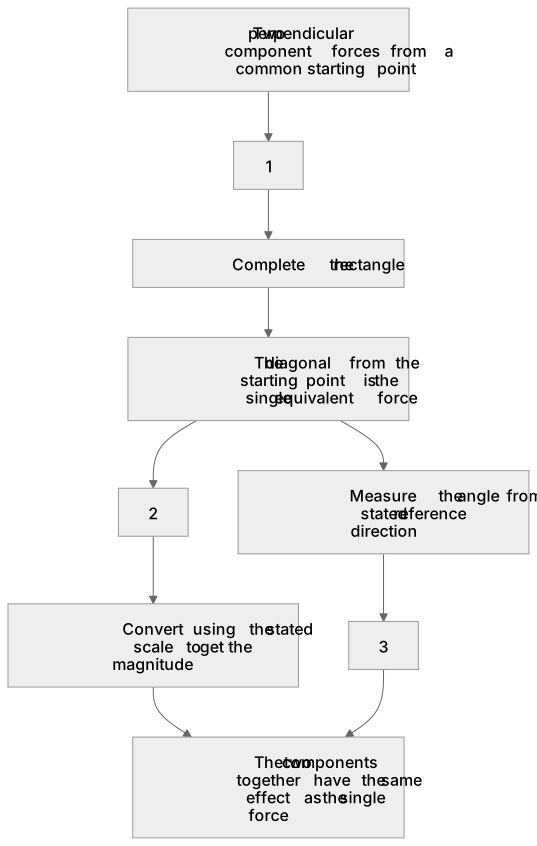
1Box 1
2Box 2
3Box 3
There is more to this lesson
The full lesson goes on to check your understanding and help you earn the marks. Create a free account to carry on, with your progress saved.
A week of Premium from your first lesson · Then the free plan continues · No card, no charge
Test your understanding of Resultant forces: The two component forces together have the same effect as the single force.
Active recall beats re-reading. Take an instant quiz now to test what you’ve learned and lock it into long-term memory.
A week of Premium from your first lesson · Then the free plan continues · No card, no charge