AQA · GCSE · Physics
Course version: 8463 · Version from Sept 2016
Students should be able to calculate the resultant of two forces that act…
Full specification wording
Resultant forces: Students should be able to calculate the resultant of two forces that act in a straight line.
For two forces on the same straight line, the resultant is found by simple addition and subtraction once you have fixed a positive direction.
Checked against the AQA 8463 specification (opens in a new tab) on .
- Point 3 of 7
- 2 key terms
Study notes
From the checked teaching notes for this specification point.
The idea
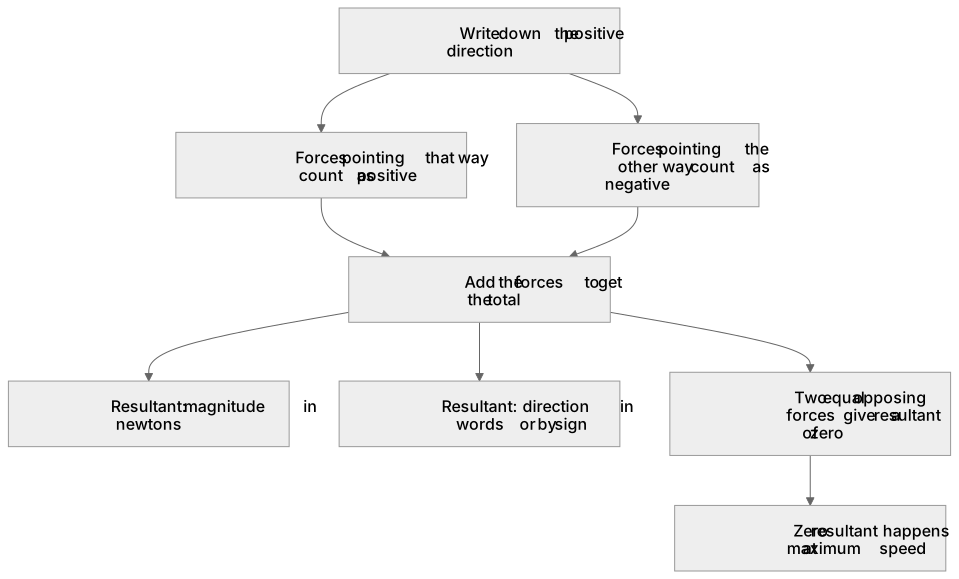
For two forces on the same straight line, the resultant is found by simple addition and subtraction once you have fixed a positive direction. Start by writing down which way you are calling positive. Forces pointing that way count as positive, forces the other way as negative, and the resultant is the total. A car with a 4200 N driving force and 3000 N of drag has a resultant of 1200 N forwards. Two equal opposing forces give a resultant of zero, which is what happens once a car reaches maximum speed, when the driving force and the resistive forces are equal. Always finish with both the magnitude in newtons and the direction, because force is a vector.
What earns the marks
- The correct subtraction of the opposing force, such as 4200 - 3000.
- Adding forces acting the same way and subtracting the one acting the opposite way.
- The magnitude of the resultant in newtons.
- The direction of the resultant, named in words or shown by the sign.
Common mistakes and how to put them right
Always subtracting the two forces regardless of which way they point.
Giving a size with no direction.
Adding a 400 N driving force and 400 N of drag to get 800 N instead of zero.
Forgetting that the resultant is zero when the object moves at a constant speed.
Changing the positive direction between two parts of the same question.
Exam tips
- Write the positive direction at the top of your working; it costs one line and prevents sign errors.
- If the object is at constant speed, you already know the resultant is zero, which can give you the missing force.
- State the direction in words, such as 'forwards' or 'to the left', rather than relying on a minus sign alone.
Try the lesson
The start of the Resultant forces: Students should be able to calculate the resultant of two forces that act in a straight line. lesson, made from checked teaching notes for this specification point.
Have a go first
A box is pushed to the right with a force of 30 N. A friction force of 12 N acts to the left. What is the resultant force on the box?
Listen
For two forces on the same straight line, the resultant is found by simple addition and subtraction once you have fixed a positive direction. Start by writing down which way you are calling positive. Forces pointing that way count as positive, forces the other way as negative, and the resultant is the total. A car with a 4200 N driving force and 3000 N of drag has a resultant of 1200 N forwards. Two equal opposing forces give a resultant of zero, which is what happens once a car reaches maximum speed, when the driving force and the resistive forces are equal. Always finish with both the magnitude in newtons and the direction, because force is a vector. A strong answer earns marks for these points. the correct subtraction of the opposing force, such as 4200 - 3000. adding forces acting the same way and subtracting the one acting the opposite way. the magnitude of the resultant in newtons. the direction of the resultant, named in words or shown by the sign. Exam tip: Write the positive direction at the top of your working; it costs one line and prevents sign errors.
See it
Key words
Say what each word means before you turn the card.
positive direction
Try answering aloud or in your head before turning the card.
adding and subtracting forces
Try answering aloud or in your head before turning the card.
See every definition
- positive direction
- The way you decide to call positive before calculating, so forces pointing that way count as positive and forces the other way as negative.
- adding and subtracting forces
- The simple method of finding the resultant of two forces on the same straight line once a positive direction is fixed.
Label the diagram
Some boxes have lost their names. Pick the right name for each number.
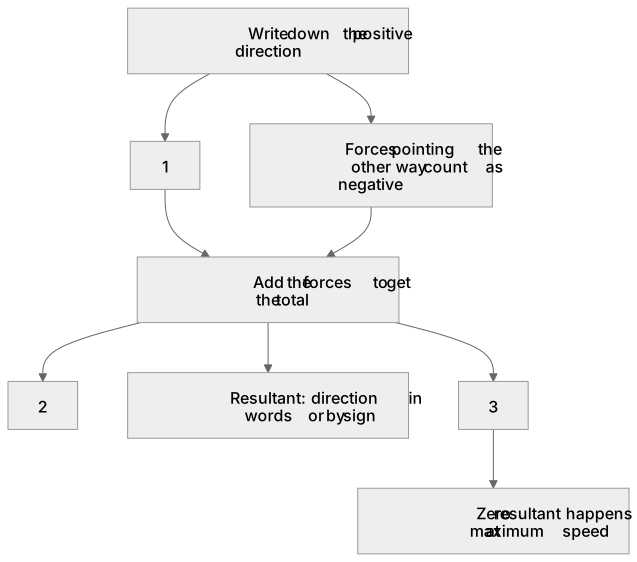
1Box 1
2Box 2
3Box 3
There is more to this lesson
The full lesson goes on to check your understanding and help you earn the marks. Create a free account to carry on, with your progress saved.
A week of Premium from your first lesson · Then the free plan continues · No card, no charge
Test your understanding of Resultant forces: Students should be able to calculate the resultant of two forces that act in a straight line.
Active recall beats re-reading. Take an instant quiz now to test what you’ve learned and lock it into long-term memory.
A week of Premium from your first lesson · Then the free plan continues · No card, no charge