AQA · GCSE · Physics
Course version: 8463 · Version from Sept 2016
Resultant forces: This single force is called the resultant force.
The single force that has the same effect as all the forces acting on an object is called the resultant force.
Checked against the AQA 8463 specification (opens in a new tab) on .
- Point 2 of 7
Study notes
From the checked teaching notes for this specification point.
The idea
The single force that has the same effect as all the forces acting on an object is called the resultant force. Its size and its direction together decide what the object does. If the resultant force is zero the object either stays at rest or carries on at constant velocity; that is the case for a hailstone at terminal velocity, where air resistance has grown until it equals the weight. If the resultant force is not zero the object accelerates in the direction of that resultant, which is why a hailstone accelerates at the start of its fall, when its weight is greater than the air resistance. Because the resultant is a vector, an answer is only complete when it gives both a size in newtons and a direction.
What earns the marks
- Naming the single equivalent force the resultant force.
- A resultant force of zero meaning the object stays at rest or moves at constant velocity.
- A non-zero resultant force meaning the object accelerates in the direction of the resultant.
- Applying this, such as a hailstone accelerating because there is a resultant force, its weight being greater than the air resistance.
Common mistakes and how to put them right
Giving the name 'resultant force' when the question asks for its size and direction.
Saying a resultant force of zero means no forces act on the object.
Claiming an object at terminal velocity has stopped moving.
Assuming the resultant force always points in the direction the object is travelling.
Treating the resultant force as a separate physical force pushing the object in addition to the real ones.
Exam tips
- For 'why does it accelerate', the one-mark answer is that there is a resultant force acting; adding which force is larger makes it safe.
- Use 'constant velocity' rather than 'not moving' when the resultant is zero, since both cases are allowed.
- Quote a direction with every resultant, even when the arithmetic feels obvious.
Try the lesson
The start of the Resultant forces: This single force is called the resultant force. lesson, made from checked teaching notes for this specification point.
Have a go first
A number of forces act on a shopping trolley. The single force that has the same effect as all of these forces acting together is given a special name. What is this single force called?
Listen
The single force that has the same effect as all the forces acting on an object is called the resultant force. Its size and its direction together decide what the object does. If the resultant force is zero the object either stays at rest or carries on at constant velocity; that is the case for a hailstone at terminal velocity, where air resistance has grown until it equals the weight. If the resultant force is not zero the object accelerates in the direction of that resultant, which is why a hailstone accelerates at the start of its fall, when its weight is greater than the air resistance. Because the resultant is a vector, an answer is only complete when it gives both a size in newtons and a direction. A strong answer earns marks for these points. naming the single equivalent force the resultant force. a resultant force of zero meaning the object stays at rest or moves at constant velocity. a non-zero resultant force meaning the object accelerates in the direction of the resultant. applying this, such as a hailstone accelerating because there is a resultant force, its weight being greater than the air resistance. Exam tip: For 'why does it accelerate', the one-mark answer is that there is a resultant force acting; adding which force is larger makes it safe.
See it
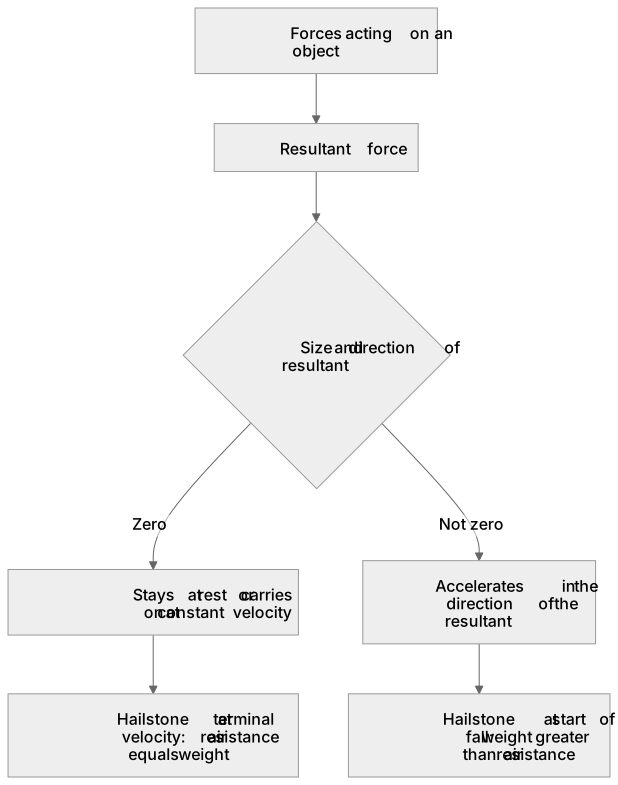
Label the diagram
Some boxes have lost their names. Pick the right name for each number.
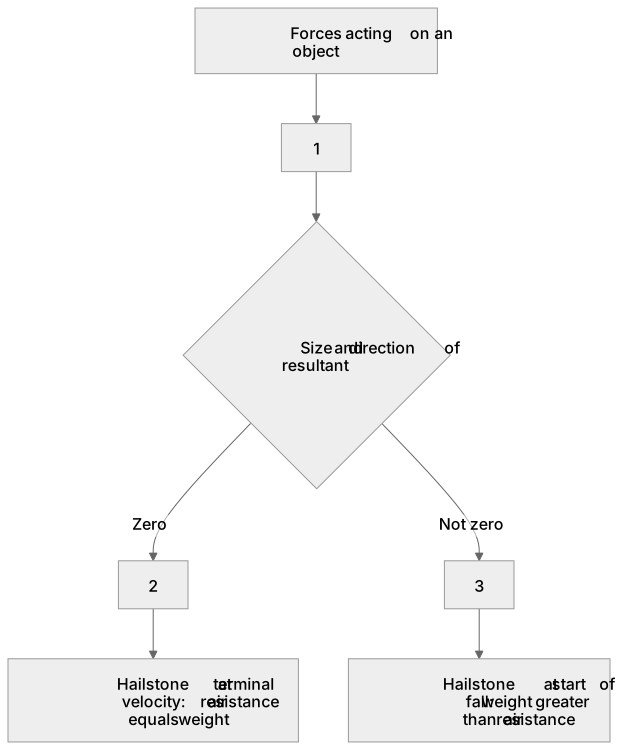
1Box 1
2Box 2
3Box 3
There is more to this lesson
The full lesson goes on to check your understanding and help you earn the marks. Create a free account to carry on, with your progress saved.
A week of Premium from your first lesson · Then the free plan continues · No card, no charge
Test your understanding of Resultant forces: This single force is called the resultant force.
Active recall beats re-reading. Take an instant quiz now to test what you’ve learned and lock it into long-term memory.
A week of Premium from your first lesson · Then the free plan continues · No card, no charge