AQA · GCSE · Physics
Course version: 8463 · Version from Sept 2016
Scalar and vector quantities: Scalar quantities have magnitude only.
A scalar quantity is completely described by a number and a unit, its magnitude, with no direction attached.
Checked against the AQA 8463 specification (opens in a new tab) on .
- Point 1 of 4
- 4 key terms
Study notes
From the checked teaching notes for this specification point.
The idea
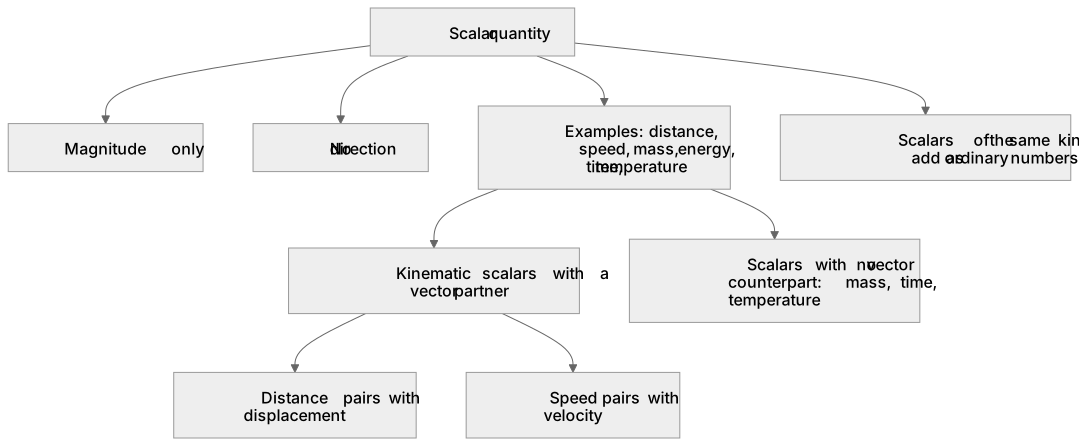
A scalar quantity is completely described by a number and a unit, its magnitude, with no direction attached. Distance, speed, mass, energy, time and temperature are all scalars. Because there is no direction, scalars of the same kind add as ordinary numbers, so walking 3 km then 4 km always totals 7 km of distance however the route bends. Some kinematic scalars have a vector partner that does carry direction: distance pairs with displacement, and speed with velocity. However, scalars like mass, time, and temperature have no vector counterpart. This distinction is often examined when comparing a winding route between two towns to a straight line.
What earns the marks
- Defining a scalar as having magnitude only, with no direction.
- A correct example, such as distance, speed, mass, energy or temperature.
- Stating that scalars of the same type add as ordinary numbers.
- Correctly pairing a kinematic scalar with its vector partner, such as distance with displacement.
Common mistakes and how to put them right
Calling weight a scalar, when it is a force and therefore a vector.
Claiming every scalar has a vector partner, forgetting that mass, time, and temperature do not.
Listing velocity, force or acceleration among the scalars.
Exam tips
- Learn the specific scalar-vector pairs like distance with displacement and speed with velocity, as these are examined most.
- Use the exact phrase 'magnitude only', which is the wording the mark scheme accepts.
Try the lesson
The start of the Scalar and vector quantities: Scalar quantities have magnitude only. lesson, made from checked teaching notes for this specification point.
Have a go first
Which of these quantities is a scalar quantity because it has magnitude only?
Listen
A scalar quantity is completely described by a number and a unit, its magnitude, with no direction attached. Distance, speed, mass, energy, time and temperature are all scalars. Because there is no direction, scalars of the same kind add as ordinary numbers, so walking 3 km then 4 km always totals 7 km of distance however the route bends. Some kinematic scalars have a vector partner that does carry direction: distance pairs with displacement, and speed with velocity. However, scalars like mass, time, and temperature have no vector counterpart. This distinction is often examined when comparing a winding route between two towns to a straight line. A strong answer earns marks for these points. defining a scalar as having magnitude only, with no direction. a correct example, such as distance, speed, mass, energy or temperature. stating that scalars of the same type add as ordinary numbers. correctly pairing a kinematic scalar with its vector partner, such as distance with displacement. Exam tip: Learn the specific scalar-vector pairs like distance with displacement and speed with velocity, as these are examined most.
See it
Key words
Say what each word means before you turn the card.
scalar quantity
Try answering aloud or in your head before turning the card.
magnitude only
Try answering aloud or in your head before turning the card.
distance and displacement
Try answering aloud or in your head before turning the card.
adding scalars
Try answering aloud or in your head before turning the card.
See every definition
- scalar quantity
- A quantity that is completely described by a number and a unit, its magnitude, with no direction attached.
- magnitude only
- Having a number and a unit with no direction attached, which is how a scalar quantity is completely described.
- distance and displacement
- A kinematic scalar paired with the vector partner that does carry direction.
- adding scalars
- Scalars of the same kind add as ordinary numbers, so walking 3 km then 4 km always totals 7 km of distance however the route bends.
Label the diagram
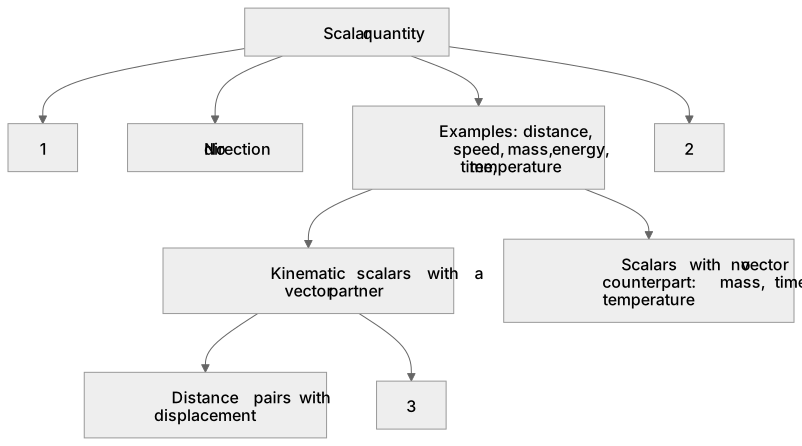
Some boxes have lost their names. Pick the right name for each number.
1Box 1
2Box 2
3Box 3
There is more to this lesson
The full lesson goes on to check your understanding and help you earn the marks. Create a free account to carry on, with your progress saved.
A week of Premium from your first lesson · Then the free plan continues · No card, no charge
Test your understanding of Scalar and vector quantities: Scalar quantities have magnitude only.
Active recall beats re-reading. Take an instant quiz now to test what you’ve learned and lock it into long-term memory.
A week of Premium from your first lesson · Then the free plan continues · No card, no charge