AQA · GCSE · Physics
Course version: 8463 · Version from Sept 2016
Sound waves can travel through solids causing vibrations in the solid.
Full specification wording
Sound waves (physics only) (HT only): Sound waves can travel through solids causing vibrations in the solid.
This is Higher tier physics only.
Checked against the AQA 8463 specification (opens in a new tab) on .
- Point 1 of 6
Study notes
From the checked teaching notes for this specification point.
The idea
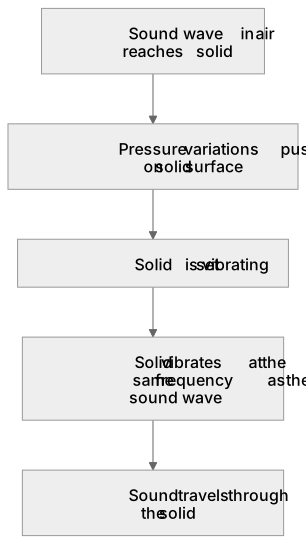
This is Higher tier physics only. Sound is a longitudinal mechanical wave: particles of the medium oscillate parallel to the direction of energy transfer, producing compressions and rarefactions. Because the disturbance is passed on by particle collisions, sound needs a medium and cannot travel through a vacuum. When a sound wave in air reaches a solid, pressure variations push on the surface and set the solid vibrating at the same frequency, converting the wave into vibrations of the solid. Sound travels faster in a solid than in air (roughly 330 m/s in air but several thousand m/s in steel) because particles are close together and strongly bonded. This mechanism allows sound to travel through a solid wall or a string telephone.
What earns the marks
- Stating that sound waves can cause a solid to vibrate when they strike it.
- Explaining that pressure variations in the air push on the solid surface.
- Stating that the solid vibrates at the same frequency as the sound wave.
- Explaining that sound travels faster in solids because particles are closer together and strongly bonded.
Common mistakes and how to put them right
Describing sound as transverse, or saying the particles travel along with the wave rather than oscillating about a fixed position.
Claiming sound can travel through a vacuum because light can.
Confusing the speed of the sound wave with the speed of the vibrating particles.
Exam tips
- In a compare question, pair each point: sound is mechanical and needs a medium whereas light is electromagnetic and does not.
- Use oscillations parallel to the direction of energy transfer as your definition of longitudinal; wave travel is accepted for energy transfer.
Try the lesson
The start of the Sound waves (physics only) (HT only): Sound waves can travel through solids causing vibrations in the solid. lesson, made from checked teaching notes for this specification point.
Have a go first
A student holds a vibrating tuning fork against a wooden desk. Sound is heard clearly through the desk. What happens in the wood as the sound wave travels through it?
Listen
This is Higher tier physics only. Sound is a longitudinal mechanical wave: particles of the medium oscillate parallel to the direction of energy transfer, producing compressions and rarefactions. Because the disturbance is passed on by particle collisions, sound needs a medium and cannot travel through a vacuum. When a sound wave in air reaches a solid, pressure variations push on the surface and set the solid vibrating at the same frequency, converting the wave into vibrations of the solid. Sound travels faster in a solid than in air (roughly 330 m/s in air but several thousand m/s in steel) because particles are close together and strongly bonded. This mechanism allows sound to travel through a solid wall or a string telephone. A strong answer earns marks for these points. stating that sound waves can cause a solid to vibrate when they strike it. explaining that pressure variations in the air push on the solid surface. stating that the solid vibrates at the same frequency as the sound wave. explaining that sound travels faster in solids because particles are closer together and strongly bonded. Exam tip: In a compare question, pair each point: sound is mechanical and needs a medium whereas light is electromagnetic and does not.
See it
Put it in order
Put these steps in the order they happen.
- 1. Pressure variations push on solid surface
- 2. Solid is set vibrating
- 3. Sound wave in air reaches solid
- 4. Sound travels through the solid
- 5. Solid vibrates at the same frequency as the sound wave
Label the diagram
Some boxes have lost their names. Pick the right name for each number.
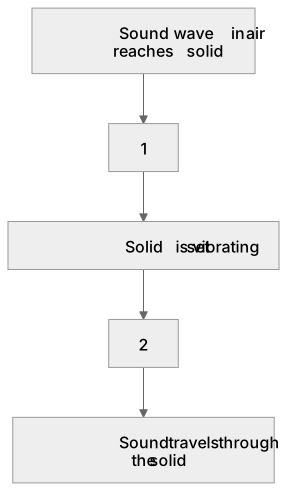
1Box 1
2Box 2
There is more to this lesson
The full lesson goes on to check your understanding and help you earn the marks. Create a free account to carry on, with your progress saved.
A week of Premium from your first lesson · Then the free plan continues · No card, no charge
Test your understanding of Sound waves (physics only) (HT only): Sound waves can travel through solids causing vibrations in the solid.
Active recall beats re-reading. Take an instant quiz now to test what you’ve learned and lock it into long-term memory.
A week of Premium from your first lesson · Then the free plan continues · No card, no charge