AQA · GCSE · Physics
Course version: 8463 · Version from Sept 2016
Within the ear, sound waves cause the ear drum and other parts to vibrate…
Full specification wording
Sound waves (physics only) (HT only): Within the ear, sound waves cause the ear drum and other parts to vibrate which causes the sensation of sound.
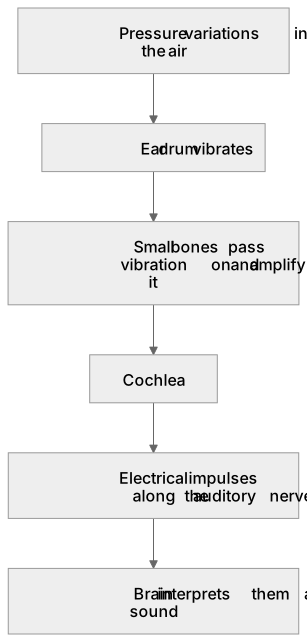
The ear is a converter: it turns pressure variations in air into vibrations of solids and then into nerve impulses.
Checked against the AQA 8463 specification (opens in a new tab) on .
- Point 2 of 6
- 4 key terms
Study notes
From the checked teaching notes for this specification point.
The idea
The ear is a converter: it turns pressure variations in air into vibrations of solids and then into nerve impulses. A sound wave travelling down the ear canal makes the air pressure at the ear drum rise and fall, so the drum, a thin stretched membrane, is pushed in and out at the frequency of the wave. The drum is joined to three small bones, the ossicles, which pass the vibration on and amplify it before it reaches the fluid filled cochlea. Hair cells in the cochlea respond to those vibrations and send electrical impulses along the auditory nerve, and the brain interprets them as sound. The sensation of sound is produced in the brain, not in the ear itself. A larger amplitude gives a louder sound; a higher frequency gives a higher pitch.
What earns the marks
- Saying that pressure variations in the air make the ear drum vibrate.
- Stating that the vibration is passed on by the small bones to the cochlea.
- Saying that the vibration is converted into electrical impulses sent to the brain.
- Stating that the ear drum vibrates at the same frequency as the sound wave.
Common mistakes and how to put them right
Saying the ear drum hears the sound, when the sensation is produced by the brain.
Describing the sound wave itself travelling into the cochlea, rather than being converted into vibrations of solids and fluid.
Confusing amplitude with frequency, so linking loudness to pitch.
Stating that air particles travel from the source all the way into the ear canal.
Exam tips
- Answer as a chain: air pressure variation, ear drum, small bones, cochlea, nerve impulse, brain.
- Keep the word vibrate for the solid parts and pressure variation for the air, so the conversion is clear.
- If the command word is explain, every link in the chain needs a reason, not just a name.
Try the lesson
The start of the Sound waves (physics only) (HT only): Within the ear, sound waves cause the ear drum and other parts to vibrate which causes the sensation of sound. lesson, made from checked teaching notes for this specification point.
Have a go first
A sound wave travelling through the air reaches a person's ear. Which part of the ear does the sound wave make vibrate first?
Listen
The ear is a converter: it turns pressure variations in air into vibrations of solids and then into nerve impulses. A sound wave travelling down the ear canal makes the air pressure at the ear drum rise and fall, so the drum, a thin stretched membrane, is pushed in and out at the frequency of the wave. The drum is joined to three small bones, the ossicles, which pass the vibration on and amplify it before it reaches the fluid filled cochlea. Hair cells in the cochlea respond to those vibrations and send electrical impulses along the auditory nerve, and the brain interprets them as sound. The sensation of sound is produced in the brain, not in the ear itself. A larger amplitude gives a louder sound; a higher frequency gives a higher pitch. A strong answer earns marks for these points. saying that pressure variations in the air make the ear drum vibrate. stating that the vibration is passed on by the small bones to the cochlea. saying that the vibration is converted into electrical impulses sent to the brain. stating that the ear drum vibrates at the same frequency as the sound wave. Exam tip: Answer as a chain: air pressure variation, ear drum, small bones, cochlea, nerve impulse, brain.
See it
Put it in order
Put these steps in the order they happen.
- 1. Small bones pass vibration on and amplify it
- 2. Ear drum vibrates
- 3. Pressure variations in the air
- 4. Brain interprets them as sound
- 5. Electrical impulses along the auditory nerve
- 6. Cochlea
Key words
Say what each word means before you turn the card.
ear drum
Try answering aloud or in your head before turning the card.
ossicles
Try answering aloud or in your head before turning the card.
nerve impulses
Try answering aloud or in your head before turning the card.
pitch and loudness
Try answering aloud or in your head before turning the card.
See every definition
- ear drum
- A thin stretched membrane that is pushed in and out at the frequency of the wave by the rising and falling air pressure.
- ossicles
- Three small bones joined to the drum which pass the vibration on and amplify it before it reaches the fluid filled cochlea.
- nerve impulses
- Electrical impulses sent along the auditory nerve by hair cells in the cochlea, which the brain interprets as sound.
- pitch and loudness
- A higher frequency gives a higher pitch, and a larger amplitude gives a louder sound.
Label the diagram
Some boxes have lost their names. Pick the right name for each number.
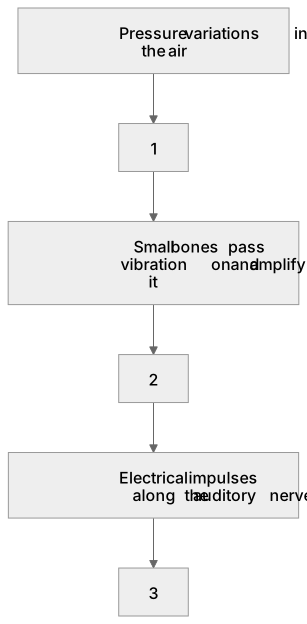
1Box 1
2Box 2
3Box 3
There is more to this lesson
The full lesson goes on to check your understanding and help you earn the marks. Create a free account to carry on, with your progress saved.
A week of Premium from your first lesson · Then the free plan continues · No card, no charge
Test your understanding of Sound waves (physics only) (HT only): Within the ear, sound waves cause the ear drum and other parts to vibrate which causes the sensation of sound.
Active recall beats re-reading. Take an instant quiz now to test what you’ve learned and lock it into long-term memory.
A week of Premium from your first lesson · Then the free plan continues · No card, no charge