AQA · GCSE · Physics
Course version: 8463 · Version from Sept 2016
This restricts the limits of human hearing.
Full specification wording
Sound waves (physics only) (HT only): This restricts the limits of human hearing.
Human hearing runs from about 20 Hz to 20 kHz.
Checked against the AQA 8463 specification (opens in a new tab) on .
- Point 4 of 6
- 4 key terms
Study notes
From the checked teaching notes for this specification point.
The idea
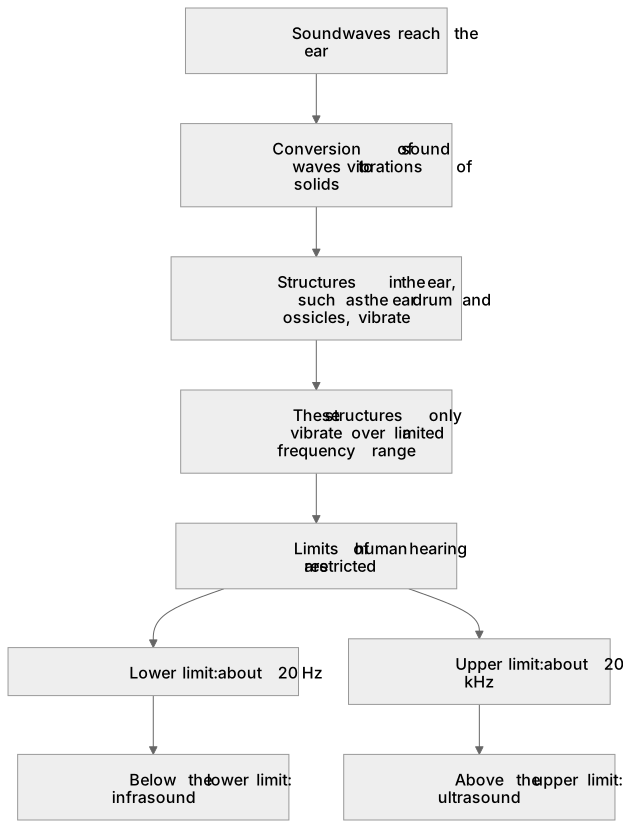
Human hearing runs from about 20 Hz to 20 kHz. The conversion of sound waves to vibrations of solids works over a limited frequency range. The ceiling exists because the structures within the ear, such as the ear drum and ossicles, cannot vibrate fast enough to detect higher frequencies. Sounds above the upper limit are ultrasound and those below the lower limit are infrasound. The range of human hearing narrows with age, with the top end falling first. Prolonged exposure to loud noise can also damage the ear and raise the minimum sound level a person can detect, particularly at high frequencies. Exam questions may ask students to interpret graphs showing how the minimum audible level changes with age and noise exposure.
What earns the marks
- Stating the range of normal human hearing as 20 Hz to 20 kHz.
- Explaining that the limits of human hearing are restricted because the solid structures in the ear only vibrate over a limited frequency range.
- Saying the minimum sound level that can be heard increases with age.
- Saying that working in a loud environment raises the minimum level detectable, particularly at higher frequencies.
Common mistakes and how to put them right
Saying sounds above 20 kHz do not exist, instead of saying humans cannot detect them.
Confusing the upper limit of human hearing (20,000 Hz) with the lower limit (20 Hz).
Reading a hearing graph as loudness rather than as the quietest sound that can just be heard.
Exam tips
- Learn 20 Hz and 20 kHz as a pair, and convert the upper limit to 20 000 Hz when a calculation needs consistent units.
- Use the phrase minimum sound level that can be heard rather than volume when reading audibility graphs.
- Remember that the conversion of sound waves to vibrations of solids only works over a limited frequency range.
Try the lesson
The start of the Sound waves (physics only) (HT only): This restricts the limits of human hearing. lesson, made from checked teaching notes for this specification point.
Have a go first
The human ear can typically only detect sound waves with frequencies between 20 Hz and 20 000 Hz. What is the primary physical reason for this restricted range of hearing?
Listen
Human hearing runs from about 20 Hz to 20 kHz. The conversion of sound waves to vibrations of solids works over a limited frequency range. The ceiling exists because the structures within the ear, such as the ear drum and ossicles, cannot vibrate fast enough to detect higher frequencies. Sounds above the upper limit are ultrasound and those below the lower limit are infrasound. The range of human hearing narrows with age, with the top end falling first. Prolonged exposure to loud noise can also damage the ear and raise the minimum sound level a person can detect, particularly at high frequencies. Exam questions may ask students to interpret graphs showing how the minimum audible level changes with age and noise exposure. A strong answer earns marks for these points. stating the range of normal human hearing as 20 Hz to 20 kHz. explaining that the limits of human hearing are restricted because the solid structures in the ear only vibrate over a limited frequency range. saying the minimum sound level that can be heard increases with age. saying that working in a loud environment raises the minimum level detectable, particularly at higher frequencies. Exam tip: Learn 20 Hz and 20 kHz as a pair, and convert the upper limit to 20 000 Hz when a calculation needs consistent units.
See it
Key words
Say what each word means before you turn the card.
20 Hz to 20 kHz
Try answering aloud or in your head before turning the card.
hearing loss with age
Try answering aloud or in your head before turning the card.
audibility graphs
Try answering aloud or in your head before turning the card.
vibration of solids
Try answering aloud or in your head before turning the card.
See every definition
- 20 Hz to 20 kHz
- The range of normal human hearing, running from about 20 Hz to 20 kHz.
- hearing loss with age
- The range of human hearing narrows with age, with the top end falling first.
- audibility graphs
- Graphs showing how the minimum audible level changes with age and noise exposure.
- vibration of solids
- The conversion of sound waves to vibrations of solids works over a limited frequency range.
Label the diagram
Some boxes have lost their names. Pick the right name for each number.
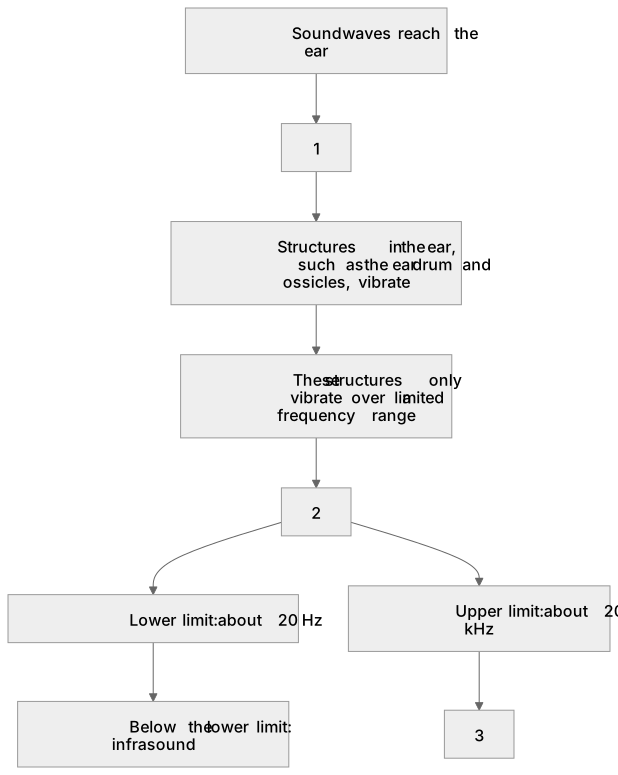
1Box 1
2Box 2
3Box 3
There is more to this lesson
The full lesson goes on to check your understanding and help you earn the marks. Create a free account to carry on, with your progress saved.
A week of Premium from your first lesson · Then the free plan continues · No card, no charge
Test your understanding of Sound waves (physics only) (HT only): This restricts the limits of human hearing.
Active recall beats re-reading. Take an instant quiz now to test what you’ve learned and lock it into long-term memory.
A week of Premium from your first lesson · Then the free plan continues · No card, no charge