AQA · GCSE · Physics
Course version: 8463 · Version from Sept 2016
The conversion of sound waves to vibrations of solids works over a limited…
Full specification wording
Sound waves (physics only) (HT only): The conversion of sound waves to vibrations of solids works over a limited frequency range.
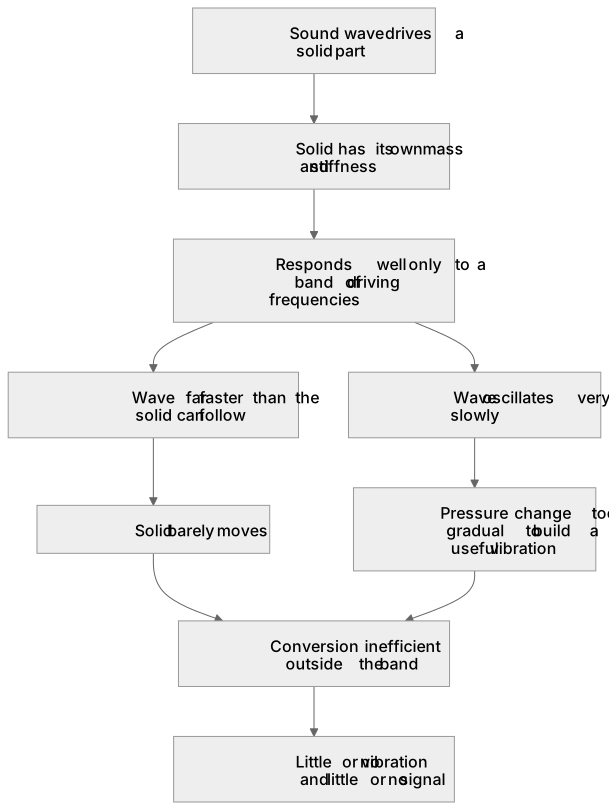
A solid part such as the ear drum has its own mass and stiffness, so it responds well only to a band of driving frequencies.
Checked against the AQA 8463 specification (opens in a new tab) on .
- Point 3 of 6
- 4 key terms
Study notes
From the checked teaching notes for this specification point.
The idea
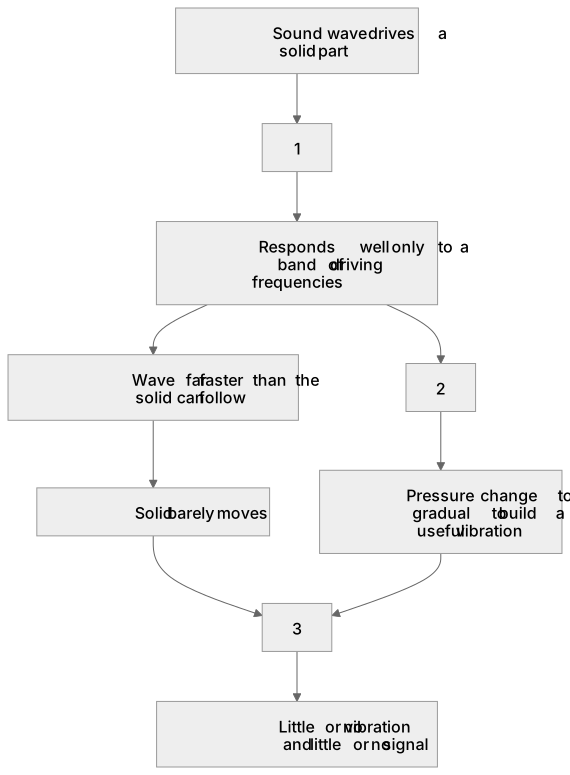
A solid part such as the ear drum has its own mass and stiffness, so it responds well only to a band of driving frequencies. If the wave oscillates far faster than the drum can follow, the drum barely moves; if it oscillates very slowly, the pressure change is too gradual to build a useful vibration. So converting a sound wave into vibration of a solid, and back again, is efficient only over a limited frequency range. The same limit applies to every device that does this job: a microphone diaphragm, a loudspeaker cone and the ossicles of the ear all have a working range set by their size, mass and stiffness. Outside that band the transfer becomes inefficient, so waves outside it produce little or no vibration and therefore little or no signal.
What earns the marks
- Stating that the vibrating solid has a mass and stiffness that limit how fast it can be made to vibrate.
- Saying the conversion becomes inefficient outside a particular frequency band.
- Linking the limited range of the ear drum to the limits of human hearing.
- Applying the idea to another converter, such as a microphone diaphragm or a loudspeaker cone.
Common mistakes and how to put them right
Saying high frequency sounds are too quiet to hear, rather than too fast for the solid part to follow.
Assuming the limit is set by the air rather than by the properties of the vibrating solid.
Treating the range as identical for every person and every device.
Confusing the frequency range with the loudness needed before a sound is heard.
Exam tips
- Answer in terms of the physical properties of the vibrating part: mass, stiffness and how fast it can respond.
- Link the limit straight to numbers, 20 Hz to 20 kHz, when the question is about human hearing.
- If a graph of minimum sound level against frequency is given, describe the overall trend before quoting individual values.
Try the lesson
The start of the Sound waves (physics only) (HT only): The conversion of sound waves to vibrations of solids works over a limited frequency range. lesson, made from checked teaching notes for this specification point.
Have a go first
A microphone converts sound waves into vibrations of a solid. What happens to this conversion for sounds with frequencies outside the microphone's limited frequency range?
Listen
A solid part such as the ear drum has its own mass and stiffness, so it responds well only to a band of driving frequencies. If the wave oscillates far faster than the drum can follow, the drum barely moves; if it oscillates very slowly, the pressure change is too gradual to build a useful vibration. So converting a sound wave into vibration of a solid, and back again, is efficient only over a limited frequency range. The same limit applies to every device that does this job: a microphone diaphragm, a loudspeaker cone and the ossicles of the ear all have a working range set by their size, mass and stiffness. Outside that band the transfer becomes inefficient, so waves outside it produce little or no vibration and therefore little or no signal. A strong answer earns marks for these points. stating that the vibrating solid has a mass and stiffness that limit how fast it can be made to vibrate. saying the conversion becomes inefficient outside a particular frequency band. linking the limited range of the ear drum to the limits of human hearing. applying the idea to another converter, such as a microphone diaphragm or a loudspeaker cone. Exam tip: Answer in terms of the physical properties of the vibrating part: mass, stiffness and how fast it can respond.
See it
Key words
Say what each word means before you turn the card.
limited frequency range
Try answering aloud or in your head before turning the card.
mass and stiffness
Try answering aloud or in your head before turning the card.
efficiency of conversion
Try answering aloud or in your head before turning the card.
diaphragms and drums
Try answering aloud or in your head before turning the card.
See every definition
- limited frequency range
- The conversion of sound waves to vibrations of solids works only over a band of driving frequencies.
- mass and stiffness
- Properties of a solid part such as the ear drum that set its working range.
- efficiency of conversion
- Converting a sound wave into vibration of a solid, and back again, is efficient only over a limited frequency range.
- diaphragms and drums
- A microphone diaphragm, a loudspeaker cone and the ear drum all have a working range set by their size, mass and stiffness.
Label the diagram
Some boxes have lost their names. Pick the right name for each number.
1Box 1
2Box 2
3Box 3
There is more to this lesson
The full lesson goes on to check your understanding and help you earn the marks. Create a free account to carry on, with your progress saved.
A week of Premium from your first lesson · Then the free plan continues · No card, no charge
Test your understanding of Sound waves (physics only) (HT only): The conversion of sound waves to vibrations of solids works over a limited frequency range.
Active recall beats re-reading. Take an instant quiz now to test what you’ve learned and lock it into long-term memory.
A week of Premium from your first lesson · Then the free plan continues · No card, no charge