AQA · GCSE · Physics
Course version: 8463 · Version from Sept 2016
It is not only moving objects that have varying speed. The speed of sound…
Full specification wording
Speed: It is not only moving objects that have varying speed. The speed of sound and the speed of the wind also vary.
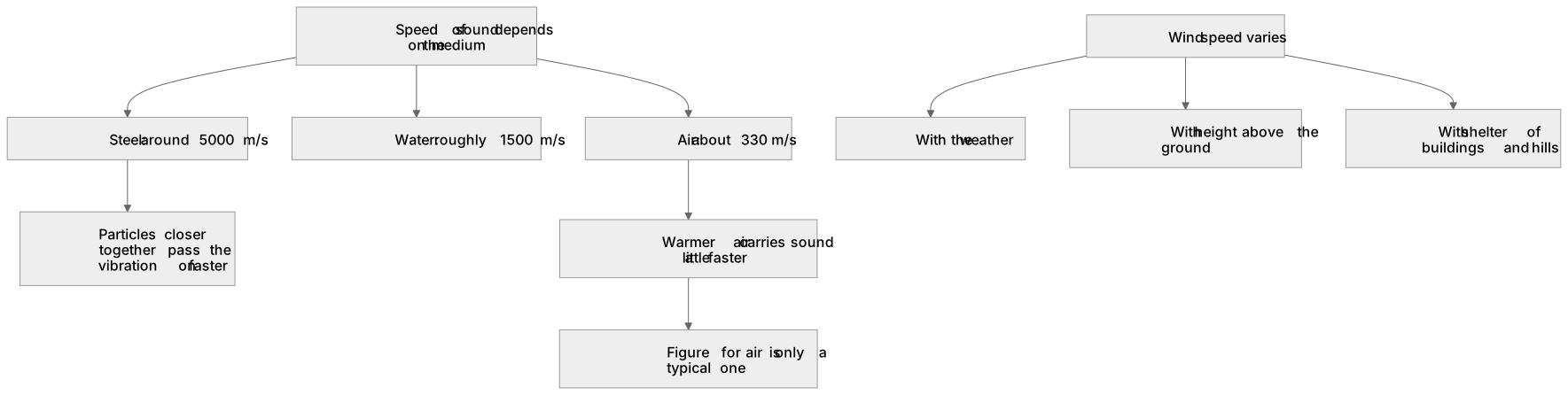
The speed of sound is a property of the material the wave travels through rather than of the source, and it changes when the material changes: about 330 m/s in air, roughly 1500 m/s in water and…
Checked against the AQA 8463 specification (opens in a new tab) on .
- Point 6 of 9
Study notes
From the checked teaching notes for this specification point.
The idea
The speed of sound is a property of the material the wave travels through rather than of the source, and it changes when the material changes: about 330 m/s in air, roughly 1500 m/s in water and around 5000 m/s in steel, because particles that are closer together pass the vibration on faster. Warmer air also carries sound a little faster, so the figure for air is only a typical one. Wind speed varies constantly with the weather, with height above the ground and with the shelter of buildings and hills, which is why wind turbines are mounted on tall towers in exposed places. In both cases a single quoted number is an average or a typical figure and not a fixed constant of nature.
What earns the marks
- The speed of sound depending on the medium it travels through.
- Sound travelling faster in solids than in gases, with closer particles as the reason.
- The speed of sound in air changing with temperature.
- Wind speed varying with the weather, the height or the surroundings.
Common mistakes and how to put them right
Believing a loud sound travels faster than a quiet one.
Quoting the speed of sound in air for a sound travelling through water or metal.
Saying sound travels fastest in a vacuum.
Treating 330 m/s as an exact value under all conditions.
Exam tips
- Check the medium before choosing a value for the speed of sound.
- Use 330 m/s for air unless the question supplies a different figure.
Try the lesson
The start of the Speed: It is not only moving objects that have varying speed. The speed of sound and the speed of the wind also vary. lesson, made from checked teaching notes for this specification point.
Have a go first
Which of the following statements about the speed of sound and the speed of the wind is correct?
Listen
The speed of sound is a property of the material the wave travels through rather than of the source, and it changes when the material changes: about 330 m/s in air, roughly 1500 m/s in water and around 5000 m/s in steel, because particles that are closer together pass the vibration on faster. Warmer air also carries sound a little faster, so the figure for air is only a typical one. Wind speed varies constantly with the weather, with height above the ground and with the shelter of buildings and hills, which is why wind turbines are mounted on tall towers in exposed places. In both cases a single quoted number is an average or a typical figure and not a fixed constant of nature. A strong answer earns marks for these points. the speed of sound depending on the medium it travels through. sound travelling faster in solids than in gases, with closer particles as the reason. the speed of sound in air changing with temperature. wind speed varying with the weather, the height or the surroundings. Exam tip: Check the medium before choosing a value for the speed of sound.
See it
Label the diagram
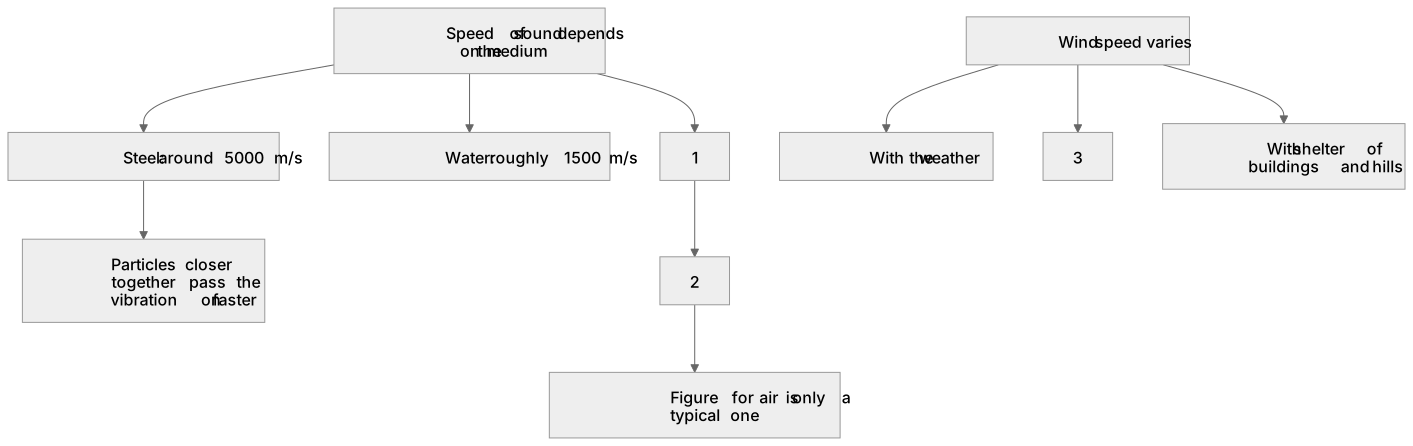
Some boxes have lost their names. Pick the right name for each number.
1Box 1
2Box 2
3Box 3
There is more to this lesson
The full lesson goes on to check your understanding and help you earn the marks. Create a free account to carry on, with your progress saved.
A week of Premium from your first lesson · Then the free plan continues · No card, no charge
Test your understanding of Speed: It is not only moving objects that have varying speed. The speed of sound and the speed of the wind also vary.
Active recall beats re-reading. Take an instant quiz now to test what you’ve learned and lock it into long-term memory.
A week of Premium from your first lesson · Then the free plan continues · No card, no charge