AQA · GCSE · Physics
Course version: 8463 · Version from Sept 2016
Students should be able to make measurements of distance and time and then…
Full specification wording
Speed: Students should be able to make measurements of distance and time and then calculate speeds of objects.
Measuring a speed means measuring a length and a time and then dividing one by the other.
Checked against the AQA 8463 specification (opens in a new tab) on .
- Point 8 of 9
- 4 key terms
Study notes
From the checked teaching notes for this specification point.
The idea
Measuring a speed means measuring a length and a time and then dividing one by the other. Choose the instrument to suit the size: a metre rule for a bench, a tape measure or a trundle wheel for a corridor or a track. Time with a stopwatch for anything lasting several seconds and with light gates for anything faster, because a human reaction time of around 0.2 s is a large fraction of a short interval and is the main source of random error. Repeat each timing at least three times, take a mean, and discard any obvious anomaly. Then divide the distance in metres by the time in seconds to get a speed in metres per second. Measuring over a longer distance reduces the percentage uncertainty in the timing.
What earns the marks
- A named instrument suitable for measuring the distance.
- Timing with a stopwatch or with light gates, and a reason for the choice.
- Repeating the measurement and taking a mean.
- Calculating the speed as distance divided by time, in metres and seconds.
Common mistakes and how to put them right
Timing a very short interval by hand and ignoring reaction time.
Taking a single reading and treating it as reliable.
Mixing centimetres with seconds and then quoting the answer in metres per second.
Starting the timer before the object starts moving.
Exam tips
- Say why light gates are used - they remove human reaction time - rather than just naming them.
- Choose the longest sensible distance in order to cut the percentage uncertainty.
Try the lesson
The start of the Speed: Students should be able to make measurements of distance and time and then calculate speeds of objects. lesson, made from checked teaching notes for this specification point.
Have a go first
A toy car travels 2 m along a bench in 4 s. What is the average speed of the toy car?
Listen
Measuring a speed means measuring a length and a time and then dividing one by the other. Choose the instrument to suit the size: a metre rule for a bench, a tape measure or a trundle wheel for a corridor or a track. Time with a stopwatch for anything lasting several seconds and with light gates for anything faster, because a human reaction time of around 0.2 s is a large fraction of a short interval and is the main source of random error. Repeat each timing at least three times, take a mean, and discard any obvious anomaly. Then divide the distance in metres by the time in seconds to get a speed in metres per second. Measuring over a longer distance reduces the percentage uncertainty in the timing. A strong answer earns marks for these points. a named instrument suitable for measuring the distance. timing with a stopwatch or with light gates, and a reason for the choice. repeating the measurement and taking a mean. calculating the speed as distance divided by time, in metres and seconds. Exam tip: Say why light gates are used - they remove human reaction time - rather than just naming them.
See it
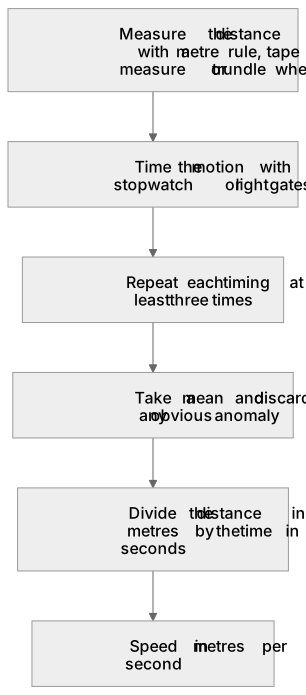
Put it in order
Put these steps in the order they happen.
- 1. Repeat each timing at least three times
- 2. Time the motion with a stopwatch or light gates
- 3. Measure the distance with a metre rule, tape measure or trundle wheel
- 4. Speed in metres per second
- 5. Divide the distance in metres by the time in seconds
- 6. Take a mean and discard any obvious anomaly
Key words
Say what each word means before you turn the card.
light gates
Try answering aloud or in your head before turning the card.
reaction time
Try answering aloud or in your head before turning the card.
repeats and means
Try answering aloud or in your head before turning the card.
measuring distance
Try answering aloud or in your head before turning the card.
See every definition
- light gates
- Used for timing anything faster, because a human reaction time of around 0.2 s is a large fraction of a short interval.
- reaction time
- Around 0.2 s for a human, and the main source of random error when timing a short interval.
- repeats and means
- Each timing is repeated at least three times, a mean is taken, and any obvious anomaly is discarded.
- measuring distance
- A metre rule for a bench, or a tape measure or a trundle wheel for a corridor or a track.
Label the diagram
Some boxes have lost their names. Pick the right name for each number.
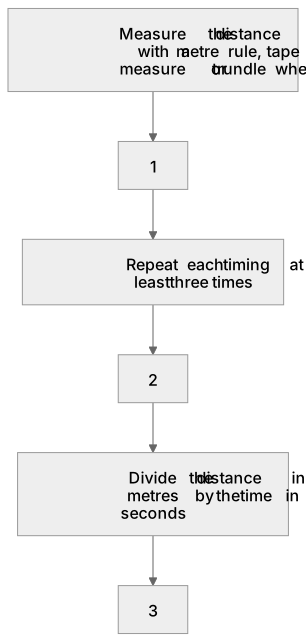
1Box 1
2Box 2
3Box 3
There is more to this lesson
The full lesson goes on to check your understanding and help you earn the marks. Create a free account to carry on, with your progress saved.
A week of Premium from your first lesson · Then the free plan continues · No card, no charge
Test your understanding of Speed: Students should be able to make measurements of distance and time and then calculate speeds of objects.
Active recall beats re-reading. Take an instant quiz now to test what you’ve learned and lock it into long-term memory.
A week of Premium from your first lesson · Then the free plan continues · No card, no charge