AQA · GCSE · Physics
Course version: 8463 · Version from Sept 2016
The speed at which a person can walk, run or cycle depends on many factors…
Full specification wording
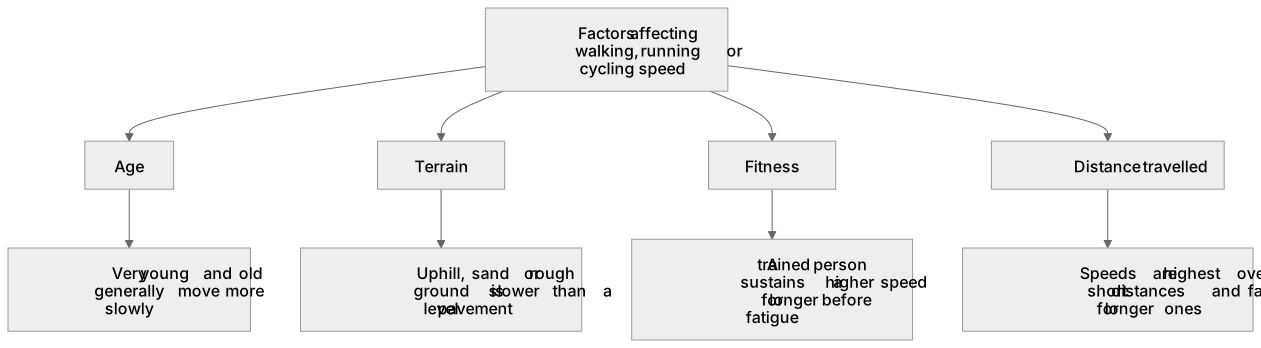
Speed: The speed at which a person can walk, run or cycle depends on many factors including: age, terrain, fitness and distance travelled.
The specification names four factors and expects a reason for each.
Checked against the AQA 8463 specification (opens in a new tab) on .
- Point 3 of 9
- 3 key terms
Study notes
From the checked teaching notes for this specification point.
The idea
The specification names four factors and expects a reason for each. Age: the very young and the old generally move more slowly, as muscle power and stride length change. Terrain: walking uphill, on sand or over rough ground is slower than on a level pavement, because more work is done against gravity and against friction. Fitness: a trained person sustains a higher speed for longer before fatigue forces them to slow down. Distance travelled: speeds are highest over short distances and fall for longer ones, which is why a sprinter's pace could never be held for a marathon. Examiners also accept wind, the load carried, temperature and the surface underfoot. Questions ask you to suggest a factor and explain its effect, so always give both.
What earns the marks
- Naming a relevant factor such as age, terrain, fitness or distance travelled.
- The direction of its effect on the speed.
- A reason linking that factor to the effect.
- A second factor treated in the same way where two are asked for.
Common mistakes and how to put them right
Listing factors with no explanation of how each one changes the speed.
Offering how fast they want to go, which is not a physical factor.
Confusing the effect of distance on speed with the effect of speed on distance.
Giving two versions of the same factor, such as hills and slopes, as two separate answers.
Exam tips
- Name, direction, reason - three parts for every factor you give.
- Check how many factors the question asks for and give exactly that many, each fully explained.
Try the lesson
The start of the Speed: The speed at which a person can walk, run or cycle depends on many factors including: age, terrain, fitness and distance travelled. lesson, made from checked teaching notes for this specification point.
Have a go first
Which of these is a factor that can affect the speed at which a person walks?
Listen
The specification names four factors and expects a reason for each. Age: the very young and the old generally move more slowly, as muscle power and stride length change. Terrain: walking uphill, on sand or over rough ground is slower than on a level pavement, because more work is done against gravity and against friction. Fitness: a trained person sustains a higher speed for longer before fatigue forces them to slow down. Distance travelled: speeds are highest over short distances and fall for longer ones, which is why a sprinter's pace could never be held for a marathon. Examiners also accept wind, the load carried, temperature and the surface underfoot. Questions ask you to suggest a factor and explain its effect, so always give both. A strong answer earns marks for these points. naming a relevant factor such as age, terrain, fitness or distance travelled. the direction of its effect on the speed. a reason linking that factor to the effect. a second factor treated in the same way where two are asked for. Exam tip: Name, direction, reason - three parts for every factor you give.
See it
Key words
Say what each word means before you turn the card.
terrain
Try answering aloud or in your head before turning the card.
fitness
Try answering aloud or in your head before turning the card.
distance travelled
Try answering aloud or in your head before turning the card.
See every definition
- terrain
- Walking uphill, on sand or over rough ground is slower than on a level pavement, because more work is done against gravity and against friction.
- fitness
- A trained person sustains a higher speed for longer before fatigue forces them to slow down.
- distance travelled
- Speeds are highest over short distances and fall for longer ones, which is why a sprinter's pace could never be held for a marathon.
Label the diagram
Some boxes have lost their names. Pick the right name for each number.
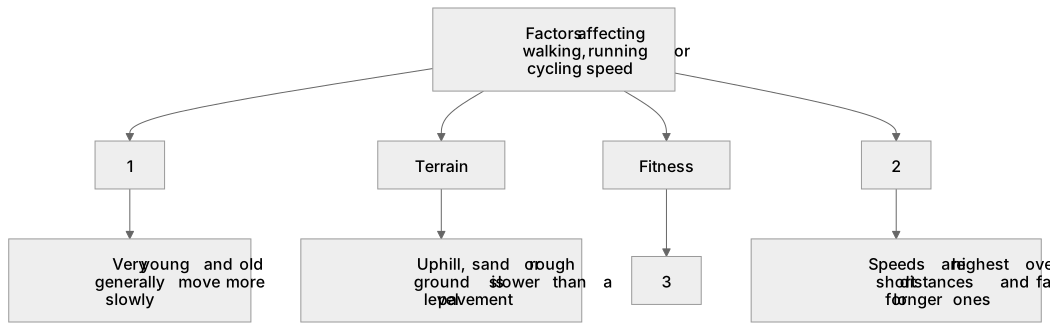
1Box 1
2Box 2
3Box 3
There is more to this lesson
The full lesson goes on to check your understanding and help you earn the marks. Create a free account to carry on, with your progress saved.
A week of Premium from your first lesson · Then the free plan continues · No card, no charge
Test your understanding of Speed: The speed at which a person can walk, run or cycle depends on many factors including: age, terrain, fitness and distance travelled.
Active recall beats re-reading. Take an instant quiz now to test what you’ve learned and lock it into long-term memory.
A week of Premium from your first lesson · Then the free plan continues · No card, no charge