AQA · GCSE · Physics
Course version: 8463 · Version from Sept 2016
For a given braking force the greater the speed of the vehicle, the…
Full specification wording
Stopping distance: For a given braking force the greater the speed of the vehicle, the greater the stopping distance.
The two parts of the stopping distance grow differently with speed.
Checked against the AQA 8463 specification (opens in a new tab) on .
- Point 2 of 4
Study notes
From the checked teaching notes for this specification point.
The idea
The two parts of the stopping distance grow differently with speed. Thinking distance is speed × reaction time, so it is directly proportional to speed: at a reaction time of 0.6 s, doubling the speed from 10 m/s to 20 m/s doubles the thinking distance from 6 m to 12 m. Braking distance comes from energy. The kinetic energy to be removed is ½ m v², and the work done by the brakes is braking force × braking distance, so with a fixed braking force the braking distance goes with the square of the speed. Doubling the speed from 10 m/s to 20 m/s takes the braking distance from 6 m to 24 m, four times as far. The stopping distance therefore rises far more steeply than the speed.
What earns the marks
- Stating that thinking distance is directly proportional to speed.
- Supporting that with figures, such as 6 m at 10 m/s rising to 12 m at 20 m/s.
- Stating that braking distance is not proportional to speed but increases more steeply.
- The supporting braking figures, such as 6 m at 10 m/s rising to 24 m at 20 m/s.
Common mistakes and how to put them right
Saying both distances double when the speed doubles.
Calling the braking distance graph proportional simply because it rises as speed rises.
Assuming the driver brakes harder at higher speeds, when the question fixes the braking force.
Confusing the braking distance with the time taken to stop.
Exam tips
- Quote a pair of numbers from the table when you judge a proportionality claim; the figures carry a mark of their own.
- Test proportionality by dividing: if distance ÷ speed is the same for every row, it is proportional.
- Use the words 'increases by a factor of four' rather than 'increases a lot'.
Try the lesson
The start of the Stopping distance: For a given braking force the greater the speed of the vehicle, the greater the stopping distance. lesson, made from checked teaching notes for this specification point.
Have a go first
Two identical cars, A and B, are travelling on the same road. Car A is travelling at 20 m/s and Car B is travelling at 30 m/s. Both drivers apply the exact same braking force to stop. Which statement about their stopping distances is correct?
Listen
The two parts of the stopping distance grow differently with speed. Thinking distance is speed × reaction time, so it is directly proportional to speed: at a reaction time of 0.6 s, doubling the speed from 10 m/s to 20 m/s doubles the thinking distance from 6 m to 12 m. Braking distance comes from energy. The kinetic energy to be removed is ½ m v², and the work done by the brakes is braking force × braking distance, so with a fixed braking force the braking distance goes with the square of the speed. Doubling the speed from 10 m/s to 20 m/s takes the braking distance from 6 m to 24 m, four times as far. The stopping distance therefore rises far more steeply than the speed. A strong answer earns marks for these points. stating that thinking distance is directly proportional to speed. supporting that with figures, such as 6 m at 10 m/s rising to 12 m at 20 m/s. stating that braking distance is not proportional to speed but increases more steeply. the supporting braking figures, such as 6 m at 10 m/s rising to 24 m at 20 m/s. Exam tip: Quote a pair of numbers from the table when you judge a proportionality claim; the figures carry a mark of their own.
See it
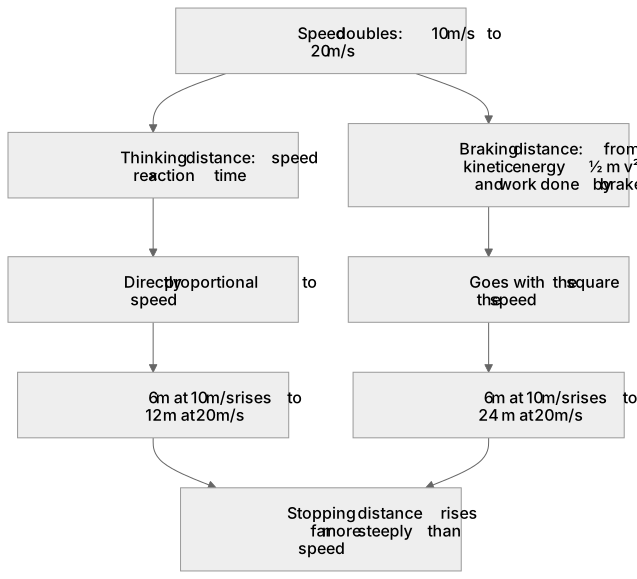
Label the diagram
Some boxes have lost their names. Pick the right name for each number.
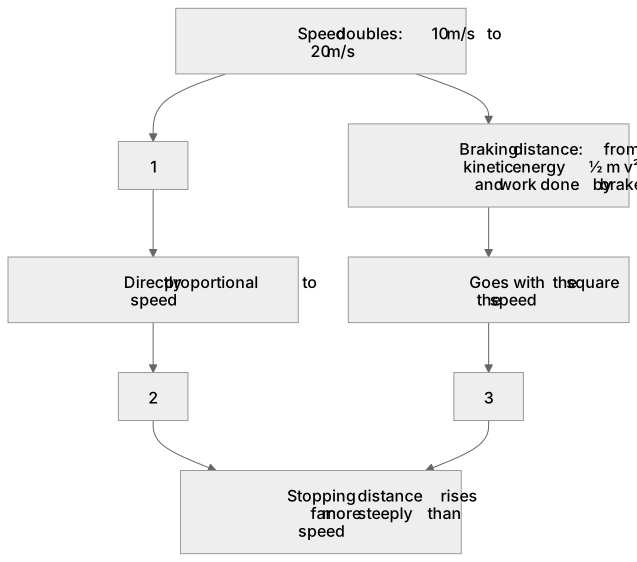
1Box 1
2Box 2
3Box 3
There is more to this lesson
The full lesson goes on to check your understanding and help you earn the marks. Create a free account to carry on, with your progress saved.
A week of Premium from your first lesson · Then the free plan continues · No card, no charge
Test your understanding of Stopping distance: For a given braking force the greater the speed of the vehicle, the greater the stopping distance.
Active recall beats re-reading. Take an instant quiz now to test what you’ve learned and lock it into long-term memory.
A week of Premium from your first lesson · Then the free plan continues · No card, no charge