AQA · GCSE · Physics
Course version: 8463 · Version from Sept 2016
The stopping distance of a vehicle is the sum of the distance the vehicle…
Full specification wording
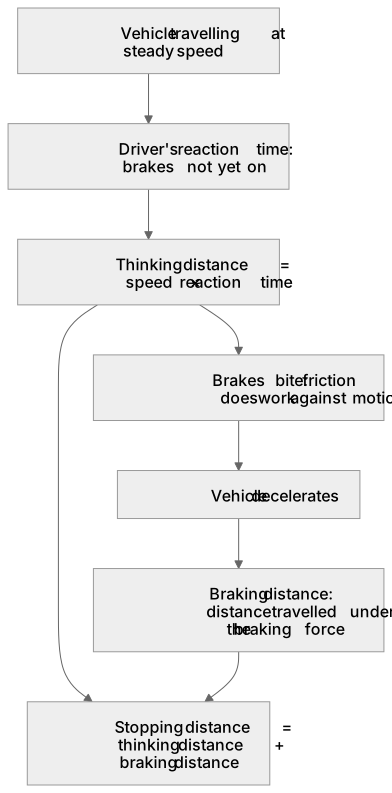
Stopping distance: The stopping distance of a vehicle is the sum of the distance the vehicle travels during the driver’s reaction time (thinking distance) and the distance it travels under the braking force (braking distance).
Stopping a vehicle happens in two stages.
Checked against the AQA 8463 specification (opens in a new tab) on .
- Point 1 of 4
- 3 key terms
Study notes
From the checked teaching notes for this specification point.
The idea
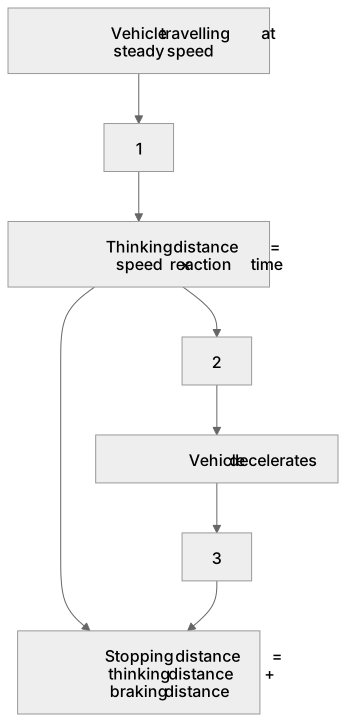
Stopping a vehicle happens in two stages. During the driver's reaction time the brakes are not yet on, so the vehicle carries on at its original steady speed; the distance covered then is the thinking distance, equal to speed × reaction time. Once the brakes bite, friction does work against the motion and the vehicle decelerates; the distance covered during that is the braking distance, defined as the distance travelled under the braking force. Add the two and you have the stopping distance. On a stacked bar chart or a table of typical values, read both parts separately before adding: at 100 km/h a thinking distance of 20 m and a braking distance of 60 m give a stopping distance of 80 m.
What earns the marks
- Reading the thinking distance and the braking distance separately from the graph or table.
- Adding the two distances to give the stopping distance.
- The answer with the unit m.
- Defining braking distance as the distance travelled under the braking force.
- Stating that the vehicle travels at a steady speed during the driver's reaction time.
Common mistakes and how to put them right
Quoting the braking distance alone when the question asks for the stopping distance.
Saying the car is already slowing down during the thinking distance.
Reading the top of a stacked bar as the braking distance, when it is the total stopping distance.
Converting km/h to m/s by dividing by ten rather than by 3.6.
Exam tips
- Write 'stopping distance = thinking distance + braking distance' before substituting; the equation itself often earns a mark.
- Show both values you read from the graph, because later marks can still be awarded from a misread value.
- Check which distance the question wants; the two words are deliberately close together in the question stem.
Try the lesson
The start of the Stopping distance: The stopping distance of a vehicle is the sum of the distance the vehicle travels during the driver’s reaction time (thinking distance) and the distance it travels under the braking force (braking distance). lesson, made from checked teaching notes for this specification point.
Have a go first
A car travels 9 m while the driver reacts and then 21 m while the brakes are applied. What is the stopping distance of the car?
Listen
Stopping a vehicle happens in two stages. During the driver's reaction time the brakes are not yet on, so the vehicle carries on at its original steady speed; the distance covered then is the thinking distance, equal to speed × reaction time. Once the brakes bite, friction does work against the motion and the vehicle decelerates; the distance covered during that is the braking distance, defined as the distance travelled under the braking force. Add the two and you have the stopping distance. On a stacked bar chart or a table of typical values, read both parts separately before adding: at 100 km/h a thinking distance of 20 m and a braking distance of 60 m give a stopping distance of 80 m. A strong answer earns marks for these points. reading the thinking distance and the braking distance separately from the graph or table. adding the two distances to give the stopping distance. the answer with the unit m. defining braking distance as the distance travelled under the braking force. Exam tip: Write 'stopping distance = thinking distance + braking distance' before substituting; the equation itself often earns a mark.
See it
Key words
Say what each word means before you turn the card.
stopping distance
Try answering aloud or in your head before turning the card.
thinking distance
Try answering aloud or in your head before turning the card.
braking distance
Try answering aloud or in your head before turning the card.
See every definition
- stopping distance
- The sum of the distance the vehicle travels during the driver's reaction time and the distance it travels under the braking force.
- thinking distance
- The distance the vehicle travels during the driver's reaction time, when the brakes are not yet on and it carries on at its original steady speed.
- braking distance
- The distance travelled under the braking force, during which friction does work against the motion and the vehicle decelerates.
Label the diagram
Some boxes have lost their names. Pick the right name for each number.
1Box 1
2Box 2
3Box 3
There is more to this lesson
The full lesson goes on to check your understanding and help you earn the marks. Create a free account to carry on, with your progress saved.
A week of Premium from your first lesson · Then the free plan continues · No card, no charge
Test your understanding of Stopping distance: The stopping distance of a vehicle is the sum of the distance the vehicle travels during the driver’s reaction time (thinking distance) and the distance it travels under the braking force (braking distance).
Active recall beats re-reading. Take an instant quiz now to test what you’ve learned and lock it into long-term memory.
A week of Premium from your first lesson · Then the free plan continues · No card, no charge