AQA · GCSE · Physics
Course version: 8463 · Version from Sept 2016
The experimental work of James Chadwick provided the evidence to show the…
Full specification wording
The development of the model of the atom (common content with chemistry): The experimental work of James Chadwick provided the evidence to show the existence of neutrons within the nucleus.
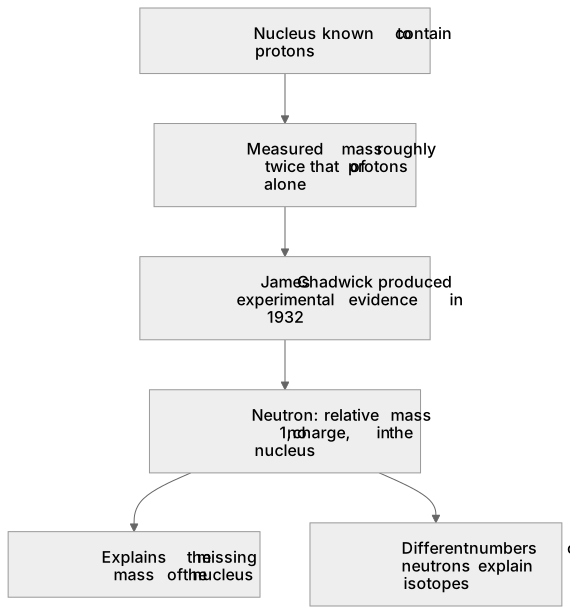
By the 1920s the nucleus was known to contain protons, but the measured mass of a nucleus was roughly twice what the protons alone could account for.
Checked against the AQA 8463 specification (opens in a new tab) on .
- Point 11 of 12
- 3 key terms
Study notes
From the checked teaching notes for this specification point.
The idea
By the 1920s the nucleus was known to contain protons, but the measured mass of a nucleus was roughly twice what the protons alone could account for. In 1932 James Chadwick produced the experimental evidence for a third particle, the neutron, sitting in the nucleus alongside the protons. A neutron has a relative mass of 1, the same as a proton, but carries no charge, so adding neutrons changes the mass of a nucleus without changing its charge or the element. That immediately explained the missing mass and also explained isotopes, atoms of one element with the same proton number but different numbers of neutrons and so different masses.
What earns the marks
- Naming James Chadwick as providing the evidence for the neutron.
- Stating that the neutron is uncharged and is found in the nucleus.
- Stating that the neutron accounts for the extra mass of the nucleus.
- Stating that different numbers of neutrons explain the existence of isotopes.
Common mistakes and how to put them right
Saying Chadwick discovered the proton or the nucleus.
Giving the neutron a negative charge because of its name.
Placing neutrons in orbit around the nucleus with the electrons.
Putting the discovery of the neutron before the discovery of the nucleus.
Exam tips
- Pair the name Chadwick with the word neutron in your revision notes; recall questions ask for exactly that link.
- State both properties of the neutron, relative mass 1 and no charge, when asked what he showed.
- Bring in isotopes as the consequence; it often earns the final mark in an explanation.
Try the lesson
The start of the The development of the model of the atom (common content with chemistry): The experimental work of James Chadwick provided the evidence to show the existence of neutrons within the nucleus. lesson, made from checked teaching notes for this specification point.
Have a go first
Which particle did James Chadwick's experiments provide evidence for?
Listen
By the 1920s the nucleus was known to contain protons, but the measured mass of a nucleus was roughly twice what the protons alone could account for. In 1932 James Chadwick produced the experimental evidence for a third particle, the neutron, sitting in the nucleus alongside the protons. A neutron has a relative mass of 1, the same as a proton, but carries no charge, so adding neutrons changes the mass of a nucleus without changing its charge or the element. That immediately explained the missing mass and also explained isotopes, atoms of one element with the same proton number but different numbers of neutrons and so different masses. A strong answer earns marks for these points. naming James Chadwick as providing the evidence for the neutron. stating that the neutron is uncharged and is found in the nucleus. stating that the neutron accounts for the extra mass of the nucleus. stating that different numbers of neutrons explain the existence of isotopes. Exam tip: Pair the name Chadwick with the word neutron in your revision notes; recall questions ask for exactly that link.
See it
Key words
Say what each word means before you turn the card.
Chadwick
Try answering aloud or in your head before turning the card.
the neutron
Try answering aloud or in your head before turning the card.
isotopes
Try answering aloud or in your head before turning the card.
See every definition
- Chadwick
- His experimental work provided the evidence to show the existence of neutrons within the nucleus.
- the neutron
- A particle sitting in the nucleus alongside the protons, with a relative mass of 1 and no charge.
- isotopes
- Atoms of one element with the same proton number but different numbers of neutrons and so different masses.
Label the diagram
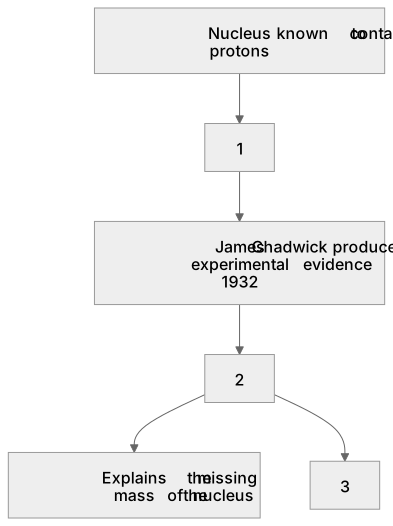
Some boxes have lost their names. Pick the right name for each number.
1Box 1
2Box 2
3Box 3
There is more to this lesson
The full lesson goes on to check your understanding and help you earn the marks. Create a free account to carry on, with your progress saved.
A week of Premium from your first lesson · Then the free plan continues · No card, no charge
Test your understanding of The development of the model of the atom (common content with chemistry): The experimental work of James Chadwick provided the evidence to show the existence of neutrons within the nucleus.
Active recall beats re-reading. Take an instant quiz now to test what you’ve learned and lock it into long-term memory.
A week of Premium from your first lesson · Then the free plan continues · No card, no charge