AQA · GCSE · Physics
Course version: 8463 · Version from Sept 2016
The name proton was given to these particles.
Full specification wording
The development of the model of the atom (common content with chemistry): The name proton was given to these particles.
The identical positively charged particles that make up the charge of a nucleus were named protons.
Checked against the AQA 8463 specification (opens in a new tab) on .
- Point 10 of 12
- 4 key terms
Study notes
From the checked teaching notes for this specification point.
The idea
The identical positively charged particles that make up the charge of a nucleus were named protons. A proton has a relative charge of +1 and a relative mass of 1, the same mass as a neutron and about two thousand times the mass of an electron. The number of protons in a nucleus is the atomic number, and it is what fixes the identity of the element: six protons is always carbon, whatever the number of neutrons or electrons. Because the proton number determines the element, the periodic table is ordered by it. Losing or gaining electrons makes an ion but leaves the proton number, and so the element, unchanged.
What earns the marks
- Naming the subdivided units of nuclear positive charge as protons.
- A relative charge of +1 and a relative mass of 1 for a proton.
- Stating that the number of protons is the atomic number.
- Stating that the number of protons determines which element the atom is.
Common mistakes and how to put them right
Naming the particle a neutron or an electron.
Giving the proton a negative charge or a charge of zero.
Saying the proton was named by Chadwick.
Claiming the proton number changes when an atom becomes an ion.
Exam tips
- Pair proton with +1 and relative mass 1 every time; one-mark recall questions use exactly this.
- Say the number of protons is the atomic number when a question asks what fixes the element.
- Do not confuse naming the proton with discovering the nucleus; they are separate steps.
Try the lesson
The start of the The development of the model of the atom (common content with chemistry): The name proton was given to these particles. lesson, made from checked teaching notes for this specification point.
Have a go first
What is the name of the positively charged particle found inside the nucleus of an atom?
Listen
The identical positively charged particles that make up the charge of a nucleus were named protons. A proton has a relative charge of +1 and a relative mass of 1, the same mass as a neutron and about two thousand times the mass of an electron. The number of protons in a nucleus is the atomic number, and it is what fixes the identity of the element: six protons is always carbon, whatever the number of neutrons or electrons. Because the proton number determines the element, the periodic table is ordered by it. Losing or gaining electrons makes an ion but leaves the proton number, and so the element, unchanged. A strong answer earns marks for these points. naming the subdivided units of nuclear positive charge as protons. a relative charge of +1 and a relative mass of 1 for a proton. stating that the number of protons is the atomic number. stating that the number of protons determines which element the atom is. Exam tip: Pair proton with +1 and relative mass 1 every time; one-mark recall questions use exactly this.
See it
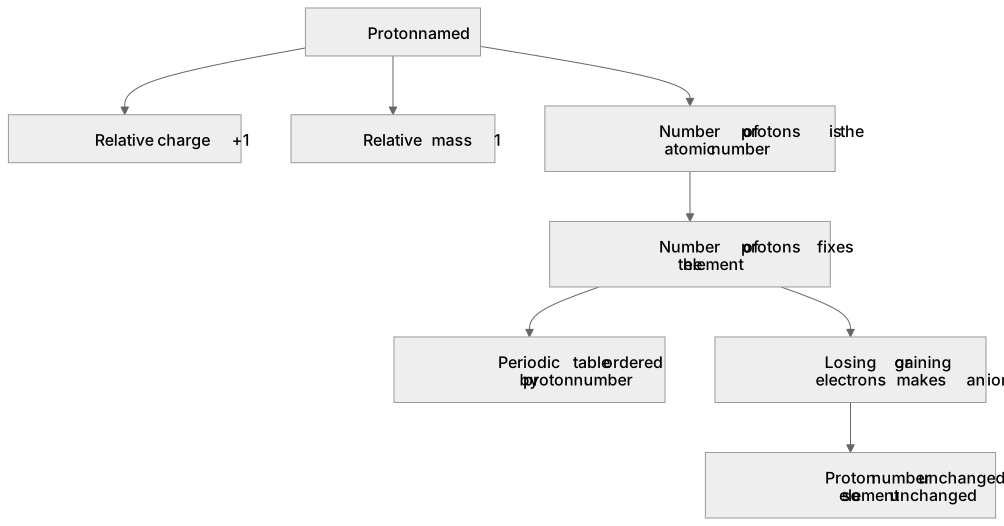
Key words
Say what each word means before you turn the card.
proton
Try answering aloud or in your head before turning the card.
relative charge and mass
Try answering aloud or in your head before turning the card.
atomic number
Try answering aloud or in your head before turning the card.
element identity
Try answering aloud or in your head before turning the card.
See every definition
- proton
- The name given to the identical positively charged particles that make up the charge of a nucleus.
- relative charge and mass
- A proton has a relative charge of +1 and a relative mass of 1, the same mass as a neutron.
- atomic number
- The number of protons in a nucleus.
- element identity
- The number of protons fixes which element the atom is, so six protons is always carbon.
Label the diagram
Some boxes have lost their names. Pick the right name for each number.
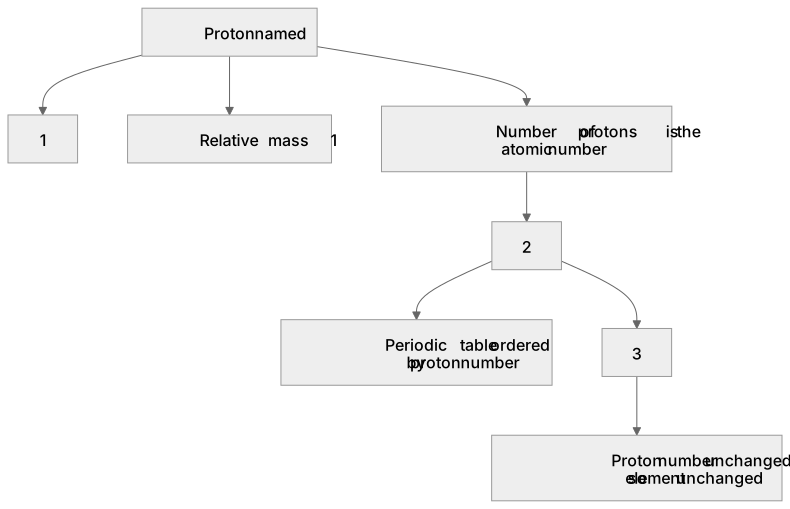
1Box 1
2Box 2
3Box 3
There is more to this lesson
The full lesson goes on to check your understanding and help you earn the marks. Create a free account to carry on, with your progress saved.
A week of Premium from your first lesson · Then the free plan continues · No card, no charge
Test your understanding of The development of the model of the atom (common content with chemistry): The name proton was given to these particles.
Active recall beats re-reading. Take an instant quiz now to test what you’ve learned and lock it into long-term memory.
A week of Premium from your first lesson · Then the free plan continues · No card, no charge