AQA · GCSE · Physics
Course version: 8463 · Version from Sept 2016
(HT only) If an object is accelerating, its speed at any particular time…
Full specification wording
The distance–time relationship: (HT only) If an object is accelerating, its speed at any particular time can be determined by drawing a tangent and measuring the gradient of the distance–time graph at that time.
On a curve the gradient is different at every point, so the speed at one instant is found with a tangent: a straight line that just touches the curve at that time without crossing it.
Checked against the AQA 8463 specification (opens in a new tab) on .
- Point 3 of 5
- 2 key terms
Study notes
From the checked teaching notes for this specification point.
The idea
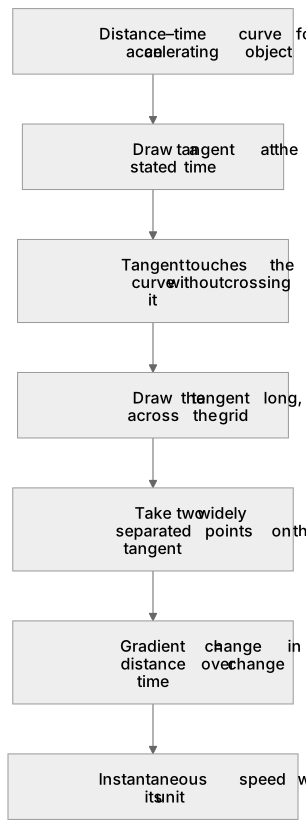
On a curve the gradient is different at every point, so the speed at one instant is found with a tangent: a straight line that just touches the curve at that time without crossing it. Line a ruler up so that the curve leaves it at the same angle on both sides, draw the tangent long, right across the grid if there is room, and then take the gradient of the ruled tangent rather than of the curve, using two widely separated points on it. Mark schemes award a mark for the tangent drawn at the right time, a mark for attempting the gradient and a mark for the value, and they explicitly refuse a line that cuts through the curve. The steeper the tangent, the faster the object is moving at that instant.
What earns the marks
- A tangent drawn at the stated time that touches the curve without crossing it.
- An attempt to calculate the gradient of the tangent.
- A correct substitution of the change in distance over the change in time.
- The instantaneous speed quoted with its unit.
Common mistakes and how to put them right
Drawing a chord between two points on the curve instead of a tangent.
Drawing a line that crosses the curve, which mark schemes do not allow.
Taking the gradient of the curve either side of the tangent rather than of the ruled line.
Reading the distance at that time and calling it the speed.
Exam tips
- Draw the tangent as long as the grid allows and take the two gradient points far apart on it, because a short tangent magnifies reading error.
- Check by eye that the curve pulls away from your ruler symmetrically on both sides.
Try the lesson
The start of the The distance–time relationship: (HT only) If an object is accelerating, its speed at any particular time can be determined by drawing a tangent and measuring the gradient of the distance–time graph at that time. lesson, made from checked teaching notes for this specification point.
Have a go first
A distance–time graph for an accelerating object is curved. To find the speed at a particular time, what should be drawn at that point on the curve?
Listen
On a curve the gradient is different at every point, so the speed at one instant is found with a tangent: a straight line that just touches the curve at that time without crossing it. Line a ruler up so that the curve leaves it at the same angle on both sides, draw the tangent long, right across the grid if there is room, and then take the gradient of the ruled tangent rather than of the curve, using two widely separated points on it. Mark schemes award a mark for the tangent drawn at the right time, a mark for attempting the gradient and a mark for the value, and they explicitly refuse a line that cuts through the curve. The steeper the tangent, the faster the object is moving at that instant. A strong answer earns marks for these points. a tangent drawn at the stated time that touches the curve without crossing it. an attempt to calculate the gradient of the tangent. a correct substitution of the change in distance over the change in time. the instantaneous speed quoted with its unit. Exam tip: Draw the tangent as long as the grid allows and take the two gradient points far apart on it, because a short tangent magnifies reading error.
See it
Put it in order
Put these steps in the order they happen.
- 1. Instantaneous speed with its unit
- 2. Gradient = change in distance over change in time
- 3. Tangent touches the curve without crossing it
- 4. Take two widely separated points on the tangent
- 5. Distance–time curve for an accelerating object
- 6. Draw a tangent at the stated time
- 7. Draw the tangent long, across the grid
Key words
Say what each word means before you turn the card.
tangent
Try answering aloud or in your head before turning the card.
instantaneous speed
Try answering aloud or in your head before turning the card.
See every definition
- tangent
- A straight line that just touches the curve at that time without crossing it.
- instantaneous speed
- The speed at one instant, found from the gradient of the tangent to the distance–time graph at that time.
Label the diagram
Some boxes have lost their names. Pick the right name for each number.
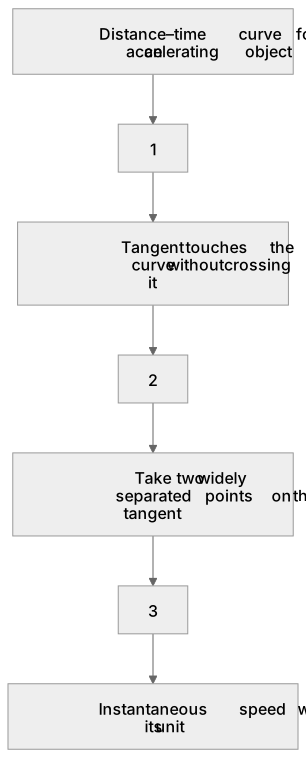
1Box 1
2Box 2
3Box 3
There is more to this lesson
The full lesson goes on to check your understanding and help you earn the marks. Create a free account to carry on, with your progress saved.
A week of Premium from your first lesson · Then the free plan continues · No card, no charge
Test your understanding of The distance–time relationship: (HT only) If an object is accelerating, its speed at any particular time can be determined by drawing a tangent and measuring the gradient of the distance–time graph at that time.
Active recall beats re-reading. Take an instant quiz now to test what you’ve learned and lock it into long-term memory.
A week of Premium from your first lesson · Then the free plan continues · No card, no charge