AQA · GCSE · Physics
Course version: 8463 · Version from Sept 2016
Fusion processes in stars produce all of the naturally occurring elements.…
Full specification wording
The life cycle of a star: Fusion processes in stars produce all of the naturally occurring elements. Elements heavier than iron are produced in a supernova.
Fusion builds heavier nuclei out of lighter ones.
Checked against the AQA 8463 specification (opens in a new tab) on .
- Point 3 of 5
- 4 key terms
Study notes
From the checked teaching notes for this specification point.
The idea
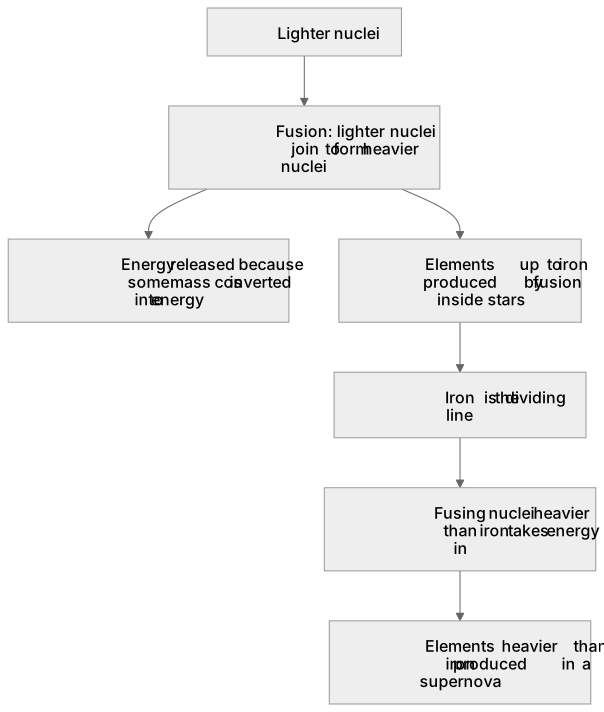
Fusion builds heavier nuclei out of lighter ones. A main sequence star fuses hydrogen into helium; later, in the giant stages, helium fuses into carbon and oxygen, and a massive star goes on building heavier nuclei as far as iron. Each of these reactions releases energy, because some of the mass of the nuclei is converted into energy. Iron is where it stops, because fusing nuclei heavier than iron takes energy in rather than giving it out, so no star can make gold or uranium in its core. Those elements are made in the enormous energies of a supernova explosion instead. Every element above hydrogen was assembled inside a star or in a supernova, including the carbon in you and the iron in your blood.
What earns the marks
- Lighter nuclei fusing to form heavier nuclei.
- Energy being released because some of the mass is converted into energy.
- Fusion inside stars producing the elements up to iron.
- Elements heavier than iron being produced in a supernova.
Common mistakes and how to put them right
Saying that fusion splits large nuclei, which is fission.
Claiming that a star can fuse elements heavier than iron in its core.
Writing that elements are burned into existence, which is a chemical rather than a nuclear description.
Saying that fusion creates energy, rather than releasing it from the mass of the nuclei.
Exam tips
- State fusion as light nuclei joining to form heavier nuclei, because that phrasing is the first mark.
- Name iron as the dividing line, and the supernova as the source of everything above it.
- Keep fusion and fission apart by remembering that fusion needs extreme temperature and pressure.
Try the lesson
The start of the The life cycle of a star: Fusion processes in stars produce all of the naturally occurring elements. Elements heavier than iron are produced in a supernova. lesson, made from checked teaching notes for this specification point.
Have a go first
During which event in the life cycle of a massive star are elements heavier than iron produced?
Listen
Fusion builds heavier nuclei out of lighter ones. A main sequence star fuses hydrogen into helium; later, in the giant stages, helium fuses into carbon and oxygen, and a massive star goes on building heavier nuclei as far as iron. Each of these reactions releases energy, because some of the mass of the nuclei is converted into energy. Iron is where it stops, because fusing nuclei heavier than iron takes energy in rather than giving it out, so no star can make gold or uranium in its core. Those elements are made in the enormous energies of a supernova explosion instead. Every element above hydrogen was assembled inside a star or in a supernova, including the carbon in you and the iron in your blood. A strong answer earns marks for these points. lighter nuclei fusing to form heavier nuclei. energy being released because some of the mass is converted into energy. fusion inside stars producing the elements up to iron. elements heavier than iron being produced in a supernova. Exam tip: State fusion as light nuclei joining to form heavier nuclei, because that phrasing is the first mark.
See it
Key words
Say what each word means before you turn the card.
nuclear fusion
Try answering aloud or in your head before turning the card.
iron as the limit
Try answering aloud or in your head before turning the card.
elements from a supernova
Try answering aloud or in your head before turning the card.
mass converted into energy
Try answering aloud or in your head before turning the card.
See every definition
- nuclear fusion
- Lighter nuclei join to form heavier nuclei, releasing energy because some of the mass of the nuclei is converted into energy.
- iron as the limit
- Fusing nuclei heavier than iron takes energy in rather than giving it out, so no star can make elements such as gold or uranium in its core.
- elements from a supernova
- Elements heavier than iron are produced in the enormous energies of a supernova explosion instead of in a star's core.
- mass converted into energy
- Each of these reactions releases energy, because some of the mass of the nuclei is converted into energy.
Label the diagram
Some boxes have lost their names. Pick the right name for each number.
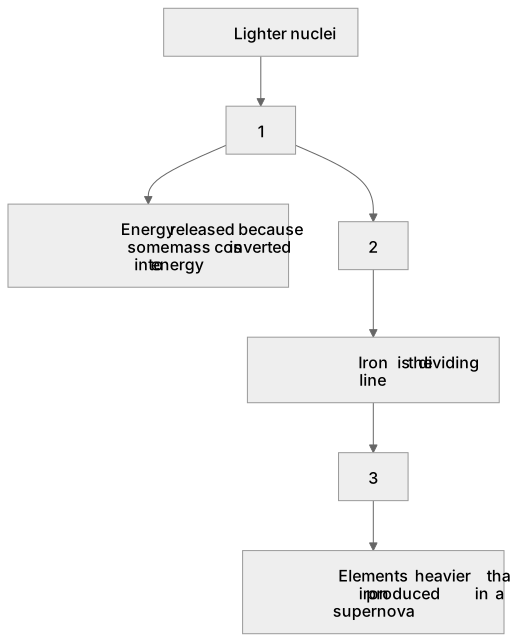
1Box 1
2Box 2
3Box 3
There is more to this lesson
The full lesson goes on to check your understanding and help you earn the marks. Create a free account to carry on, with your progress saved.
A week of Premium from your first lesson · Then the free plan continues · No card, no charge
Test your understanding of The life cycle of a star: Fusion processes in stars produce all of the naturally occurring elements. Elements heavier than iron are produced in a supernova.
Active recall beats re-reading. Take an instant quiz now to test what you’ve learned and lock it into long-term memory.
A week of Premium from your first lesson · Then the free plan continues · No card, no charge