AQA · GCSE · Physics
Course version: 8463 · Version from Sept 2016
Electrical power is transferred from power stations to consumers using the…
Full specification wording
The National Grid: Electrical power is transferred from power stations to consumers using the National Grid.
The grid's job is to move power, and power is the product of potential difference and current, P = V I. A station generating 500 MW can deliver that power as a huge current at a low potential…
Checked against the AQA 8463 specification (opens in a new tab) on .
- Point 2 of 4
- 4 key terms
Study notes
From the checked teaching notes for this specification point.
The idea
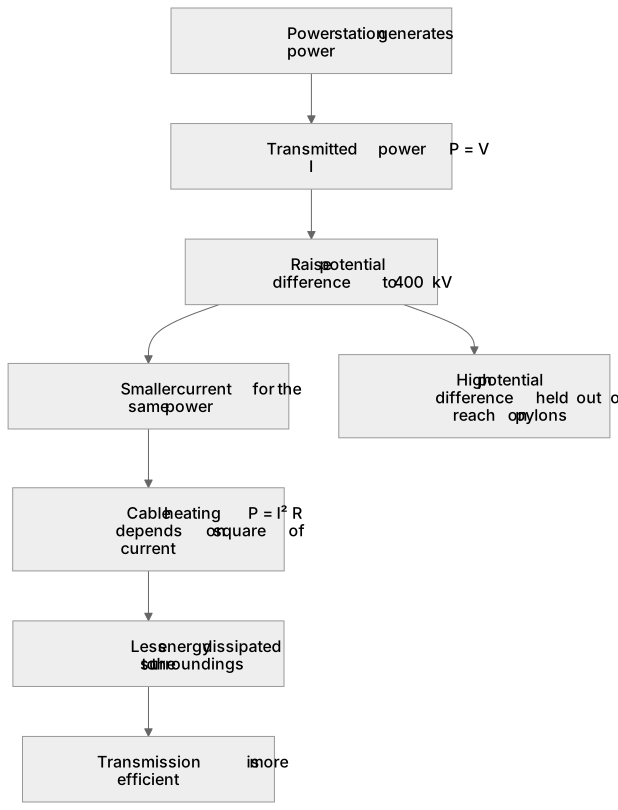
The grid's job is to move power, and power is the product of potential difference and current, P = V I. A station generating 500 MW can deliver that power as a huge current at a low potential difference or as a small current at a very high one. The cables have resistance, and the power wasted heating them is P = I² R, which depends on the square of the current and not on the potential difference. So the grid transmits at 400 kV: raising the potential difference from 25 kV to 400 kV cuts the current by a factor of 16 for the same transmitted power, and cuts the wasted heating by 16², which is 256. That is why long-distance lines always run at high potential difference and must be held out of reach on pylons.
What earns the marks
- The transmitted power being the product of potential difference and current, P = V I.
- A higher transmission potential difference giving a smaller current for the same power.
- The power wasted in the cables depending on the square of the current, P = I² R.
- Less energy being dissipated to the surroundings, so the transmission is more efficient.
Common mistakes and how to put them right
Saying a higher potential difference reduces the wasted energy without mentioning the smaller current.
Stating that the potential difference decreases at the step-up transformer.
Claiming no energy at all is transferred to the surroundings from the cables.
Using P = I R rather than P = I² R when arguing about cable losses.
Exam tips
- Answer in the order potential difference up, current down, I² R losses down, efficiency up.
- Never write that the step-up transformer reduces potential difference, because mark schemes refuse the whole answer.
- Write 'reduces the energy transferred to the surroundings' rather than 'stops energy being lost'.
Try the lesson
The start of the The National Grid: Electrical power is transferred from power stations to consumers using the National Grid. lesson, made from checked teaching notes for this specification point.
Have a go first
Which system is used to transfer electrical power from power stations to consumers?
Listen
The grid's job is to move power, and power is the product of potential difference and current, P = V I. A station generating 500 MW can deliver that power as a huge current at a low potential difference or as a small current at a very high one. The cables have resistance, and the power wasted heating them is P = I² R, which depends on the square of the current and not on the potential difference. So the grid transmits at 400 kV: raising the potential difference from 25 kV to 400 kV cuts the current by a factor of 16 for the same transmitted power, and cuts the wasted heating by 16², which is 256. That is why long-distance lines always run at high potential difference and must be held out of reach on pylons. A strong answer earns marks for these points. the transmitted power being the product of potential difference and current, P = V I. a higher transmission potential difference giving a smaller current for the same power. the power wasted in the cables depending on the square of the current, P = I² R. less energy being dissipated to the surroundings, so the transmission is more efficient. Exam tip: Answer in the order potential difference up, current down, I² R losses down, efficiency up.
See it
Key words
Say what each word means before you turn the card.
P = V I
Try answering aloud or in your head before turning the card.
I² R losses
Try answering aloud or in your head before turning the card.
high potential difference
Try answering aloud or in your head before turning the card.
transmission efficiency
Try answering aloud or in your head before turning the card.
See every definition
- P = V I
- The transmitted power is the product of potential difference and current.
- I² R losses
- The power wasted heating the cables depends on the square of the current, P = I² R.
- high potential difference
- Transmitting at a high potential difference gives a smaller current for the same power, so less energy is dissipated to the surroundings.
- transmission efficiency
- Less energy being dissipated to the surroundings means the transmission is more efficient.
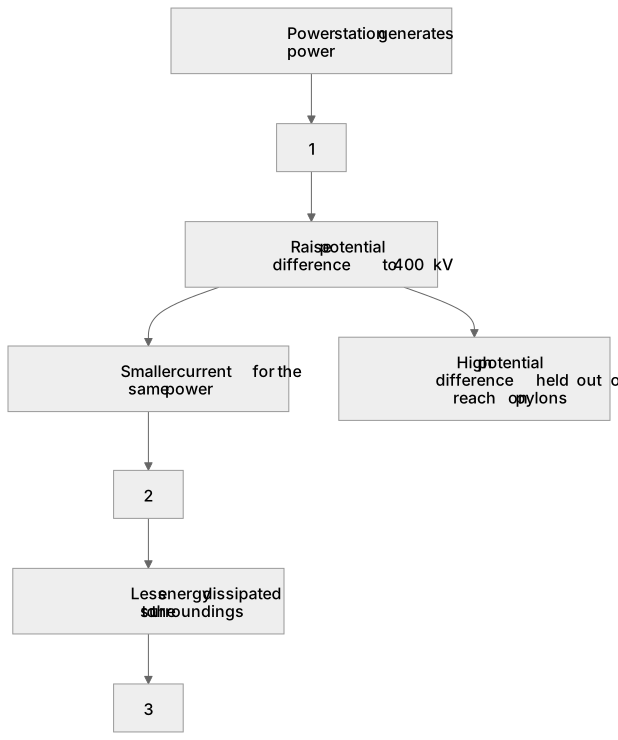
Label the diagram
Some boxes have lost their names. Pick the right name for each number.
1Box 1
2Box 2
3Box 3
There is more to this lesson
The full lesson goes on to check your understanding and help you earn the marks. Create a free account to carry on, with your progress saved.
A week of Premium from your first lesson · Then the free plan continues · No card, no charge
Test your understanding of The National Grid: Electrical power is transferred from power stations to consumers using the National Grid.
Active recall beats re-reading. Take an instant quiz now to test what you’ve learned and lock it into long-term memory.
A week of Premium from your first lesson · Then the free plan continues · No card, no charge