AQA · GCSE · Physics
Course version: 8463 · Version from Sept 2016
The National Grid is a system of cables and transformers linking power…
Full specification wording
The National Grid: The National Grid is a system of cables and transformers linking power stations to consumers.
The National Grid is the countrywide network of cables, pylons and transformers connecting every power station to every consumer.
Checked against the AQA 8463 specification (opens in a new tab) on .
- Point 1 of 4
Study notes
From the checked teaching notes for this specification point.
The idea
The National Grid is the countrywide network of cables, pylons and transformers connecting every power station to every consumer. Electricity generated at around 25 kV leaves a station through a step-up transformer that raises the potential difference to 275 kV or 400 kV for the long transmission lines, and a chain of step-down transformers at substations brings it back down, first for towns and industry and finally to about 230 V for homes. Because every station feeds the same network, no house depends on a particular power station, and output can be matched to demand as it rises in the evening or falls overnight. Stations are often held below maximum output to keep spare capacity for a surge, a breakdown or a still, cloudy day.
What earns the marks
- Describing the grid as a national network of cables and transformers linking power stations to consumers.
- A step-up transformer at the power station and step-down transformers near consumers.
- The supply being matched to the demand of the consumers.
- Spare capacity kept for an emergency shutdown or for unreliable renewable output.
Common mistakes and how to put them right
Describing the grid as a store of electricity rather than a transmission network.
Saying each home is supplied by one named power station.
Placing the step-down transformer at the power station and the step-up transformer at the house.
Claiming stations run at maximum output at all times in order to be efficient.
Exam tips
- Trace the route in order, station, step-up, transmission lines, step-down, consumer, when asked to describe the grid.
- For 'suggest two reasons' questions about spare capacity, give genuinely distinct reasons rather than two wordings of one.
- Quote 400 kV for transmission and 230 V for homes to show the scale of the change.
Try the lesson
The start of the The National Grid: The National Grid is a system of cables and transformers linking power stations to consumers. lesson, made from checked teaching notes for this specification point.
Have a go first
Which parts of the National Grid carry electrical power from power stations to consumers?
Listen
The National Grid is the countrywide network of cables, pylons and transformers connecting every power station to every consumer. Electricity generated at around 25 kV leaves a station through a step-up transformer that raises the potential difference to 275 kV or 400 kV for the long transmission lines, and a chain of step-down transformers at substations brings it back down, first for towns and industry and finally to about 230 V for homes. Because every station feeds the same network, no house depends on a particular power station, and output can be matched to demand as it rises in the evening or falls overnight. Stations are often held below maximum output to keep spare capacity for a surge, a breakdown or a still, cloudy day. A strong answer earns marks for these points. describing the grid as a national network of cables and transformers linking power stations to consumers. a step-up transformer at the power station and step-down transformers near consumers. the supply being matched to the demand of the consumers. spare capacity kept for an emergency shutdown or for unreliable renewable output. Exam tip: Trace the route in order, station, step-up, transmission lines, step-down, consumer, when asked to describe the grid.
See it
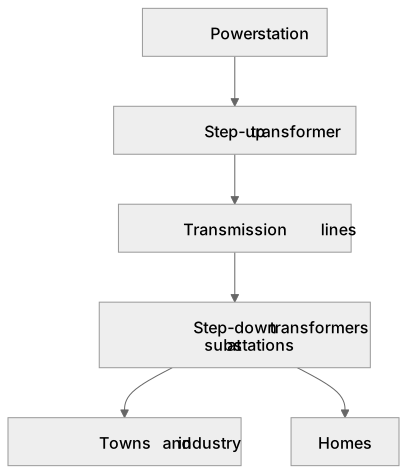
Label the diagram
Some boxes have lost their names. Pick the right name for each number.
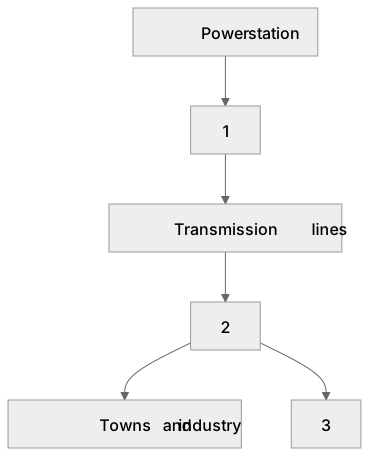
1Box 1
2Box 2
3Box 3
There is more to this lesson
The full lesson goes on to check your understanding and help you earn the marks. Create a free account to carry on, with your progress saved.
A week of Premium from your first lesson · Then the free plan continues · No card, no charge
Test your understanding of The National Grid: The National Grid is a system of cables and transformers linking power stations to consumers.
Active recall beats re-reading. Take an instant quiz now to test what you’ve learned and lock it into long-term memory.
A week of Premium from your first lesson · Then the free plan continues · No card, no charge