AQA · GCSE · Physics
Course version: 8463 · Version from Sept 2016
Electromagnetic waves are transverse waves that transfer energy from the…
Full specification wording
Types of electromagnetic waves: Electromagnetic waves are transverse waves that transfer energy from the source of the waves to an absorber.
Electromagnetic waves are oscillating electric and magnetic fields, and the oscillations are perpendicular to the direction of energy transfer, which makes them transverse.
Checked against the AQA 8463 specification (opens in a new tab) on .
- Point 1 of 5
- 4 key terms
Study notes
From the checked teaching notes for this specification point.
The idea
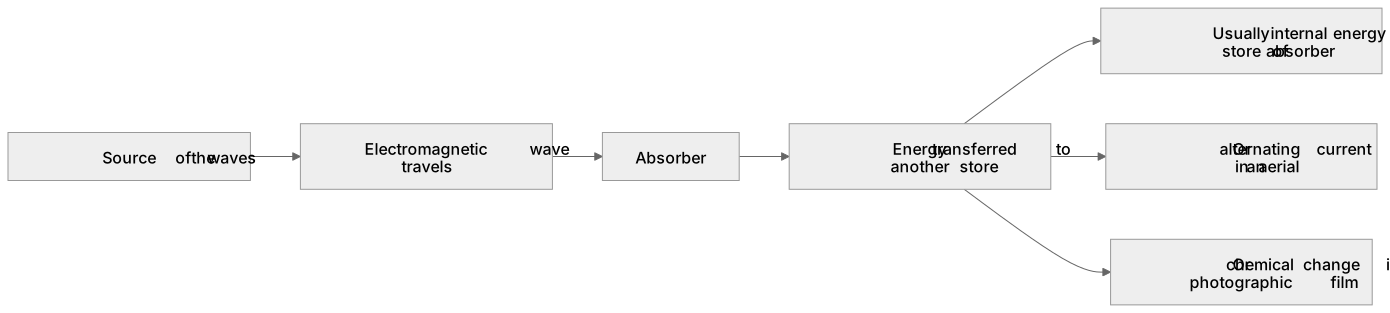
Electromagnetic waves are oscillating electric and magnetic fields, and the oscillations are perpendicular to the direction of energy transfer, which makes them transverse. Unlike sound they do not need particles, so they travel through a vacuum, which is how energy from the Sun reaches the Earth. Each wave transfers energy from a source to an absorber: the Sun to your skin, a hot grill element to food, a transmitter to an aerial. Nothing material travels from source to absorber, only energy. When the wave is absorbed the energy is transferred to another store, usually the internal energy store of the absorber so its temperature rises, though it can instead produce an alternating current in an aerial or a chemical change in a photographic film.
What earns the marks
- Stating that the oscillations are perpendicular to the direction of energy transfer.
- Saying that electromagnetic waves travel through a vacuum and need no medium.
- Naming the source and the absorber in the example given.
- Saying that energy, not matter, is transferred from the source to the absorber.
Common mistakes and how to put them right
Saying electromagnetic waves are longitudinal, or that the oscillations are of particles.
Writing that the wave carries energy to the absorber without naming what absorbs it.
Claiming electromagnetic waves travel faster in a solid because sound does.
Treating light as a stream of particles that are emitted and land on the absorber.
Exam tips
- Name the source and the absorber explicitly, because questions are usually marked on both.
- Use perpendicular to the direction of energy transfer as your definition of transverse.
- When comparing with sound, pair the points rather than writing two separate lists.
Try the lesson
The start of the Types of electromagnetic waves: Electromagnetic waves are transverse waves that transfer energy from the source of the waves to an absorber. lesson, made from checked teaching notes for this specification point.
Have a go first
Which type of wave are all electromagnetic waves?
Listen
Electromagnetic waves are oscillating electric and magnetic fields, and the oscillations are perpendicular to the direction of energy transfer, which makes them transverse. Unlike sound they do not need particles, so they travel through a vacuum, which is how energy from the Sun reaches the Earth. Each wave transfers energy from a source to an absorber: the Sun to your skin, a hot grill element to food, a transmitter to an aerial. Nothing material travels from source to absorber, only energy. When the wave is absorbed the energy is transferred to another store, usually the internal energy store of the absorber so its temperature rises, though it can instead produce an alternating current in an aerial or a chemical change in a photographic film. A strong answer earns marks for these points. stating that the oscillations are perpendicular to the direction of energy transfer. saying that electromagnetic waves travel through a vacuum and need no medium. naming the source and the absorber in the example given. saying that energy, not matter, is transferred from the source to the absorber. Exam tip: Name the source and the absorber explicitly, because questions are usually marked on both.
See it
Key words
Say what each word means before you turn the card.
transverse waves
Try answering aloud or in your head before turning the card.
travel through a vacuum
Try answering aloud or in your head before turning the card.
source and absorber
Try answering aloud or in your head before turning the card.
energy transfer
Try answering aloud or in your head before turning the card.
See every definition
- transverse waves
- Waves whose oscillations are perpendicular to the direction of energy transfer.
- travel through a vacuum
- Electromagnetic waves need no particles, so they can travel through a vacuum, which is how energy from the Sun reaches the Earth.
- source and absorber
- The place the wave transfers energy from and the place it transfers energy to, such as the Sun and your skin.
- energy transfer
- Energy, not matter, moves from the source to the absorber, and when the wave is absorbed the energy is transferred to another store.
Label the diagram
Some boxes have lost their names. Pick the right name for each number.
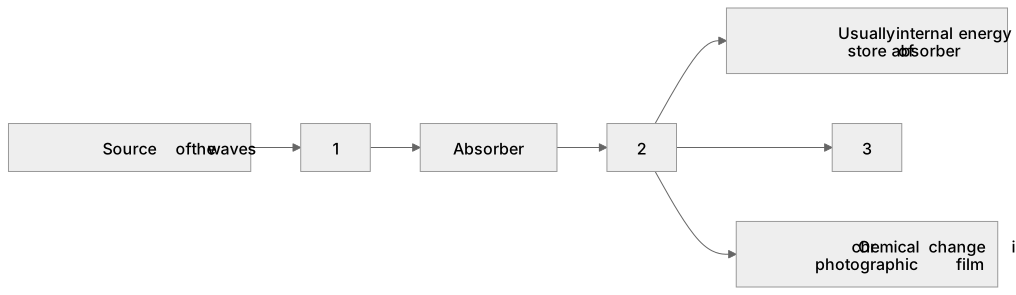
1Box 1
2Box 2
3Box 3
There is more to this lesson
The full lesson goes on to check your understanding and help you earn the marks. Create a free account to carry on, with your progress saved.
A week of Premium from your first lesson · Then the free plan continues · No card, no charge
Test your understanding of Types of electromagnetic waves: Electromagnetic waves are transverse waves that transfer energy from the source of the waves to an absorber.
Active recall beats re-reading. Take an instant quiz now to test what you’ve learned and lock it into long-term memory.
A week of Premium from your first lesson · Then the free plan continues · No card, no charge