AQA · GCSE · Physics
Course version: 8463 · Version from Sept 2016
Electromagnetic waves form a continuous spectrum and all types of…
Full specification wording
Types of electromagnetic waves: Electromagnetic waves form a continuous spectrum and all types of electromagnetic wave travel at the same velocity through a vacuum (space) or air.
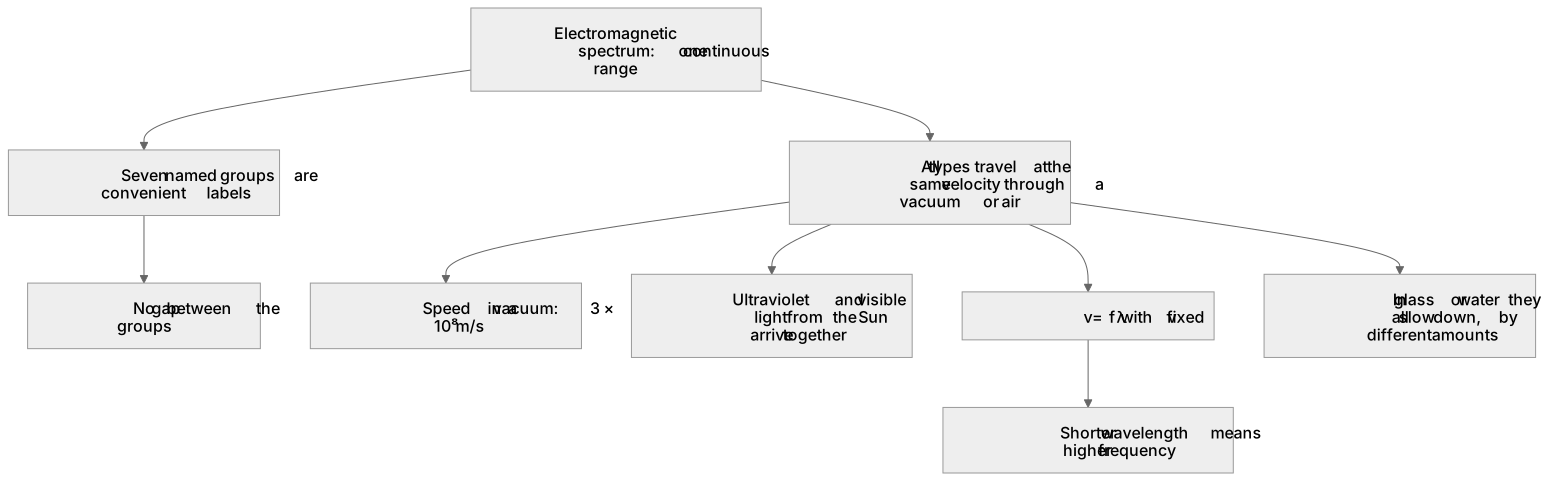
The electromagnetic spectrum is continuous: the seven named groups are convenient labels along one unbroken range of wavelengths, not seven separate kinds of wave, and there is no gap between them.
Checked against the AQA 8463 specification (opens in a new tab) on .
- Point 2 of 5
- 4 key terms
Study notes
From the checked teaching notes for this specification point.
The idea
The electromagnetic spectrum is continuous: the seven named groups are convenient labels along one unbroken range of wavelengths, not seven separate kinds of wave, and there is no gap between them. Every one of them travels at the same speed in a vacuum, 3 × 10⁸ m/s, and at very nearly the same speed in air, so ultraviolet and visible light from the Sun arrive together. Because v = f λ and v is fixed, frequency and wavelength are inversely related: the shorter the wavelength, the higher the frequency. A gamma ray and a radio wave therefore differ in wavelength and frequency but not in speed. In a material such as glass or water they all slow down, and by different amounts, which is what spreads white light into colours in a prism.
What earns the marks
- Stating that all electromagnetic waves travel at the same speed in a vacuum or air.
- Quoting that speed as 3 × 10⁸ m/s.
- Saying, for a named pair such as ultraviolet and visible light, that the two travel at the same speed.
- Using v = f λ to show that frequency rises as wavelength falls.
Common mistakes and how to put them right
Saying gamma rays travel faster than radio waves because they carry more energy.
Treating the seven groups as having sharp fixed boundaries rather than being regions of one continuous range.
Using the speed of sound in an electromagnetic wave calculation.
Saying the speed in glass is the same as the speed in a vacuum.
Exam tips
- Learn 3 × 10⁸ m/s, because it is not always printed on the equation sheet.
- Write v = f λ and rearrange before substituting, so the method mark survives an arithmetic slip.
- If asked which travels fastest in a vacuum, the answer is that they all travel at the same speed.
Try the lesson
The start of the Types of electromagnetic waves: Electromagnetic waves form a continuous spectrum and all types of electromagnetic wave travel at the same velocity through a vacuum (space) or air. lesson, made from checked teaching notes for this specification point.
Have a go first
Which statement describes the speed of all electromagnetic waves travelling through a vacuum?
Listen
The electromagnetic spectrum is continuous: the seven named groups are convenient labels along one unbroken range of wavelengths, not seven separate kinds of wave, and there is no gap between them. Every one of them travels at the same speed in a vacuum, 3 × 10⁸ m/s, and at very nearly the same speed in air, so ultraviolet and visible light from the Sun arrive together. Because v = f λ and v is fixed, frequency and wavelength are inversely related: the shorter the wavelength, the higher the frequency. A gamma ray and a radio wave therefore differ in wavelength and frequency but not in speed. In a material such as glass or water they all slow down, and by different amounts, which is what spreads white light into colours in a prism. A strong answer earns marks for these points. stating that all electromagnetic waves travel at the same speed in a vacuum or air. quoting that speed as 3 × 10⁸ m/s. saying, for a named pair such as ultraviolet and visible light, that the two travel at the same speed. using v = f λ to show that frequency rises as wavelength falls. Exam tip: Learn 3 × 10⁸ m/s, because it is not always printed on the equation sheet.
See it
Key words
Say what each word means before you turn the card.
continuous spectrum
Try answering aloud or in your head before turning the card.
3 × 10⁸ m/s
Try answering aloud or in your head before turning the card.
same speed in a vacuum
Try answering aloud or in your head before turning the card.
inverse frequency and wavelength
Try answering aloud or in your head before turning the card.
See every definition
- continuous spectrum
- The seven named groups are convenient labels along one unbroken range of wavelengths, not seven separate kinds of wave, with no gap between them.
- 3 × 10⁸ m/s
- The speed at which every type of electromagnetic wave travels through a vacuum.
- same speed in a vacuum
- All electromagnetic waves travel at the same velocity through a vacuum or air, so ultraviolet and visible light from the Sun arrive together.
- inverse frequency and wavelength
- Because v = f λ and v is fixed, the shorter the wavelength, the higher the frequency.
Label the diagram
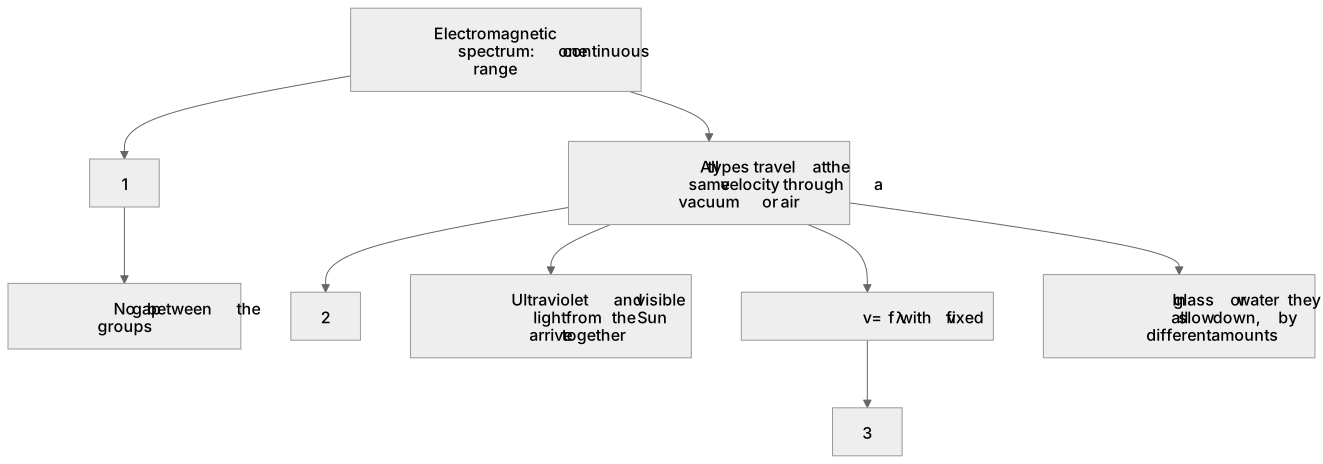
Some boxes have lost their names. Pick the right name for each number.
1Box 1
2Box 2
3Box 3
There is more to this lesson
The full lesson goes on to check your understanding and help you earn the marks. Create a free account to carry on, with your progress saved.
A week of Premium from your first lesson · Then the free plan continues · No card, no charge
Test your understanding of Types of electromagnetic waves: Electromagnetic waves form a continuous spectrum and all types of electromagnetic wave travel at the same velocity through a vacuum (space) or air.
Active recall beats re-reading. Take an instant quiz now to test what you’ve learned and lock it into long-term memory.
A week of Premium from your first lesson · Then the free plan continues · No card, no charge