AQA · GCSE · Physics
Course version: 8463 · Version from Sept 2016
Colour filters work by absorbing certain wavelengths (and colour) and…
Full specification wording
Visible light (physics only): Colour filters work by absorbing certain wavelengths (and colour) and transmitting other wavelengths (and colour).
A colour filter is a piece of coloured transparent material.
Checked against the AQA 8463 specification (opens in a new tab) on .
- Point 3 of 9
- 3 key terms
Study notes
From the checked teaching notes for this specification point.
The idea
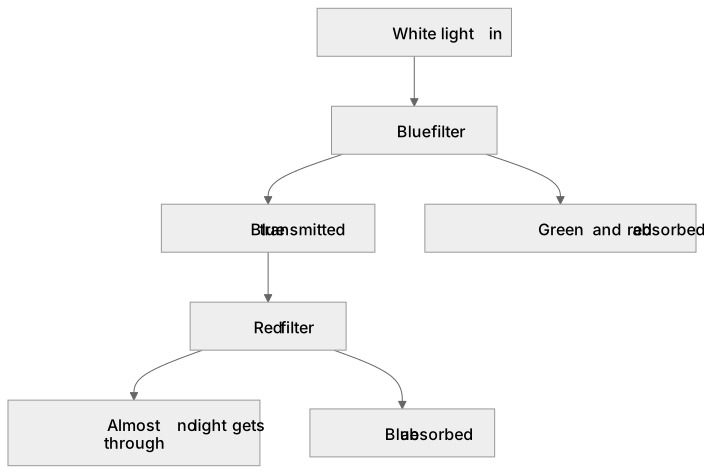
A colour filter is a piece of coloured transparent material. It transmits the wavelengths of its own colour and absorbs the rest, so the light that comes out is both coloured and dimmer than the light that went in. A blue filter transmits blue and absorbs the green and red parts of white light; a red filter transmits red and absorbs the rest. Colourless glass absorbs almost nothing, so white light passes through and stays white. The missing colours are not sent back or bent away, they are absorbed, and their energy raises the internal energy of the filter. Put a blue filter and a red filter in series and almost no light gets through at all, because whatever the first one transmits the second one absorbs.
What earns the marks
- Stating that a filter transmits light of its own colour.
- Stating that all the other colours, wavelengths or frequencies are absorbed.
- Stating that colourless glass transmits all the wavelengths, so white light is unchanged.
- Applying this to a named filter, for example blue glass absorbing the green and red light.
Common mistakes and how to put them right
Writing that the filter turns the white light blue, rather than removing the other colours from it.
Saying the unwanted colours are reflected or refracted instead of absorbed.
Expecting two different filters in series to give a mixed colour rather than near darkness.
Forgetting that light emerging from a filter is dimmer than the light that entered.
Exam tips
- Use the mark scheme words 'transmitted' and 'absorbed' in every answer about filters.
- Name the colours that are absorbed, not just the one that gets through.
- For two filters, ask what survives the first and then whether the second lets it through.
Try the lesson
The start of the Visible light (physics only): Colour filters work by absorbing certain wavelengths (and colour) and transmitting other wavelengths (and colour). lesson, made from checked teaching notes for this specification point.
Have a go first
A student shines white light at a red colour filter. What happens to the wavelengths of the light as it passes through the filter?
Listen
A colour filter is a piece of coloured transparent material. It transmits the wavelengths of its own colour and absorbs the rest, so the light that comes out is both coloured and dimmer than the light that went in. A blue filter transmits blue and absorbs the green and red parts of white light; a red filter transmits red and absorbs the rest. Colourless glass absorbs almost nothing, so white light passes through and stays white. The missing colours are not sent back or bent away, they are absorbed, and their energy raises the internal energy of the filter. Put a blue filter and a red filter in series and almost no light gets through at all, because whatever the first one transmits the second one absorbs. A strong answer earns marks for these points. stating that a filter transmits light of its own colour. stating that all the other colours, wavelengths or frequencies are absorbed. stating that colourless glass transmits all the wavelengths, so white light is unchanged. applying this to a named filter, for example blue glass absorbing the green and red light. Exam tip: Use the mark scheme words 'transmitted' and 'absorbed' in every answer about filters.
See it
Key words
Say what each word means before you turn the card.
transmission
Try answering aloud or in your head before turning the card.
absorption
Try answering aloud or in your head before turning the card.
colour filters
Try answering aloud or in your head before turning the card.
See every definition
- transmission
- The passing of certain wavelengths and colour through a colour filter, which lets through the wavelengths of its own colour.
- absorption
- The taking in of certain wavelengths and colour by a colour filter, which absorbs the rest and raises the internal energy of the filter.
- colour filters
- A piece of coloured transparent material that transmits the wavelengths of its own colour and absorbs the rest, so the light that comes out is coloured and dimmer.
Label the diagram
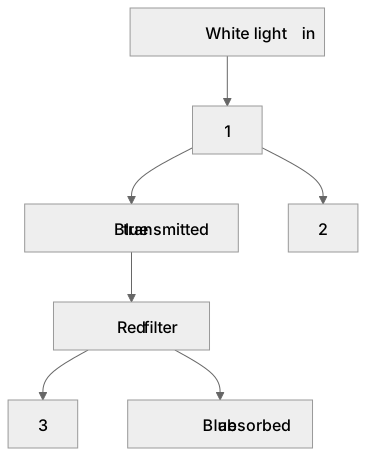
Some boxes have lost their names. Pick the right name for each number.
1Box 1
2Box 2
3Box 3
There is more to this lesson
The full lesson goes on to check your understanding and help you earn the marks. Create a free account to carry on, with your progress saved.
A week of Premium from your first lesson · Then the free plan continues · No card, no charge
Test your understanding of Visible light (physics only): Colour filters work by absorbing certain wavelengths (and colour) and transmitting other wavelengths (and colour).
Active recall beats re-reading. Take an instant quiz now to test what you’ve learned and lock it into long-term memory.
A week of Premium from your first lesson · Then the free plan continues · No card, no charge