AQA · GCSE · Physics
Course version: 8463 · Version from Sept 2016
Reflection from a smooth surface in a single direction is called specular…
Full specification wording
Visible light (physics only): Reflection from a smooth surface in a single direction is called specular reflection. Reflection from a rough surface causes scattering: this is called diffuse reflection.
Both kinds of reflection obey the same law: the angle of incidence equals the angle of reflection, both measured from the normal, the line drawn at 90° to the surface where the ray strikes.
Checked against the AQA 8463 specification (opens in a new tab) on .
- Point 2 of 9
- 4 key terms
Study notes
From the checked teaching notes for this specification point.
The idea
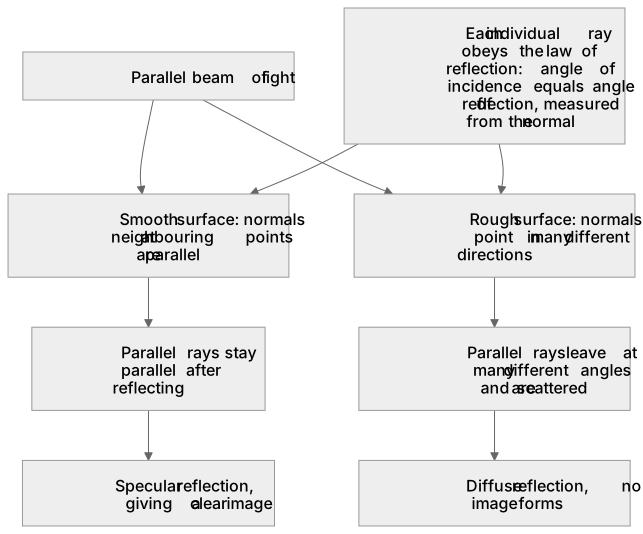
Both kinds of reflection obey the same law: the angle of incidence equals the angle of reflection, both measured from the normal, the line drawn at 90° to the surface where the ray strikes. On a smooth surface such as a mirror or still water, the normals at neighbouring points are parallel, so a parallel beam stays parallel after reflecting. That is specular reflection, and it is why you see a clear image. On a rough surface the normals point in many different directions, so parallel rays leave at many different angles and the light is scattered. That is diffuse reflection, and no image forms. The light is not absorbed any more strongly, just spread out, which is why a sheet of white paper looks bright but shows no reflection of your face. Each individual ray still obeys the law of reflection.
What earns the marks
- Drawing the normal at 90° at the point where the incident ray meets the surface.
- A ruled reflected ray with the angle of reflection equal to the angle of incidence.
- Stating that a smooth surface keeps parallel rays parallel, giving specular reflection and an image.
- Stating that a rough surface scatters parallel rays in many directions, giving diffuse reflection.
Common mistakes and how to put them right
Measuring the angles from the surface instead of from the normal.
Drawing the reflected ray freehand, or from a point other than where the incident ray strikes.
Saying the law of reflection breaks down at a rough surface rather than applying at each point.
Claiming a rough surface absorbs the light, when it scatters it.
Exam tips
- Draw and label the normal first; the angle marks are only worth credit if they are measured from it.
- Use a ruler for every ray and keep the reflected ray starting exactly at the point of incidence.
- For diffuse reflection write 'scattered in many directions', not just 'reflected badly'.
Try the lesson
The start of the Visible light (physics only): Reflection from a smooth surface in a single direction is called specular reflection. Reflection from a rough surface causes scattering: this is called diffuse reflection. lesson, made from checked teaching notes for this specification point.
Have a go first
What is the name for reflection from a smooth surface in a single direction?
Listen
Both kinds of reflection obey the same law: the angle of incidence equals the angle of reflection, both measured from the normal, the line drawn at 90° to the surface where the ray strikes. On a smooth surface such as a mirror or still water, the normals at neighbouring points are parallel, so a parallel beam stays parallel after reflecting. That is specular reflection, and it is why you see a clear image. On a rough surface the normals point in many different directions, so parallel rays leave at many different angles and the light is scattered. That is diffuse reflection, and no image forms. The light is not absorbed any more strongly, just spread out, which is why a sheet of white paper looks bright but shows no reflection of your face. Each individual ray still obeys the law of reflection. A strong answer earns marks for these points. drawing the normal at 90° at the point where the incident ray meets the surface. a ruled reflected ray with the angle of reflection equal to the angle of incidence. stating that a smooth surface keeps parallel rays parallel, giving specular reflection and an image. stating that a rough surface scatters parallel rays in many directions, giving diffuse reflection. Exam tip: Draw and label the normal first; the angle marks are only worth credit if they are measured from it.
See it
Key words
Say what each word means before you turn the card.
law of reflection
Try answering aloud or in your head before turning the card.
the normal
Try answering aloud or in your head before turning the card.
specular reflection
Try answering aloud or in your head before turning the card.
diffuse reflection
Try answering aloud or in your head before turning the card.
See every definition
- law of reflection
- The angle of incidence equals the angle of reflection, both measured from the normal.
- the normal
- The line drawn at 90° to the surface where the ray strikes.
- specular reflection
- Reflection from a smooth surface in a single direction, where parallel rays stay parallel and a clear image is seen.
- diffuse reflection
- Reflection from a rough surface, where the normals point in many different directions so parallel rays leave at many different angles and the light is scattered.
Label the diagram
Some boxes have lost their names. Pick the right name for each number.

1Box 1
2Box 2
3Box 3
There is more to this lesson
The full lesson goes on to check your understanding and help you earn the marks. Create a free account to carry on, with your progress saved.
A week of Premium from your first lesson · Then the free plan continues · No card, no charge
Test your understanding of Visible light (physics only): Reflection from a smooth surface in a single direction is called specular reflection. Reflection from a rough surface causes scattering: this is called diffuse reflection.
Active recall beats re-reading. Take an instant quiz now to test what you’ve learned and lock it into long-term memory.
A week of Premium from your first lesson · Then the free plan continues · No card, no charge