AQA · GCSE · Physics
Course version: 8463 · Version from Sept 2016
S-waves are transverse, seismic waves.
Full specification wording
Waves for detection and exploration (physics only) (HT only): S-waves are transverse, seismic waves.
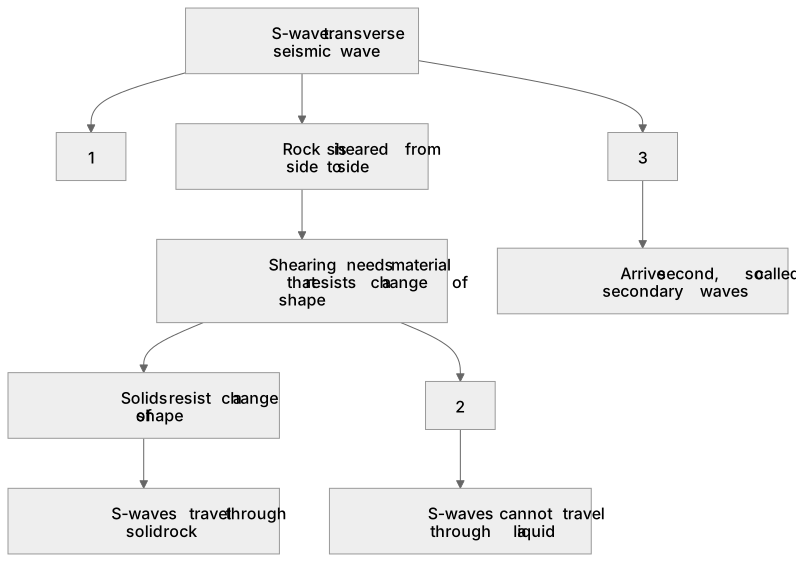
In an S-wave the rock particles oscillate at right angles, perpendicular, to the direction of energy transfer, so the rock is sheared from side to side rather than squeezed.
Checked against the AQA 8463 specification (opens in a new tab) on .
- Point 9 of 12
- 3 key terms
Study notes
From the checked teaching notes for this specification point.
The idea
In an S-wave the rock particles oscillate at right angles, perpendicular, to the direction of energy transfer, so the rock is sheared from side to side rather than squeezed. That is the same geometry as a wave on a rope or a light wave. Shearing only works where the material resists a change of shape, which solids do and liquids do not, so S-waves travel through solid rock but stop dead at a liquid boundary. They are slower than P-waves, roughly half to two thirds of the P-wave speed in the same rock, which is why they arrive second and are called secondary waves. The delay between the P and the S arrival at a station grows steadily with distance from the earthquake.
What earns the marks
- Stating that the oscillations are perpendicular to the direction of energy transfer.
- Saying that S-waves cannot travel through a liquid.
- Stating that S-waves travel more slowly than P-waves and arrive second.
- Linking the inability to travel through a liquid to a liquid not resisting a change of shape.
Common mistakes and how to put them right
Writing up and down instead of perpendicular to the direction of energy transfer, which fails for a wave travelling upwards.
Saying S-waves are slower because they are weaker.
Claiming S-waves are absorbed by the liquid core rather than being unable to travel through it at all.
Mixing up which wave is longitudinal and which is transverse.
Exam tips
- Answer the definition using the word perpendicular; sideways on its own is not credited.
- Say that a liquid cannot resist shearing, rather than that a liquid is too thin.
- When a question gives P and S arrival times, subtract them and comment on the distance.
Try the lesson
The start of the Waves for detection and exploration (physics only) (HT only): S-waves are transverse, seismic waves. lesson, made from checked teaching notes for this specification point.
Have a go first
Which description matches an S-wave?
Listen
In an S-wave the rock particles oscillate at right angles, perpendicular, to the direction of energy transfer, so the rock is sheared from side to side rather than squeezed. That is the same geometry as a wave on a rope or a light wave. Shearing only works where the material resists a change of shape, which solids do and liquids do not, so S-waves travel through solid rock but stop dead at a liquid boundary. They are slower than P-waves, roughly half to two thirds of the P-wave speed in the same rock, which is why they arrive second and are called secondary waves. The delay between the P and the S arrival at a station grows steadily with distance from the earthquake. A strong answer earns marks for these points. stating that the oscillations are perpendicular to the direction of energy transfer. saying that S-waves cannot travel through a liquid. stating that S-waves travel more slowly than P-waves and arrive second. linking the inability to travel through a liquid to a liquid not resisting a change of shape. Exam tip: Answer the definition using the word perpendicular; sideways on its own is not credited.
See it

Key words
Say what each word means before you turn the card.
shearing the rock
Try answering aloud or in your head before turning the card.
blocked by liquids
Try answering aloud or in your head before turning the card.
slower than P-waves
Try answering aloud or in your head before turning the card.
See every definition
- shearing the rock
- The rock is sheared from side to side rather than squeezed, which only works where the material resists a change of shape.
- blocked by liquids
- S-waves travel through solid rock but stop dead at a liquid boundary, because liquids do not resist a change of shape.
- slower than P-waves
- Roughly half to two thirds of the P-wave speed in the same rock, which is why they arrive second.
Label the diagram
Some boxes have lost their names. Pick the right name for each number.
1Box 1
2Box 2
3Box 3
There is more to this lesson
The full lesson goes on to check your understanding and help you earn the marks. Create a free account to carry on, with your progress saved.
A week of Premium from your first lesson · Then the free plan continues · No card, no charge
Test your understanding of Waves for detection and exploration (physics only) (HT only): S-waves are transverse, seismic waves.
Active recall beats re-reading. Take an instant quiz now to test what you’ve learned and lock it into long-term memory.
A week of Premium from your first lesson · Then the free plan continues · No card, no charge