AQA · GCSE · Physics
Course version: 8463 · Version from Sept 2016
S-waves cannot travel through a liquid. P-waves and S-waves provide…
Full specification wording
Waves for detection and exploration (physics only) (HT only): S-waves cannot travel through a liquid. P-waves and S-waves provide evidence for the structure and size of the Earth’s core.
Put the two behaviours together and the inside of the Earth can be mapped without anyone going there.
Checked against the AQA 8463 specification (opens in a new tab) on .
- Point 10 of 12
- 4 key terms
Study notes
From the checked teaching notes for this specification point.
The idea
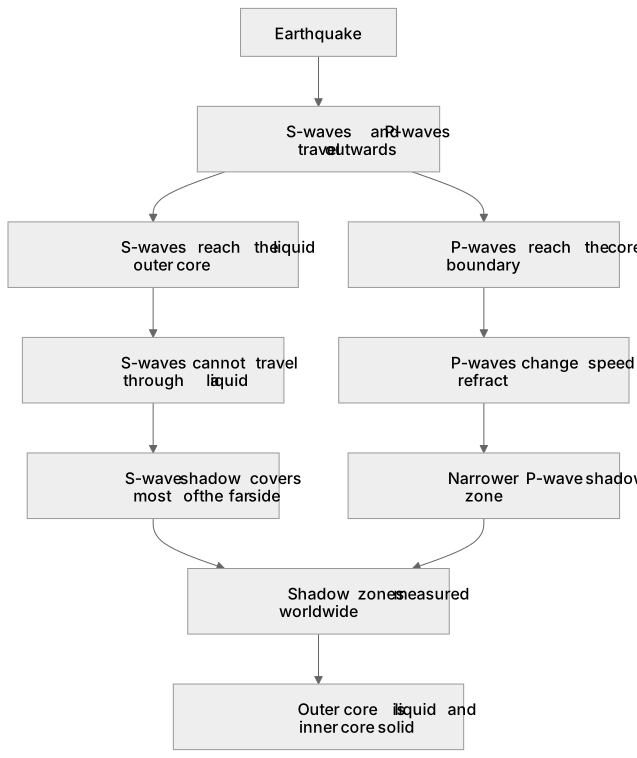
Put the two behaviours together and the inside of the Earth can be mapped without anyone going there. S-waves are transverse and need a material that resists shearing, so they stop at the boundary of the liquid outer core; that leaves a huge S-wave shadow covering most of the far side of the globe, which is the evidence that the outer core is liquid. P-waves do cross the core but change speed as they enter it, so they refract and leave a narrower P-wave shadow zone. The angular width and position of each shadow is measured from seismometers worldwide, and the only structure that fits is a layered Earth: solid mantle, liquid outer core, and a solid inner core revealed by faint refracted P-wave arrivals inside the shadow.
What earns the marks
- Stating that S-waves are not detected on the far side because they cannot travel through the liquid outer core.
- Saying that P-waves are refracted where the speed changes at the core boundary.
- Using the size of the shadow zones to work out the size of the core.
- Concluding that the outer core is liquid and the inner core solid.
Common mistakes and how to put them right
Saying the core absorbs S-waves rather than that S-waves cannot travel through a liquid at all.
Giving the conclusion, a liquid core, without the seismic evidence that supports it.
Assuming the whole core is liquid and ignoring the solid inner core.
Describing a shadow zone as where the waves are weakest rather than where direct waves do not arrive.
Exam tips
- Structure the answer as observation then conclusion: what is or is not detected, then what that shows.
- Use the term shadow zone; it is the wording examiners look for.
- Mention both wave types, since an answer using only S-waves cannot give the size of the core.
Try the lesson
The start of the Waves for detection and exploration (physics only) (HT only): S-waves cannot travel through a liquid. P-waves and S-waves provide evidence for the structure and size of the Earth’s core. lesson, made from checked teaching notes for this specification point.
Have a go first
Seismologists record seismic waves from an earthquake using detectors located around the Earth. They observe a large shadow zone on the opposite side of the Earth where no S-waves are detected. What does this shadow zone demonstrate about the Earth's interior?
Listen
Put the two behaviours together and the inside of the Earth can be mapped without anyone going there. S-waves are transverse and need a material that resists shearing, so they stop at the boundary of the liquid outer core; that leaves a huge S-wave shadow covering most of the far side of the globe, which is the evidence that the outer core is liquid. P-waves do cross the core but change speed as they enter it, so they refract and leave a narrower P-wave shadow zone. The angular width and position of each shadow is measured from seismometers worldwide, and the only structure that fits is a layered Earth: solid mantle, liquid outer core, and a solid inner core revealed by faint refracted P-wave arrivals inside the shadow. A strong answer earns marks for these points. stating that S-waves are not detected on the far side because they cannot travel through the liquid outer core. saying that P-waves are refracted where the speed changes at the core boundary. using the size of the shadow zones to work out the size of the core. concluding that the outer core is liquid and the inner core solid. Exam tip: Structure the answer as observation then conclusion: what is or is not detected, then what that shows.
See it
Key words
Say what each word means before you turn the card.
S-wave shadow
Try answering aloud or in your head before turning the card.
liquid outer core
Try answering aloud or in your head before turning the card.
solid inner core
Try answering aloud or in your head before turning the card.
refraction at the core boundary
Try answering aloud or in your head before turning the card.
See every definition
- S-wave shadow
- A huge shadow covering most of the far side of the globe, left because S-waves stop at the boundary of the liquid outer core.
- liquid outer core
- The layer at which S-waves stop, which is the evidence that this part of the core is liquid.
- solid inner core
- The part of the core revealed by faint refracted P-wave arrivals inside the shadow.
- refraction at the core boundary
- The change of direction of P-waves as they enter the core, where their speed changes.
Label the diagram
Some boxes have lost their names. Pick the right name for each number.
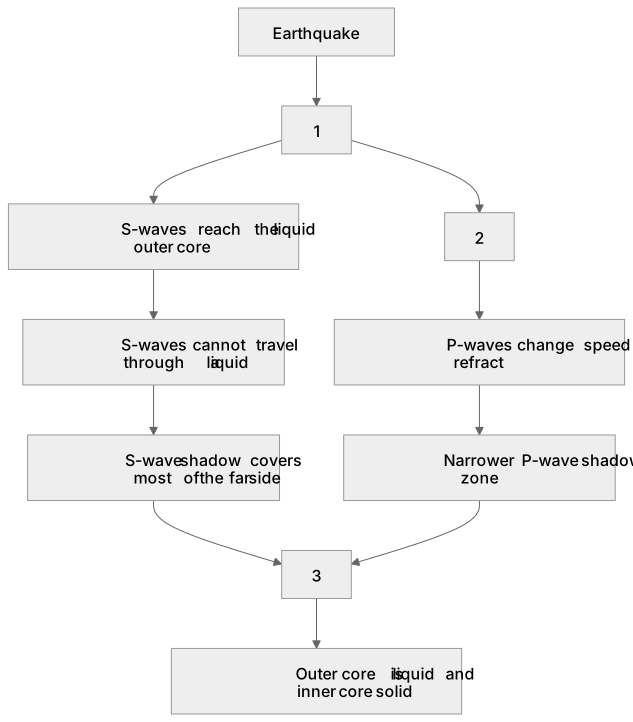
1Box 1
2Box 2
3Box 3
There is more to this lesson
The full lesson goes on to check your understanding and help you earn the marks. Create a free account to carry on, with your progress saved.
A week of Premium from your first lesson · Then the free plan continues · No card, no charge
Test your understanding of Waves for detection and exploration (physics only) (HT only): S-waves cannot travel through a liquid. P-waves and S-waves provide evidence for the structure and size of the Earth’s core.
Active recall beats re-reading. Take an instant quiz now to test what you’ve learned and lock it into long-term memory.
A week of Premium from your first lesson · Then the free plan continues · No card, no charge