AQA · GCSE · Physics
Course version: 8463 · Version from Sept 2016
Students should be able to explain in qualitative terms, how the…
Full specification wording
Waves for detection and exploration (physics only) (HT only): Students should be able to explain in qualitative terms, how the differences in velocity, absorption and reflection between different types of wave in solids and liquids can be used both for detection and exploration of structures which are hidden from direct observation.
This is the big idea of the section, Higher tier physics only.
Checked against the AQA 8463 specification (opens in a new tab) on .
- Point 1 of 12
- 4 key terms
Study notes
From the checked teaching notes for this specification point.
The idea
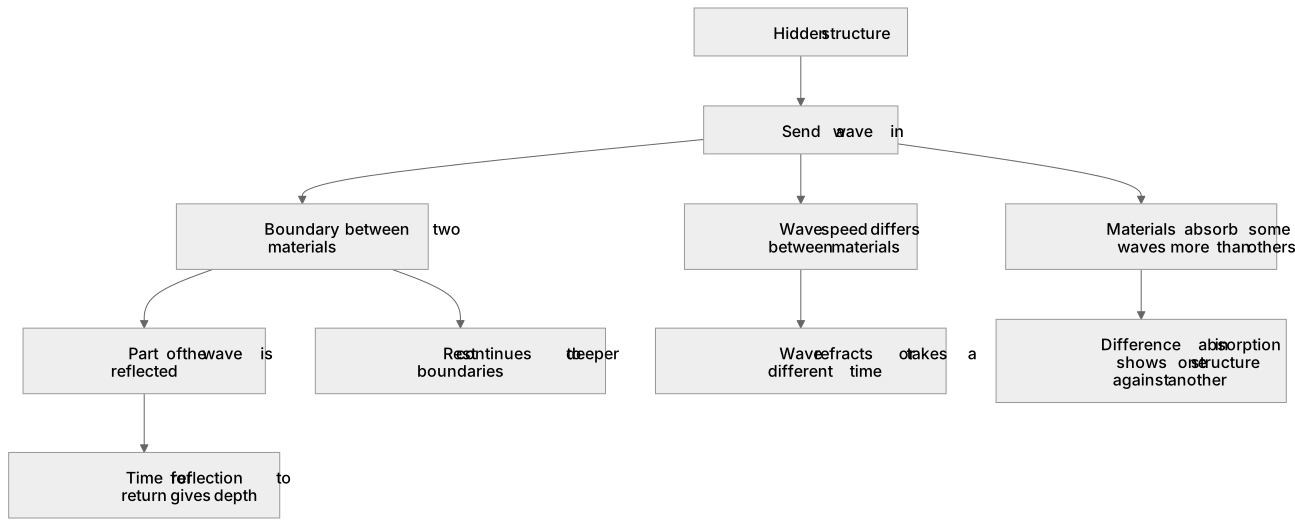
This is the big idea of the section, Higher tier physics only. We cannot see inside a body, a weld or the Earth, so we send a wave in and read what comes back. Three properties do the work. Velocity: a wave changes speed when the material changes, which refracts it and alters the travel time. Absorption: materials soak up some waves more than others, so dense bone or a flaw in a casting shows up as a shadow. Reflection: at every boundary part of the wave is reflected, and the time it takes to return gives the depth of that boundary. Ultrasound scanning uses partial reflection at soft tissue boundaries, X-ray imaging uses differences in absorption, and seismology uses differences in velocity together with the fact that S-waves stop at a liquid.
What earns the marks
- Stating that part of the wave is reflected at each boundary between two different materials.
- Linking the time for a reflection to return to the depth of that boundary.
- Saying that the wave speed differs between materials, so the wave refracts or takes a different time.
- Using a difference in absorption to explain why one structure shows up against another.
Common mistakes and how to put them right
Saying the wave passes through and shows the shape, with no mention of reflection or absorption.
Using ultrasound and X-rays interchangeably, when one relies on reflection and the other on absorption.
Forgetting that only part of the wave is reflected, so the rest continues to deeper boundaries.
Describing a detector as producing the image without the return signal being timed or measured.
Exam tips
- Decide first which of the three properties the context depends on, then build the answer around it.
- For any how do we know what is inside question, start with the boundary and what happens there.
- Use qualitative comparisons carefully: faster, slower, more strongly absorbed, partially reflected.
Try the lesson
The start of the Waves for detection and exploration (physics only) (HT only): Students should be able to explain in qualitative terms, how the differences in velocity, absorption and reflection between different types of wave in solids and liquids can be used both for detection and exploration of structures which are hidden from direct observation. lesson, made from checked teaching notes for this specification point.
Have a go first
Ultrasound waves are used to detect structures hidden inside the human body. Which property of ultrasound makes this possible?
Listen
This is the big idea of the section, Higher tier physics only. We cannot see inside a body, a weld or the Earth, so we send a wave in and read what comes back. Three properties do the work. Velocity: a wave changes speed when the material changes, which refracts it and alters the travel time. Absorption: materials soak up some waves more than others, so dense bone or a flaw in a casting shows up as a shadow. Reflection: at every boundary part of the wave is reflected, and the time it takes to return gives the depth of that boundary. Ultrasound scanning uses partial reflection at soft tissue boundaries, X-ray imaging uses differences in absorption, and seismology uses differences in velocity together with the fact that S-waves stop at a liquid. A strong answer earns marks for these points. stating that part of the wave is reflected at each boundary between two different materials. linking the time for a reflection to return to the depth of that boundary. saying that the wave speed differs between materials, so the wave refracts or takes a different time. using a difference in absorption to explain why one structure shows up against another. Exam tip: Decide first which of the three properties the context depends on, then build the answer around it.
See it
Key words
Say what each word means before you turn the card.
partial reflection
Try answering aloud or in your head before turning the card.
absorption contrast
Try answering aloud or in your head before turning the card.
change of speed
Try answering aloud or in your head before turning the card.
detection and exploration
Try answering aloud or in your head before turning the card.
See every definition
- partial reflection
- At every boundary between two different materials, part of the wave is reflected and the rest continues to deeper boundaries.
- absorption contrast
- Materials soak up some waves more than others, so a structure such as dense bone or a flaw in a casting shows up as a shadow against another.
- change of speed
- A wave changes speed when the material changes, which refracts it and alters the travel time.
- detection and exploration
- Sending a wave into a structure hidden from direct observation and reading what comes back, using differences in velocity, absorption and reflection.
Label the diagram
Some boxes have lost their names. Pick the right name for each number.
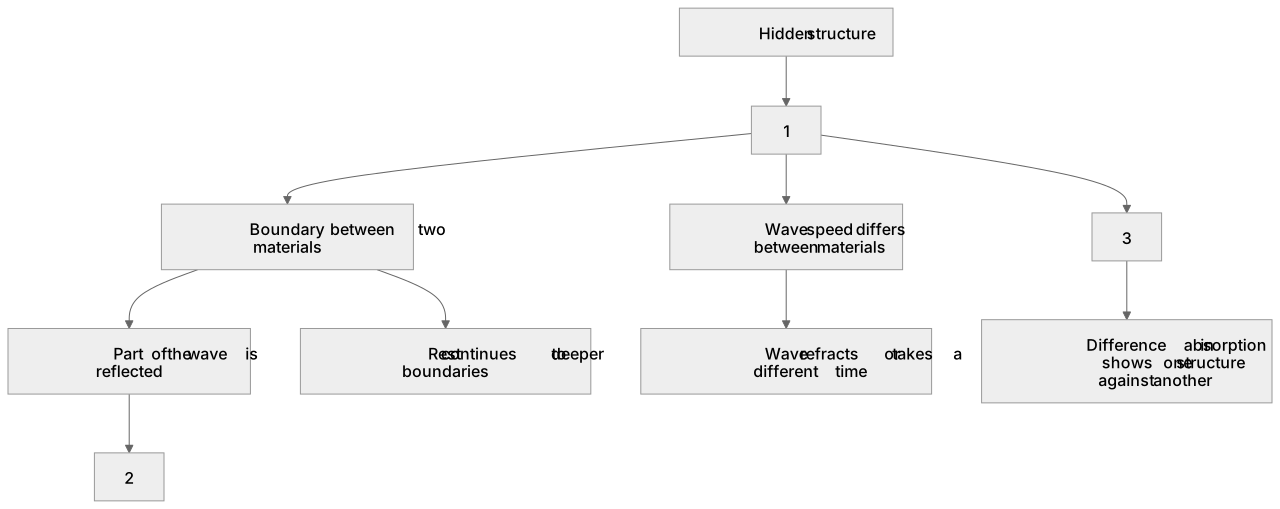
1Box 1
2Box 2
3Box 3
There is more to this lesson
The full lesson goes on to check your understanding and help you earn the marks. Create a free account to carry on, with your progress saved.
A week of Premium from your first lesson · Then the free plan continues · No card, no charge
Test your understanding of Waves for detection and exploration (physics only) (HT only): Students should be able to explain in qualitative terms, how the differences in velocity, absorption and reflection between different types of wave in solids and liquids can be used both for detection and exploration of structures which are hidden from direct observation.
Active recall beats re-reading. Take an instant quiz now to test what you’ve learned and lock it into long-term memory.
A week of Premium from your first lesson · Then the free plan continues · No card, no charge