AQA · GCSE · Physics
Course version: 8463 · Version from Sept 2016
Ultrasound waves have a frequency higher than the upper limit of hearing…
Full specification wording
Waves for detection and exploration (physics only) (HT only): Ultrasound waves have a frequency higher than the upper limit of hearing for humans.
Ultrasound is defined by frequency and nothing else: it is a longitudinal sound wave with a frequency above 20 000 Hz, so a human cannot hear it.
Checked against the AQA 8463 specification (opens in a new tab) on .
- Point 2 of 12
Study notes
From the checked teaching notes for this specification point.
The idea
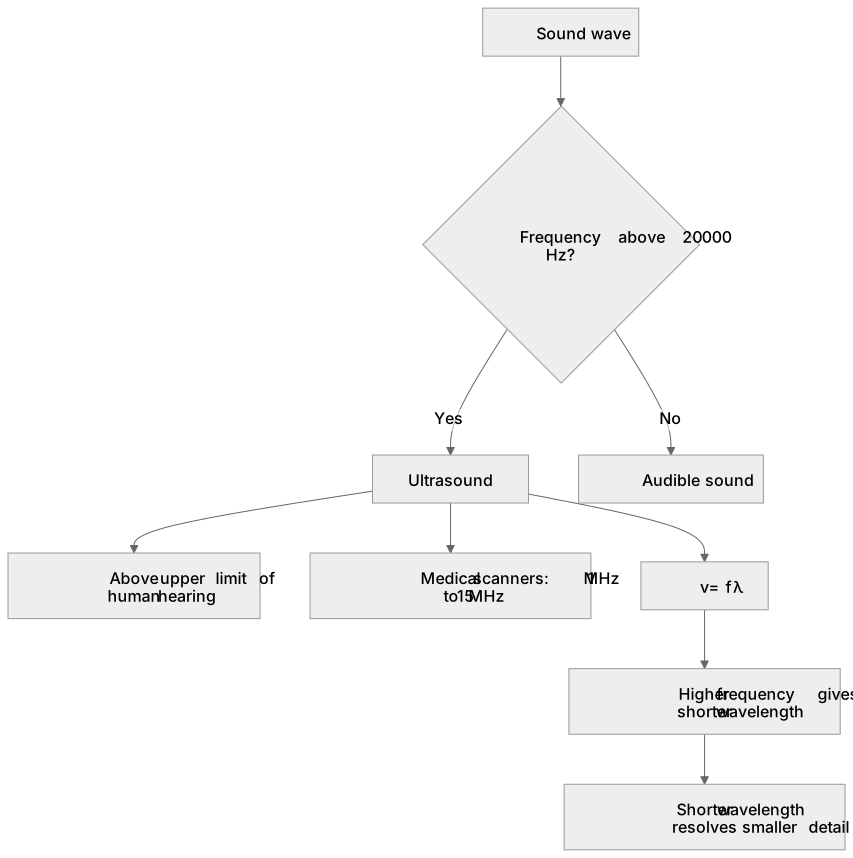
Ultrasound is defined by frequency and nothing else: it is a longitudinal sound wave with a frequency above 20 000 Hz, so a human cannot hear it. Medical scanners typically use between 1 MHz and 15 MHz. The high frequency matters because, from the wave equation v = f λ, at a fixed speed a higher frequency means a shorter wavelength, and a shorter wavelength resolves smaller detail and reflects cleanly from small boundaries. In soft tissue the speed is about 1500 m/s, so a 3 MHz wave has a wavelength of about 0.5 mm. Ultrasound obeys all the usual wave rules: it needs a medium, it is reflected and refracted at boundaries, and it is absorbed as it travels, which is why deep structures give weaker echoes.
What earns the marks
- Defining ultrasound as sound of frequency greater than 20 000 Hz.
- Stating that it lies above the upper limit of human hearing so cannot be heard.
- Using v = f λ correctly to find a wavelength from a given ultrasound frequency.
- Linking a shorter wavelength to finer detail in the image.
Common mistakes and how to put them right
Calling ultrasound an electromagnetic wave, or saying it travels at the speed of light.
Saying ultrasound is louder or more powerful rather than higher in frequency.
Substituting the speed of sound in air when the question gives a speed in tissue.
Leaving the frequency in MHz when the speed is in m/s, giving a wavelength out by a factor of a million.
Exam tips
- Convert MHz to Hz before any wave equation calculation and show the conversion.
- Define ultrasound by comparing it with 20 kHz; a definition without that comparison rarely scores.
- Use the speed the question gives you, not a remembered value, when tissue or water is involved.
Try the lesson
The start of the Waves for detection and exploration (physics only) (HT only): Ultrasound waves have a frequency higher than the upper limit of hearing for humans. lesson, made from checked teaching notes for this specification point.
Have a go first
A student reads that the upper limit of human hearing is about 20 kHz. Which statement correctly describes an ultrasound wave?
Listen
Ultrasound is defined by frequency and nothing else: it is a longitudinal sound wave with a frequency above 20 000 Hz, so a human cannot hear it. Medical scanners typically use between 1 MHz and 15 MHz. The high frequency matters because, from the wave equation v = f λ, at a fixed speed a higher frequency means a shorter wavelength, and a shorter wavelength resolves smaller detail and reflects cleanly from small boundaries. In soft tissue the speed is about 1500 m/s, so a 3 MHz wave has a wavelength of about 0.5 mm. Ultrasound obeys all the usual wave rules: it needs a medium, it is reflected and refracted at boundaries, and it is absorbed as it travels, which is why deep structures give weaker echoes. A strong answer earns marks for these points. defining ultrasound as sound of frequency greater than 20 000 Hz. stating that it lies above the upper limit of human hearing so cannot be heard. using v = f λ correctly to find a wavelength from a given ultrasound frequency. linking a shorter wavelength to finer detail in the image. Exam tip: Convert MHz to Hz before any wave equation calculation and show the conversion.
See it
There is more to this lesson
The full lesson goes on to check your understanding and help you earn the marks. Create a free account to carry on, with your progress saved.
A week of Premium from your first lesson · Then the free plan continues · No card, no charge
Test your understanding of Waves for detection and exploration (physics only) (HT only): Ultrasound waves have a frequency higher than the upper limit of hearing for humans.
Active recall beats re-reading. Take an instant quiz now to test what you’ve learned and lock it into long-term memory.
A week of Premium from your first lesson · Then the free plan continues · No card, no charge