OCR · A-Level · Physics
Course version: H556 · Version from Sept 2015
(e) current as the movement of electrons in metals and movement of ions in…
Full specification wording
Charge: (e) current as the movement of electrons in metals and movement of ions in electrolytes
Electric current is the rate of flow of charged particles, and the identity of those particles depends on the conductor.
Checked against the OCR H556 specification (opens in a new tab) on .
- Point 5 of 7
- 3 key terms
Study notes
From the checked teaching notes for this specification point.
The idea
Electric current is the rate of flow of charged particles, and the identity of those particles depends on the conductor. In a metal, outer electrons are delocalised from the positive ion lattice, so the charge carriers are electrons; a current of 1 A means 1 C of charge passes a point each second, and since each electron carries about 1.60 × 10⁻¹⁹ C, that is roughly 6.25 × 10¹⁸ electrons per second. In an electrolyte, the liquid or solution contains positive and negative ions that are free to move, so both ion types drift in opposite directions and together carry the current; the electrodes deliver or remove charge, driving chemical change. In both cases the current direction is defined by conventional current, and the carriers move much more slowly than the signal.
What earns the marks
- Current is the rate of flow of charge, I = ΔQ/Δt, measured in amperes where 1 A = 1 C s⁻¹.
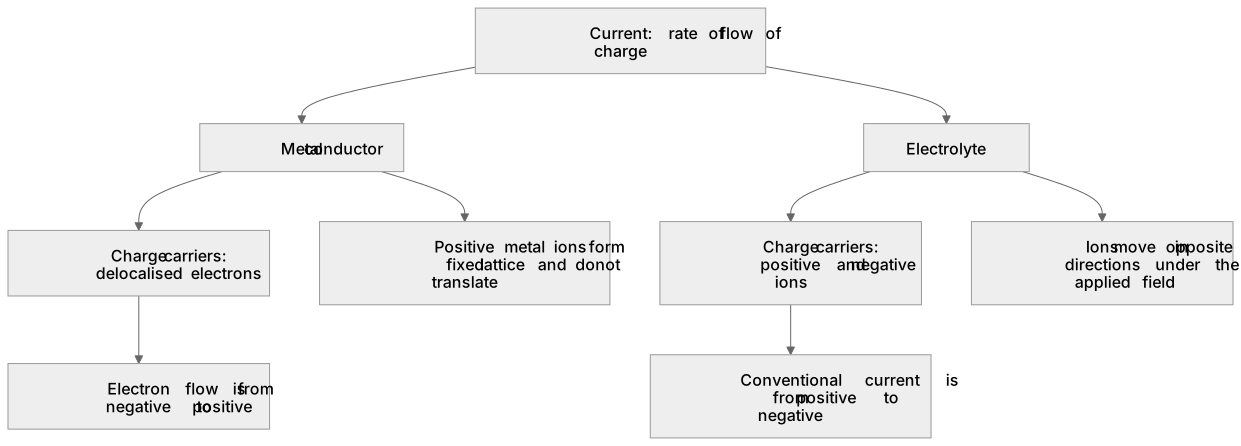
- In metals the charge carriers are delocalised electrons; the positive metal ions form a fixed lattice and do not translate.
- In electrolytes the charge carriers are positive and negative ions, which move in opposite directions under the applied field.
- The magnitude of the current depends on the charge on each carrier, the number density of carriers and their mean drift velocity.
- A current of 1 A corresponds to about 6.25 × 10¹⁸ electrons passing a point per second, since 1 ÷ (1.60 × 10⁻¹⁹ C) ≈ 6.25 × 10¹⁸.
Common mistakes and how to put them right
Thinking that in a metal the positive ions also drift and carry current.
Put it right: The ions are fixed in the lattice, so only the delocalised electrons move through the metal.
Believing that electrons travel from the negative terminal to the positive terminal at nearly the speed of light.
Put it right: The drift velocity is typically a fraction of a millimetre per second, while the electric field signal propagates much faster.
Assuming an electrolyte conducts because electrons flow through the liquid.
Put it right: Conduction in an electrolyte is by movement of positive and negative ions, with electrons transferred at the electrode surfaces.
Exam tips
- Read the stem carefully to identify the material; if it is a metal, select the option describing electron flow, and if it is an electrolyte, select the option describing ion movement.
- Check the direction wording: conventional current is from positive to negative, while electron flow in a metal is from negative to positive.
- Use I = ΔQ/Δt with the elementary charge 1.60 × 10⁻¹⁹ C to convert between current and number of carriers per second when a numerical option is offered.
Try the lesson
The start of the Charge: (e) current as the movement of electrons in metals and movement of ions in electrolytes lesson, made from checked teaching notes for this specification point.
Listen
Electric current is the rate of flow of charged particles, and the identity of those particles depends on the conductor. In a metal, outer electrons are delocalised from the positive ion lattice, so the charge carriers are electrons; a current of 1 A means 1 C of charge passes a point each second, and since each electron carries about 1.60 × 10⁻¹⁹ C, that is roughly 6.25 × 10¹⁸ electrons per second. In an electrolyte, the liquid or solution contains positive and negative ions that are free to move, so both ion types drift in opposite directions and together carry the current; the electrodes deliver or remove charge, driving chemical change. In both cases the current direction is defined by conventional current, and the carriers move much more slowly than the signal. A strong answer earns marks for these points. Current is the rate of flow of charge, I = ΔQ/Δt, measured in amperes where 1 A = 1 C s⁻¹. In metals the charge carriers are delocalised electrons; the positive metal ions form a fixed lattice and do not translate. In electrolytes the charge carriers are positive and negative ions, which move in opposite directions under the applied field. The magnitude of the current depends on the charge on each carrier, the number density of carriers and their mean drift velocity. Exam tip: Read the stem carefully to identify the material; if it is a metal, select the option describing electron flow, and if it is an electrolyte, select the option describing ion movement.
See it
Key words
Say what each word means before you turn the card.
Current
Try answering aloud or in your head before turning the card.
Charge carriers in metals
Try answering aloud or in your head before turning the card.
Charge carriers in electrolytes
Try answering aloud or in your head before turning the card.
See every definition
- Current
- The rate of flow of charged particles, given by I = ΔQ/Δt and measured in amperes where 1 A = 1 C s⁻¹.
- Charge carriers in metals
- Delocalised electrons, while the positive metal ions form a fixed lattice and do not translate.
- Charge carriers in electrolytes
- Positive and negative ions, which move in opposite directions under the applied field.
Label the diagram
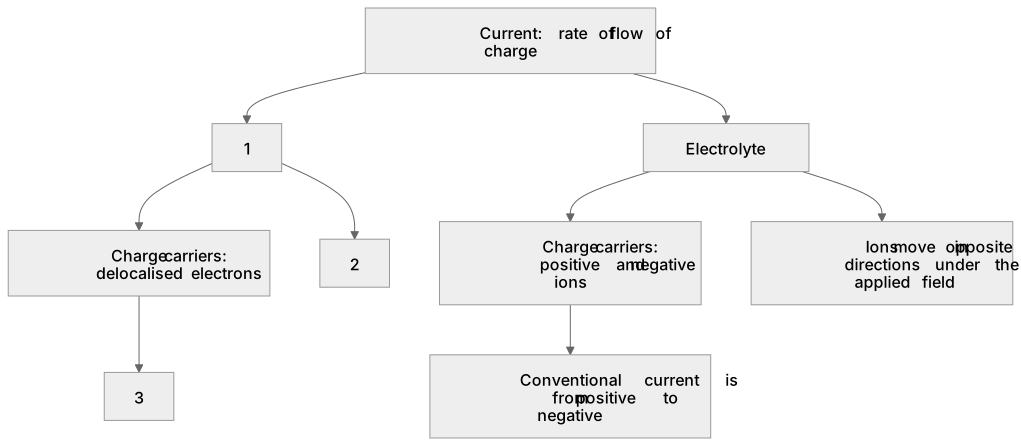
Some boxes have lost their names. Pick the right name for each number.
1Box 1
2Box 2
3Box 3
There is more to this lesson
The full lesson goes on to check your understanding and help you earn the marks. Create a free account to carry on, with your progress saved.
A week of Premium from your first lesson · Then the free plan continues · No card, no charge
Test your understanding of Charge: (e) current as the movement of electrons in metals and movement of ions in electrolytes
Active recall beats re-reading. Take an instant quiz now to test what you’ve learned and lock it into long-term memory.
A week of Premium from your first lesson · Then the free plan continues · No card, no charge